
Weltvogelpark Walsrode, (before 2010 English Walsrode Bird Park) is a bird park located in the middle of the Lüneburg Heath in North Germany near Walsrode in the state of Lower Saxony in Germany.
Weltfogelpark Walsrode ligger vid Lȕneburger Heide i norra Tyskland och är världens största fågelpark både i fråga om antal arter och area. ( Jurong Bird Park i Singapore säger sig ha flest antal individer.) Parken är på 24 ha och har cirka 4.200 fåglar uppdelat på 675 arter från alla kontinenter och alla klimatzoner i världen. Förra året var det 50 år sedan fågelparken slog upp sina portar.
Man kan tycka vad man vill om ”djurparker” och själv tycker jag oftast inte…men den här parken har gott rykte och deltar i uppfödningsprogram för utsatta arter. Vi besökte Walsrodeparken för ca 30 år sedan och blev imponerade av vad vi såg. När nu en gammal vän – och fågelälskares – dröm kunde gå i uppfyllelse om hon fick komma dit, så såg vi till att hennes dröm blev sann.
Weltvogelpark Walsrode is the largest bird park in the world in terms of species as well as land area. ( Jurong Bird Park in Singapore claims they have the largest number individual birds) It covers 24 hectares (59 acres) and houses some 4,200 birds of over 675 species from every continent and climatic zone in the world. Last year the Weltvogelpark Walsrode celebrated its fiftieth anniversary.
You can be for or against these animal parks, and I don’t ususlly visit, but this park is renowned for its beauty and well kept birds and participates in several breeding programmes for vulnerable species. We visited about 30 years ago and were really impressed. An old friend of mine – and bird lover – had this dream of visiting Walsrode, so we took her there – helping her dream come true.
Fågelparken har ett stort antal både inomhus- och utomhusvoljärer och i parkens nyare delar har man strävat efter att dessa så mycket som möjligt ska efterlikna fåglarnas naturliga hemmiljö. De äldre områdena består mestadels av skog och ett parklandskap med stora rosen- och rhododendronrabatter.
The bird park comprises a large number of internal and external aviaries as well as outdoor enclosures. In the more recent constructed areas, the birds live in an environment modelled on their natural habitat with no artificial barriers both in a free flight aviary, as well as in numerous buildings, such as the Jungle Hall. The older areas though, mainly consist of spacious parkland and woods including large rose and rhododendron beds.
Click on any picture to enlarge and start the gallery.

Opportunities to really meet the birds

…this one came walking up to me…expecting something?

Humboldt penguin – standing up and sleeping!

Single-Wattled Cassowary (New Guinea)

Victoria Crowned Pidgeon (New Guinea)

The Jungle Hall

Träskonäbb Shoe- billed stork (Sudan)

Pelican

Flowers… everywhere!
Stora attraktioner är de friflygningsuppvisningar som ges två gånger om dagen i ett stort öppet område med gräsmattor, rosenrabatter och vattenorgel. Här får vi se falkar, örnar och ugglor, men också papegojor och den jättelika sydamerikanska kondoren visa sina färdigheter.
I parkens program finns också inprickat olika matningstillfällen då du får möta fåglarna riktigt nära.
One special attraction is the variety of flight demonstrations on an open-air stage where, Not only are falcons, eagles and owls are displayed as in other shows, but parrots, South American Condors and Indian Runner Ducks too.

The tree house and stage for the open air show

Slaguggla Ural owl

Krontranor Cranes

Parrots

Andean Condor (Andes, S Am)

Condor showing its magnificent wingspan – 3.2 metres

Eagle and a proud little girl!
Det finns även en mer humoristisk, men informativ, inomhusshow där du bland annat får se kakadua och Nya Zeeländska Kea i arbete. Mycket barnvänlig park överhuvudtaget.
Indoors there is a humorous, but very informative, show with among others a cockatoo and a New Zealand Kea. There are also various feeding demonstrations and young bird rearing station which is particularly interesting to children.

The many tree sculptures were greatly admired

Kea (New Zealand) Known for its demolishing of cars…

Sorting garbage!

Good food was served too…
i något mindre burar och voljärer huserar de mest fantastiska fåglar från de tropiska delarna av världen. färgstarka och ljudliga!
In smaller aviaries/cages we found the most fantastic birds from tropical areas of the world. Colourful and loud…

King Vulture (C and S Am)

Steller’s Sea Eagle (NE Asia)

Harpy Eagle (Americas)

Yellow naped Amazon

Toucan (S Am)

Noshornsfågel Great Hornbill (S East Asia)

Noshornsfågel Knobbed Hornbill
Breeding programme
Walsrode fågelpark har ett antal fågelarter som inte kan beskådas i någon annan zoologisk park i världen. Man är också först med att få vissa arter att föröka sig i fångenskap. Parken deltar i European Endangered Species Programme och har till exempel lyckats få berguv att återinplanteras i det vilda. Man deltar också i ett flertal program för att föda upp andra utrotningshotade arter, bland annat andfågeln Madagaskarkricka.
The bird park has a range of birds that cannot be seen in other zoos in the world, and was the first to successfully breed a number of species.
The bird park participates in the European Endangered Species Programme and has, for example, made eagle owls available for reintroduction in the wild. In addition it is also taking part in a breeding programme for the Bernier’s Teal and many other birds that are threatened by extinction.
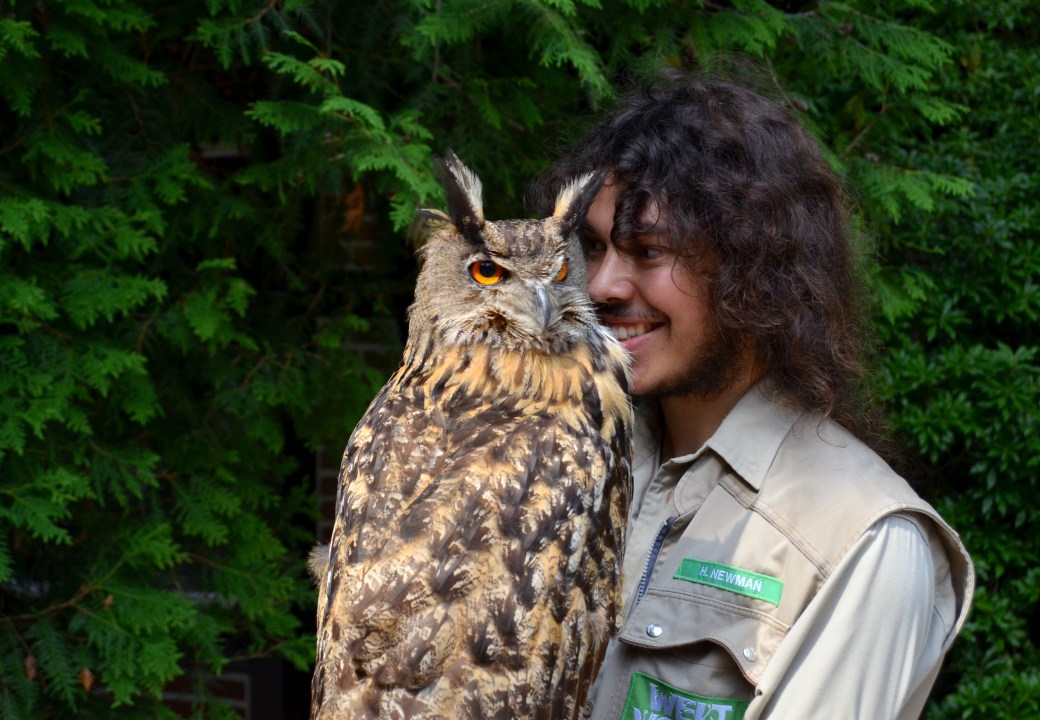
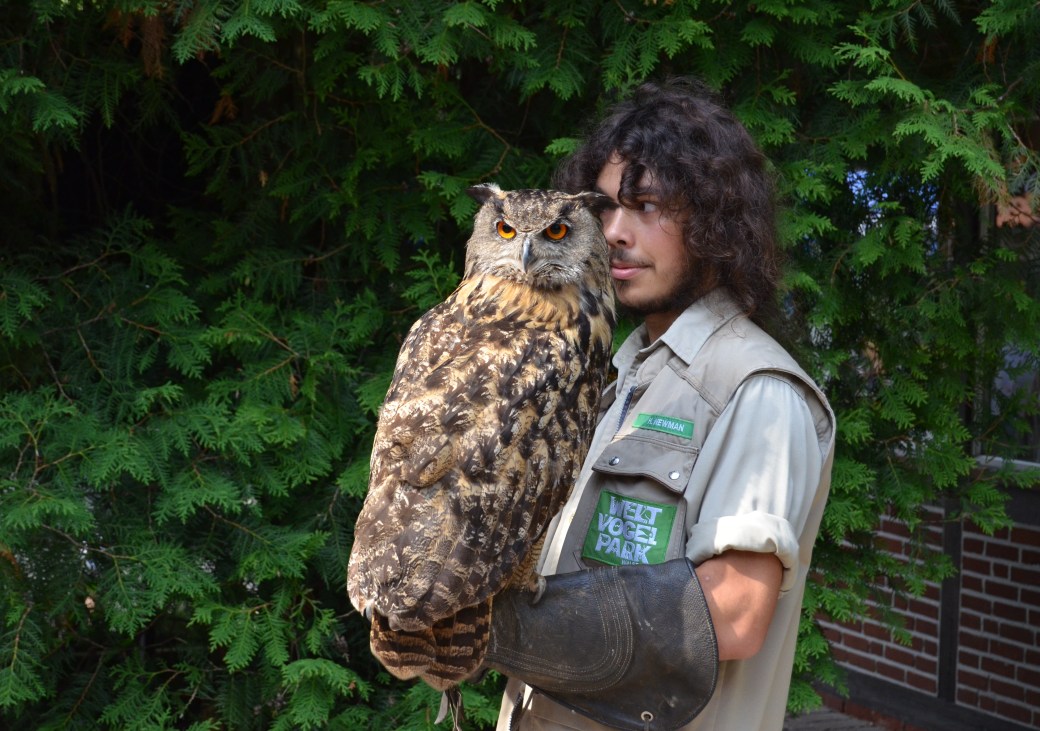
Eagle Owl and his loving caretaker
History of the bird park
Parken grundades 1962 av en handelsman från Walsrode, Fritz Geschke, för privat uppfödning av fasaner och sjöfåglar. 1964 överläts parken till en svärson,Wolf W. Brehm, som snabbt expanderade parken under 1970-talet både till ytan och med bland annat friflygning, pingvinområde och mycket mer. År 2000 tillkom Djungelhallen med asiatiska skulpturer och fåglar från Asien. Därefter tillkom Eagle Owl Hill och Treehouse Village.
År 2000 tog nya ägare över efter problem med parkens finanser och fler friflygningsuppvisningar startade vilket ökade besökartalen och garanterade för parkens överlevnad. 2009 gick en belgisk firma in med mer pengar, Floralux.
År 2010 bytte parken namn till internationella Weltvogelpark Walsrode.
The park was founded in 1962 by the Walsrode businessman, Fritz Geschke, for breeding pheasants and water birds privately. In 1964 he transferred the park to his son-in-law, Wolf W. Brehm, who expanded it rapidly, especially during the 1970s. In 1968, the 2,100-square-metre (23,000 sq ft) was opened. Trend-setting facilities such as the free flight aviary, a penguin enclosure and many others followed.
In 2000, on the occasion of the Expo in Hanover, the Jungle Hall was opened with its Indonesian artefacts and Asiatic bird species. Later the Eagle Owl Hill and Treehouse Village were added.
Due to business difficulties the park was transferred in 2000 to new ownership. The new owners introduced more and more flight demonstrations which increased the number of visitors and ensured the survival of the park. Looming insolvency was averted in March 2009 by the intervention of the Belgian firm, Floralux.
In 2010 the new official international name of Walsrode Bird Park is changed to Weltvogelpark Walsrode. The park is well worth a visit, and for some more photos and facts about the park, click the links:

http://www.weltvogelpark.de/en/

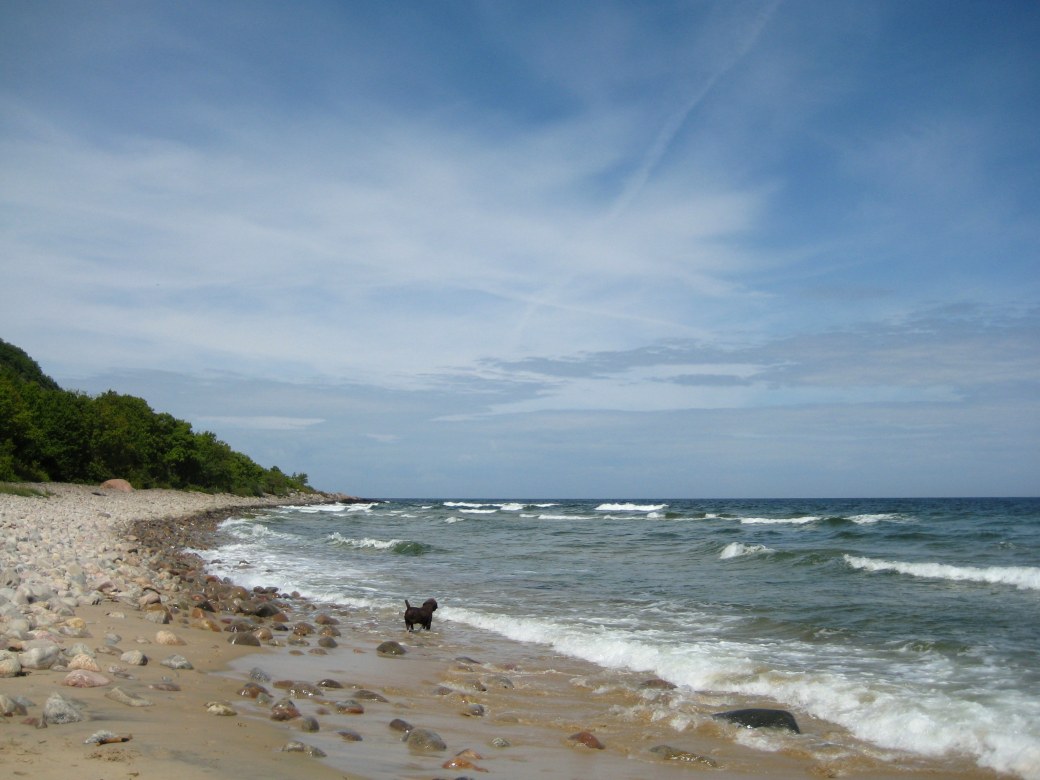




 Leya
Leya 
Du måste vara inloggad för att kunna skicka en kommentar.