Highgate Cemetery in north London, England is designated Grade I on the English Heritage Register of Parks and Gardens of Special Historic Interest in England. It is divided into two parts, named the East and West cemetery. According to Wikipedia, there are approximately 170,000 people buried in around 53,000 graves at Highgate Cemetery. Highgate Cemetery is notable both for some of the people buried there as well as for its status as a nature reserve.
The cemetery is in the London Boroughs of Camden, Haringey and Islington. The nearest transport link is Archway tube station. From there, some 20 minutes’ walking will take you to the entrance.
Highgate cemetery in its original form – the northwestern wooded area – opened in 1839, as part of a plan to provide seven large, modern cemeteries, known as the ”Magnificent Seven”, around the outside of central London. The inner-city cemeteries, mostly the graveyards attached to individual churches, had long been unable to cope with the number of burials and were seen as a hazard to health and an undignified way to treat the dead. The initial design was by architect and entrepreneur Stephen Geary.
On Monday 20 May 1839, Highgate Cemetery was dedicated to St James by the Right Reverend Charles Blomfield, Lord Bishop of London. Fifteen acres were consecrated for the use of the Church of England, and two acres set aside for Dissenters. Rights of burial were sold for either limited period or in perpetuity.
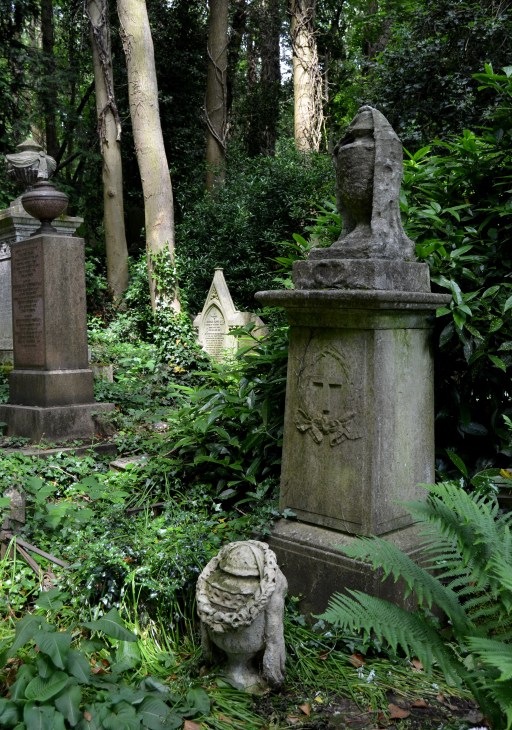
Elizabeth Jackson’s grave
The first burial was Elizabeth Jackson of Little Windmill Street, Soho, on 26 May. Our guide told us, that in those days people believed that the first person who was buried in a graveyard became a kind of protector and guardian against evil forces.
Highgate, like the others of the Magnificent Seven, soon became a fashionable place for burials and was much admired and visited. The Victorians created a wealth of Gothic tombs and buildings that occupies a spectacular south-facing hillside site slightly downhill from the top of the hill of Highgate itself, next to Waterlow Park. Being conservative and thinking English Church, they were not very interested in the ”Egyptian area”, so it took many years before anyone bought a grave there. Another interesting fact is that Victorians didn’t fancy the use of a cross on their grave – they meant that practice was for catholics only.
In 1854 the area to the east of the original area across Swains Lane was bought to form the eastern part of the cemetery. This part is still used today for burials, as is the western part.
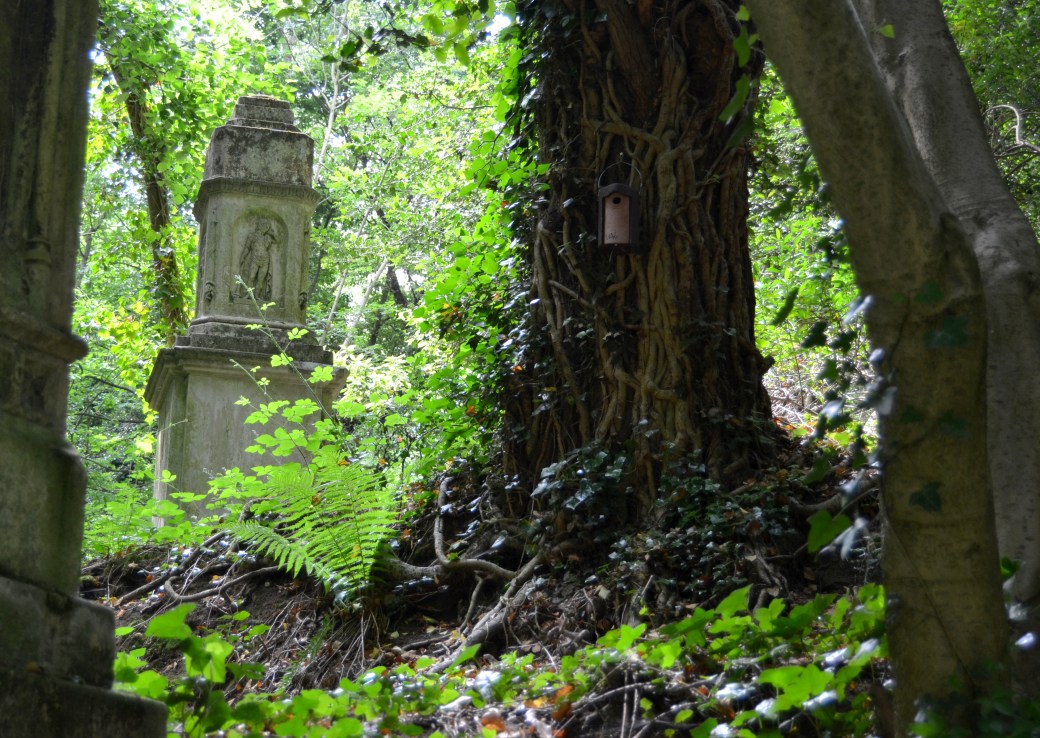
The cemetery’s grounds are full of trees, shrubbery and wild flowers, all of which have been planted and grown without human influence. The grounds are a haven for birds and small animals, and we saw many nesting boxes from the path we walked.
 Entrance to the Egyptian Avenue, West Cemetery
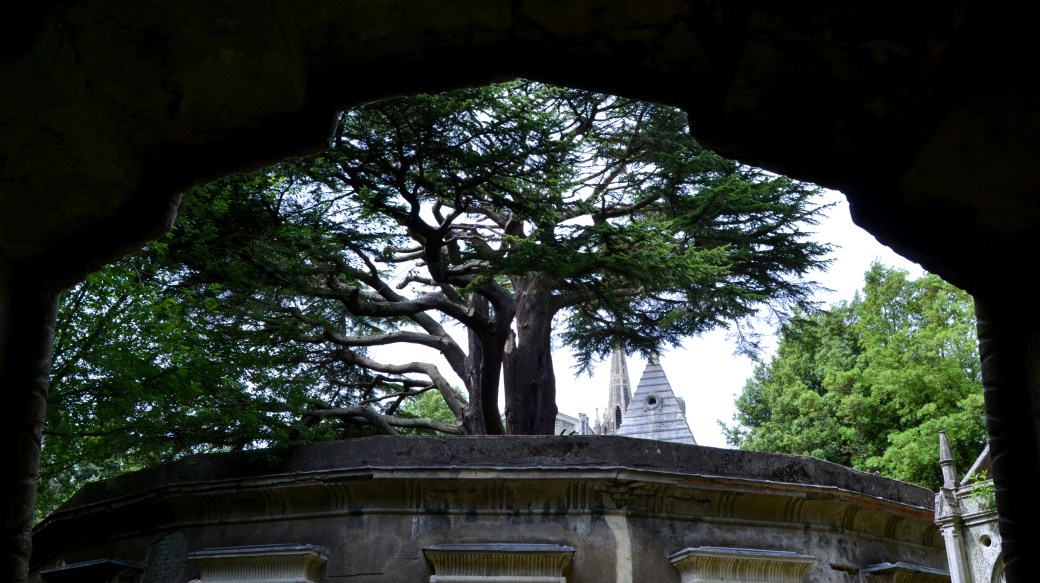 The Cedar of Lebanon
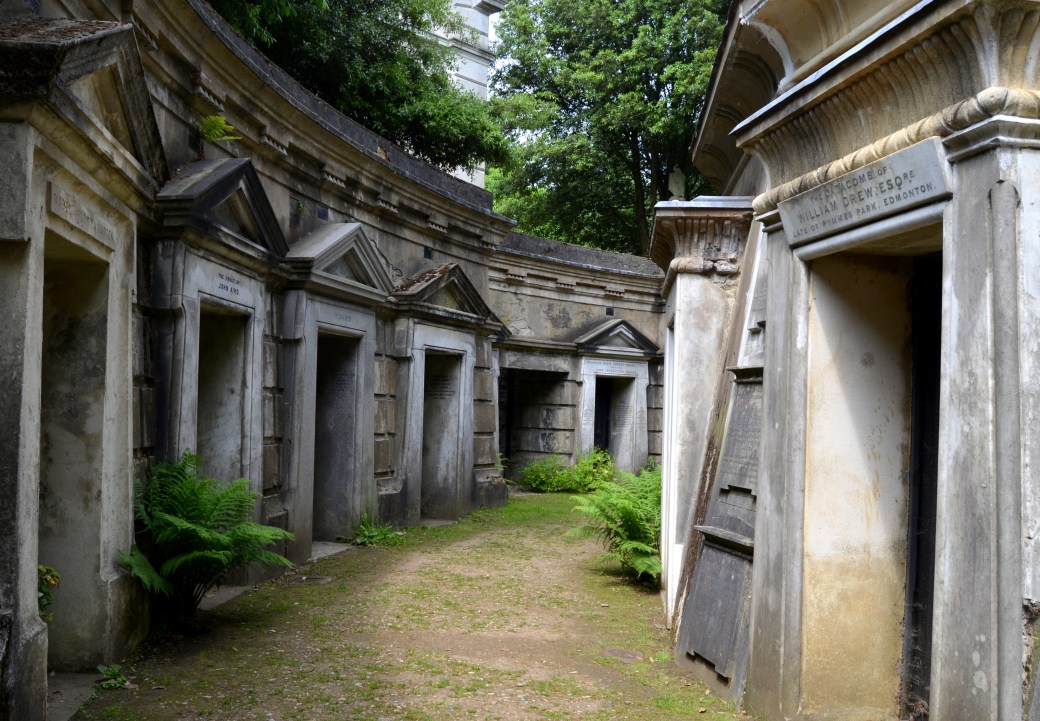 Circle of Lebanon, West Cemetery
The Egyptian Avenue and the Circle of Lebanon (topped by a huge Cedar of Lebanon – according to our guide this tree is at least three hundred years old) feature tombs, vaults and winding paths dug into hillsides. For its protection, the oldest section, which holds an impressive collection of Victorian mausoleums and gravestones, plus elaborately carved tombs, allows admission only in tour groups. (Book in advance! ) Due to vandalism and souvenir hunters only visitors with a personal connection with the cemetery can tour without a guide. In the newer eastern section, which contains a mix of Victorian and modern statuary, you can visit without a guide though. The ticket bought for West is valid for walking on the East part as well.
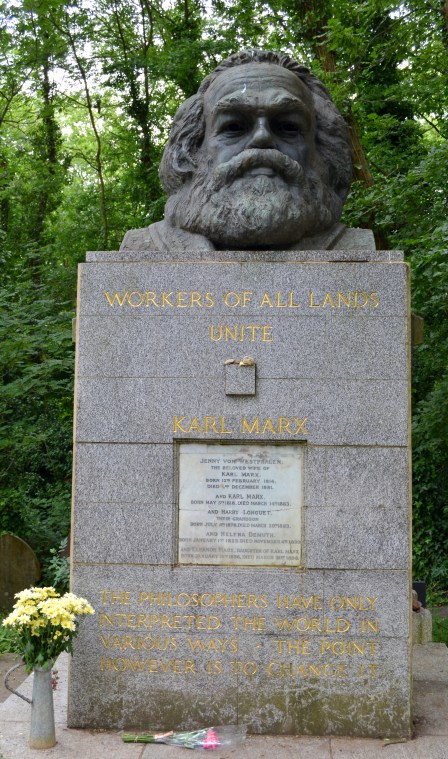
The most famous burial in the East cemetery is probably Karl Marx. The tomb of Karl Marx, the Egyptian Avenue and the Columbarium are Grade I listed buildings.
There are many other prominent figures, Victorian and otherwise, buried at Highgate Cemetery. Most of the historically notable figures lie in the Western part. Among others:
- Jane Arden, Welsh-born film director, actor, screenwriter, playwright, songwriter, and poet.
- Edward Hodges Baily, sculptor
- Beryl Bainbridge, author
- Charles Cruft, founder of Crufts dog show
- John Galsworthy, author and Nobel Prize winner (he was cremated and his ashes scattered, memorial only)
- Alexander Litvinenko, Russian dissident turned critic, murdered by poisoning in London
- Christina Rossetti, poet
- Jean Simmons, actress
We were not allowed to take photos of new graves, so Beryl Bainbridge and Alexander Litvinenko were left in peace.
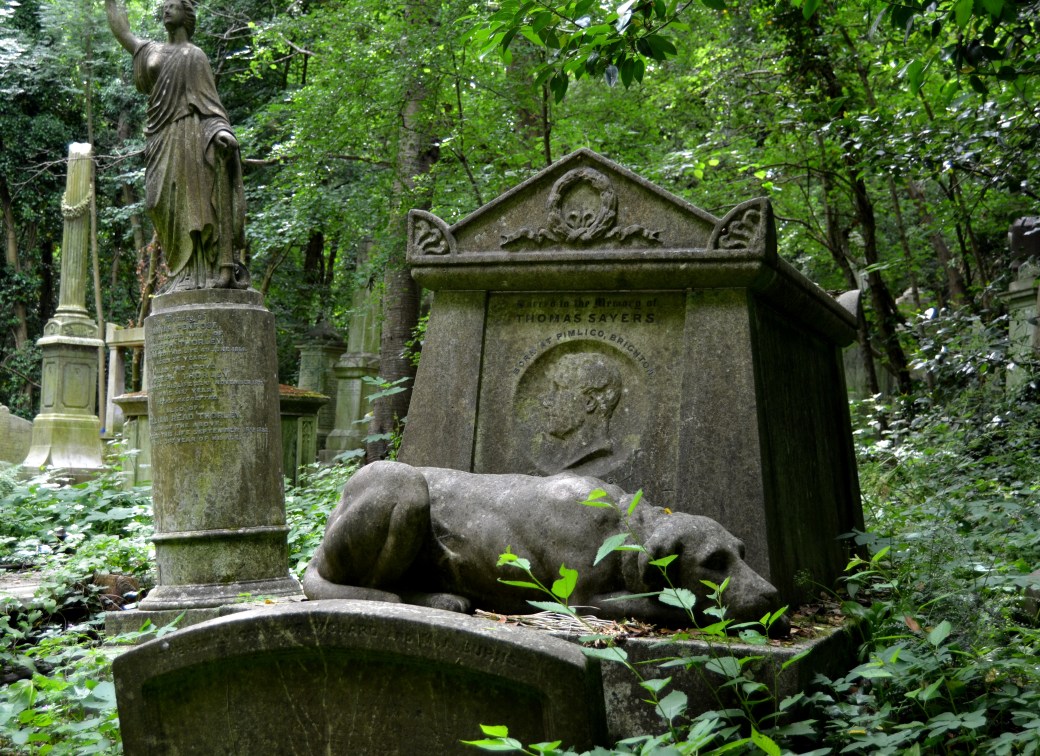 Our guide was a volunteer and very knowledgeable about the people being buried here. We got many interesting stories, and among them, one about the prize fighter Tom Sayers (1826-1865). His tomb is guarded by the stone image of his mastiff, Lion, who also was chief mourner at his funeral. It is said that on the way to the cemetery, the dog sat in the first car with the coffin – in the front seat.
Sayers’ lasting fame depends exclusively on his final contest, when he faced American champion John Camel Heenan in a battle which was widely considered to be boxing’s first world championship. It ended in chaos when the spectators invaded the ring, and the referee finally declared a draw.
Regarded as a national hero, Sayers then retired from the ring. After his death five years later at the age of 39, a huge crowd watched his cortège on its journey to highgate Cemetery and his funeral a week later attracted some 100,000 people to Camden Town.
Highgate Cemetery was featured in the popular media from the 1960s to the late 1980s for its so-called occult past, particularly as being the alleged site of the ”Highgate Vampire”. But, as our guide said, what do vampires fear the most? Surely they would not like a place like Highgate. Many writers of novels and film directors though, have been inspired by Highgate Cemetery. These are only a few examples:
- The 1977 BBC TV episode, ”Count Dracula” for the series Great Performances, was filmed in Highgate’s West cemetery.
- Tracy Chevalier‘s novel Falling Angels is set in and around Highgate Cemetery.
- Stated in the acknowledgments as the inspiration for the setting of Neil Gaiman‘s The Graveyard Book. (A favourite of mine…read it!)
- Part of a scene from the 2009 film Dorian Gray is filmed in the Circle of Lebanon
The East Cemetery hosts some more famous names besides Karl Marx, for example:
- Anatoly Kuznetsov, Soviet writer
- Douglas Adams, author of The Hitchhiker’s Guide to the Galaxy and other novels (See earlier entry: ”We didn’t know...”)
- George Eliot (Mary Ann Evans — the name on the grave is Mary Ann Cross), novelist
- Malcolm McLaren, punk impresario and original manager of the Sex Pistols
- Sir Leslie Stephen, critic, first editor of the Dictionary of National Biography, father of Virginia Wolf
Walking the ivy clad paths, passing old ornamented stones and silent statues, old roses and – a cat – follow me from East to West.


 Leya
Leya 
Very interesting post with appropriate photos.
Thank you! I like to visit cemeteries, it’s calm and beautiful.
I enjoy exploring cemeteries, but we have nothing like that here in the USA!
i have never been to your country, but i think I didn’t expect there to be something like this. It’s very Victorian, this British cemetery. The only one that could be compared with Highgate is for me Père Lachaise in Paris. But on the other hand…I haven’t visited many cemeteries – considering how many there must be in the world…
Wow, that a fantastic post – never heard of .. even if I lived for so many years close to London. I find cemeteries very pleasant and I like to walk around and read all the inscriptions on the gravestones – they tells me a story about a life or lives. Your photos are so beautiful and especially the last one in the gallery. Such a beautiful place and your photos really increase the picture. The lushness is incredible.
Thanks for becoming a subscriber. Happy blogging.
Thank you for being there.
Interesting post, I love the photos. I really like to photograph cemeteries too.
Yes, there’s something about them…serenity, peace of mind.
What a beautiful post! Thank you for the narrative. The last one is very moving…
I’m glad you enjoyed it, Amy!
Beautiful photos with the mood of serenity. It was really nice to walk along with you and letting my thoughts wander.
Thank you Ese I’m glad you found it as peaceful as I did.
What an interesting post! Thank you!
Thank you for taking your time reading it!
What an incredibly beautiful area. I had no idea it was so lovely. And trust a cat to know a good spot to rest 🙂
True. Dark marble and some rays of sun must be a smooth, warming combination.
Love your photos. Come to think of it, a visit to a cemetery gives you that feeling of being at peace because the quiet is palpable.
Well explained. Palpable.
WOW! Love it.
😉 thank you – I love strolling there…it’s peaceful.
Beautiful photography. Thank you for sharing.
Thank you for a nice comment!
What gorgeous photos and mood!! I would love to go there and I feel like I have !
Thank you! I love cemeteries…only, this time the guide hurried us along too fast. It could be that I’m a bit slow too of course…but to get the real feeling i must be alone.