The Art Nouveau movement in Europe was the architectural answer to the literary Modernist movement, starting in the 19th century.

Smilšu iela (street) 2 – (1902). One of the best examples of Jugend in Riga. The peacock typical of Jugend style and the sculptures featuring one of the most beautiful Jugend women in Riga.

The Art Nouveau movement reached its peak in the early 20th century, which is when the majority of Riga’s Art Nouveau houses were built. Riga’s term, Jugendstil, originates from the German and Scandinavian movement named after the avant-garde periodical Jugend (”Youth”). Art Nouveau was a reaction to the 19th century Academic art, and ”was inspired by natural forms and structures, not only in flowers and plants, but also in curved lines. Architects tried to harmonize with the natural environment.” (Wikipedia)

Tirgonu iela 4
Art Nouveau and Jugend could also have other names in other countries: Art Nouveau in France, Modernismo in Spain, Sezessionsstil in Austria, Stile Liberty or Stile Floreale in Italy.

In order to preserve Old Riga, Riga’s wooden buildings and the Art Nouveau architecture, the historical centre of Riga has been designated a UNESCO World Heritage Site.
Riga is one of the largest centres of Art Nouveau, with more than a third of the buildings of its Old Town and Central District built in the style; other significant centres include Paris, Barcelona, Berlin, Vienna, Krakow, Moscow and St Petersburg.

Elizabetes iela 10A and 10B (1903, M, Eisenstein). Masks, peacocks, geometrical figures and remarkable sculptured heads set among blue tiles.
The main street for Riga’s Art Nouveau district is Elizabetes, which intersects Brivibas Boulevard. Also, Alberta and Strelnieku Streets feature great examples of the style. In total, there are over 800 Art Nouveau buildings in Riga.
Most of the Art Nouveau buildings were designed and built by Latvian architects. Buildings by one of the most famous architects, Mikhail Eisenstein (father of director Sergei Eisenstein), can be found at Elizabetes 10a and 10b, as well as at Alberta 2, 2a, 4, 8 and 13. Strelnieku Street also features eccentric examples of the style.
In Riga, Art Nouveau might be split into two main directions, decorative and romantic-nationalistic The latter Art Nouveau style can be seen in the buildings by Latvian architects E. Laube, K. Peksens, and A. Vanags, such as those on Terbatas Street 15/17 and Brivibas Street 47, 58, and 62.
The day we had reserved for ”hunting” these architectural wonders started out in rain – so, here are featured only a few of the great buildings we tried to find.
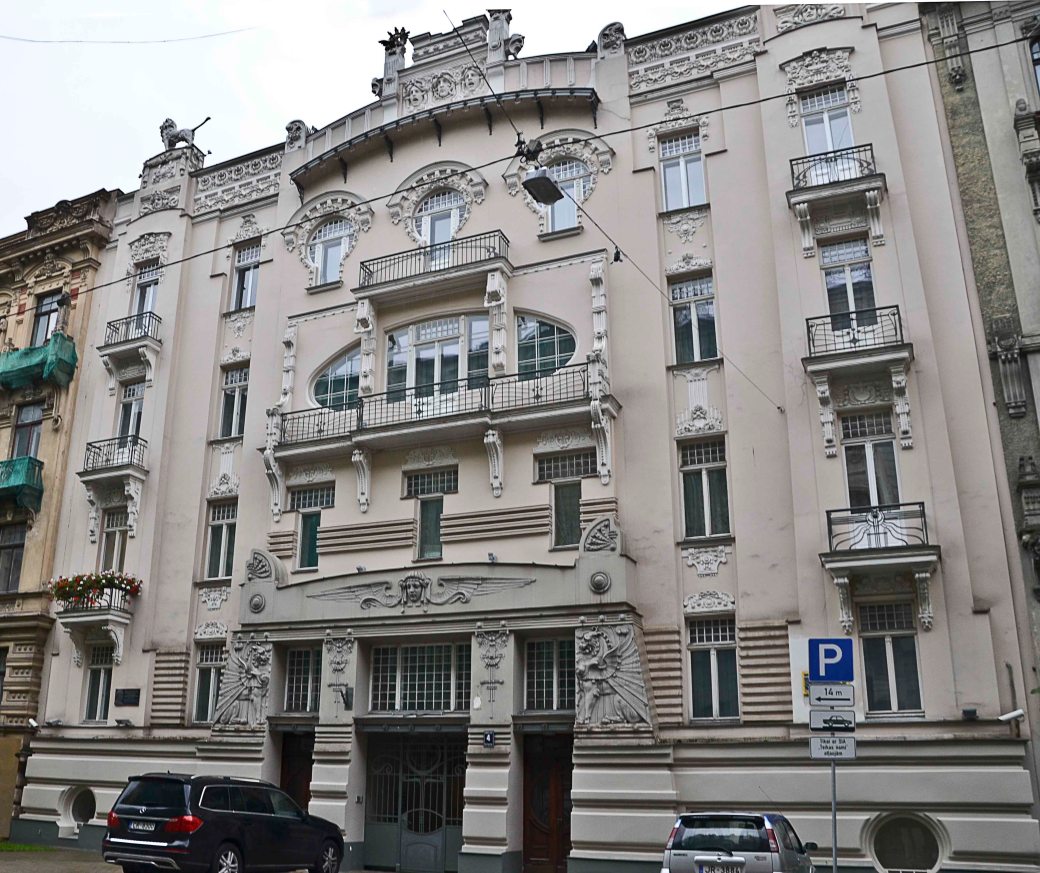
Alberta iela 4(1904, M Eisenstein) is considered to be the most elegant and original eclectic decorative Jugend house in Riga. Three Medusa heads, mouths wide open, above the corniche, the façade covered with eagles and lions and in the middle of the building a woman’s head flying, symbolizing the sun and protection.
What is Art Nouveau then? It is defined as an ornamental style whose main motifs are nature, references to antiquity and mythology. Architecturally, it is characterised by its functional structure and a richly decorated façade, including window and door openings, bay windows, reliefs, sculptures, ornamental lines or areas and stained glass. However, the interior design is just as essential an element in Art Nouveau.

Things of great beauty might reveal a grim Latvian past …On this house we could read:

We should be rather satisfied with our finds, only having three days in total for Riga and its surroundings. Some of these houses were found just roaming around in the City Centre. Finally, some exquisite details!
Detta bildspel kräver JavaScript.






 Leya
Leya 
Du måste vara inloggad för att kunna skicka en kommentar.