The most beautiful…

I sommarstaden Karlskrona ligger en berömd holme med kolonilotter – Brändaholm. Till sommarrutinerna för vår familj hör att göra ett besök där och njuta av dockhusglädjen.

Allting strålar och blomstrar därute, även människorna. Enligt turistinformationen är detta förmodligen landets vackraste koloniområde, med 45 små stugor på en liten, liten holme i Karlskrona skärgård. Tyvärr är det nästan omöjligt att köpa en stuga där. Du måste bland annat vara skriven i Karlskrona.

Brändaholm is said to be the most beautiful place in Sweden for allotment-garden cottages. What do you think?

It’s almost impossible to become the happy owner of one of those 45 cottages, because you have to live in Karlskrona. Most cottages are inherited or sold privately.

More about Brändaholm, live, here:

http://www.karlskronakanalen.se/content/vykort-fr%C3%A5n-br%C3%A4ndaholm

Birds, birds – magnificent Beauties from all over the world!

Weltvogelpark Walsrode, (before 2010 English Walsrode Bird Park) is a bird park located in the middle of the Lüneburg Heath in North Germany near Walsrode in the state of Lower Saxony in Germany.

Weltfogelpark Walsrode ligger vid Lȕneburger Heide i norra Tyskland och är världens största fågelpark både i fråga om antal arter och area. ( Jurong Bird Park i Singapore säger sig ha flest antal individer.) Parken är på 24 ha och har cirka 4.200 fåglar uppdelat på 675 arter från alla kontinenter och alla klimatzoner i världen. Förra året var det 50 år sedan fågelparken slog upp sina portar.

Man kan tycka vad man vill om ”djurparker” och själv tycker jag oftast inte…men den här parken har gott rykte och deltar i uppfödningsprogram för utsatta arter. Vi besökte Walsrodeparken för ca 30 år sedan och blev imponerade av vad vi såg. När nu en gammal vän – och fågelälskares – dröm kunde gå i uppfyllelse om hon fick komma dit, så såg vi till att hennes dröm blev sann.

Weltvogelpark Walsrode is the largest bird park in the world in terms of species as well as land area. ( Jurong Bird Park in Singapore claims they have the largest number individual birds) It covers 24 hectares (59 acres) and houses some 4,200 birds of over 675 species from every continent and climatic zone in the world. Last year the Weltvogelpark Walsrode celebrated its fiftieth anniversary.

You can be for or against these animal parks, and I don’t ususlly visit, but this park is renowned for its beauty and well kept birds and participates in several breeding programmes for vulnerable species. We visited about 30 years ago and were really impressed.  An old friend of mine – and bird lover – had this dream of visiting Walsrode, so we took her there – helping her dream come true.
Walsrode juli 2013 040

Fågelparken har ett stort antal både inomhus- och utomhusvoljärer och i parkens nyare delar har man strävat efter att dessa så mycket som möjligt ska efterlikna fåglarnas naturliga hemmiljö. De äldre områdena består mestadels av skog och ett parklandskap med stora rosen- och rhododendronrabatter.

The bird park comprises a large number of internal and external aviaries as well as outdoor enclosures. In the more recent constructed areas, the birds live in an environment modelled on their natural habitat with no artificial barriers both in a free flight aviary, as well as in numerous buildings, such as the Jungle Hall. The older areas though, mainly consist of spacious parkland and woods including large rose and rhododendron beds.

Click on any picture to enlarge and start the gallery.

Stora attraktioner är de friflygningsuppvisningar som ges två gånger om dagen i ett stort öppet område med gräsmattor, rosenrabatter och vattenorgel. Här får vi se falkar, örnar och ugglor, men också papegojor och den jättelika sydamerikanska kondoren visa sina färdigheter.

I parkens program finns också inprickat olika matningstillfällen då du får möta fåglarna riktigt nära.

One special attraction is the variety of flight demonstrations on an open-air stage where, Not only are falcons, eagles and owls are displayed as in other shows, but parrots, South American Condors and Indian Runner Ducks too.

Det finns även en mer humoristisk, men informativ, inomhusshow där du bland annat får se kakadua och Nya Zeeländska Kea i arbete. Mycket barnvänlig park överhuvudtaget.

Indoors there is a humorous, but very informative, show with among others a cockatoo and a New Zealand Kea. There are also various feeding demonstrations and young bird rearing station which is particularly interesting to children.

i något mindre burar och voljärer huserar de mest fantastiska fåglar från de tropiska delarna av världen. färgstarka och ljudliga!

In smaller aviaries/cages we found the most fantastic birds from tropical areas of the world. Colourful and loud…

Breeding programme

Walsrode fågelpark har ett antal fågelarter som inte kan beskådas i någon annan zoologisk park i världen. Man är också först med att få vissa arter att föröka sig i fångenskap. Parken deltar i European Endangered Species Programme och har till exempel lyckats få  berguv  att återinplanteras i det vilda. Man deltar också i ett flertal program för att föda upp andra utrotningshotade arter, bland annat andfågeln Madagaskarkricka.

The bird park has a range of birds that cannot be seen in other zoos in the world, and was the first to successfully breed a number of species.

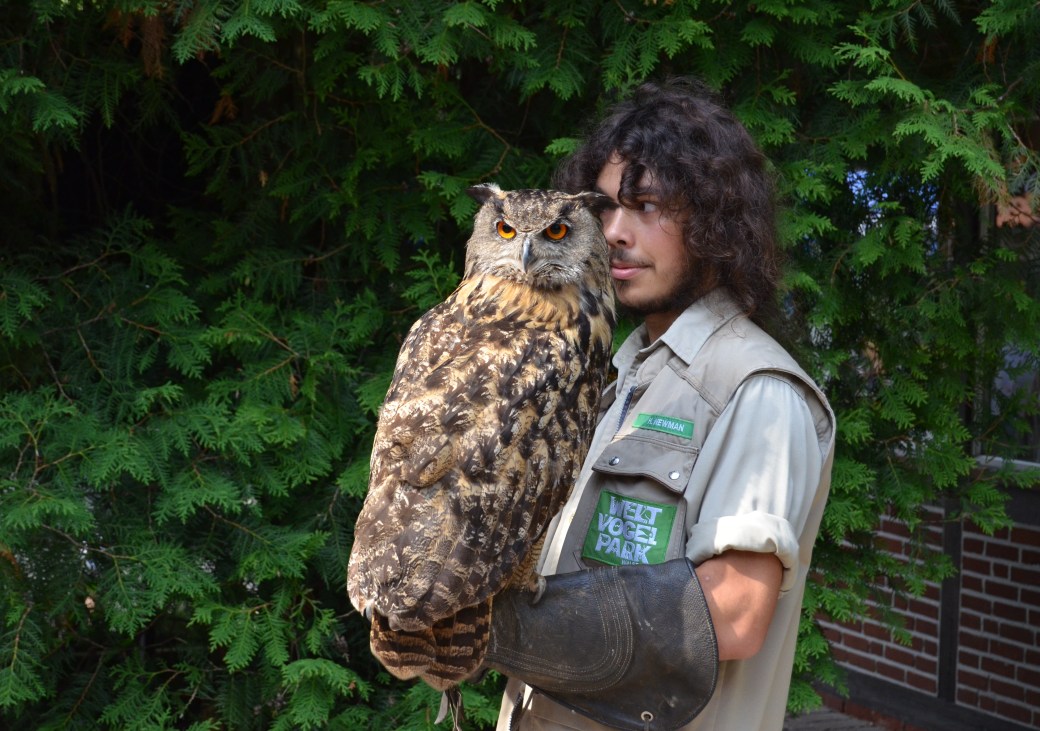
The bird park participates in the European Endangered Species Programme and has, for example, made eagle owls available for reintroduction in the wild. In addition it is also taking part in a breeding programme for the Bernier’s Teal and many other birds that are threatened by extinction.
Walsrode juli 2013 107

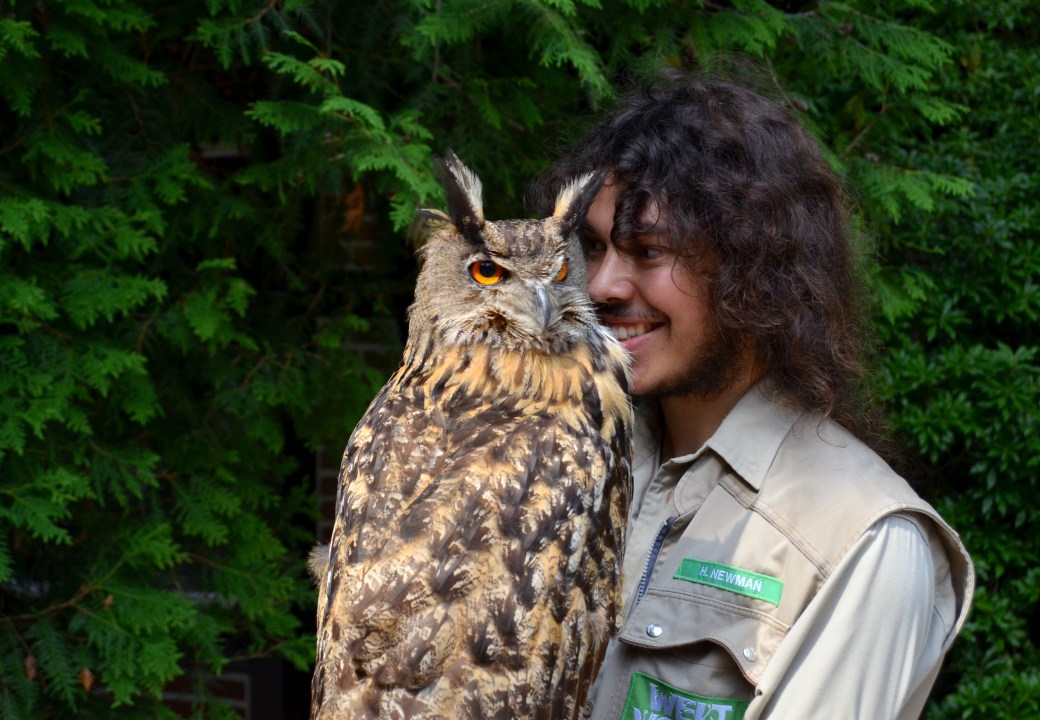
Eagle Owl and his loving caretaker

Walsrode juli 2013 106

History of the bird park

Parken grundades 1962 av en handelsman från Walsrode, Fritz Geschke, för privat uppfödning av fasaner och sjöfåglar. 1964 överläts parken till en svärson,Wolf W. Brehm, som snabbt expanderade parken under 1970-talet både till ytan och med bland annat friflygning, pingvinområde och mycket mer. År 2000 tillkom Djungelhallen med asiatiska skulpturer och fåglar från Asien. Därefter tillkom Eagle Owl Hill och Treehouse Village.

År 2000 tog nya ägare över efter problem med parkens finanser och fler friflygningsuppvisningar startade vilket ökade besökartalen och garanterade för parkens överlevnad. 2009 gick en belgisk firma in med mer pengar, Floralux.

År 2010 bytte parken namn till internationella Weltvogelpark Walsrode.

The park was founded in 1962 by the Walsrode businessman, Fritz Geschke, for breeding pheasants and water birds privately. In 1964 he transferred the park to his son-in-law, Wolf W. Brehm, who expanded it rapidly, especially during the 1970s. In 1968, the 2,100-square-metre (23,000 sq ft) was opened. Trend-setting facilities such as the free flight aviary, a penguin enclosure and many others followed.

In 2000, on the occasion of the Expo in Hanover, the Jungle Hall was opened with its Indonesian artefacts and Asiatic bird species. Later the Eagle Owl Hill and Treehouse Village were added.

Due to business difficulties the park was transferred in 2000 to new ownership. The new owners introduced more and more flight demonstrations which increased the number of visitors and ensured the survival of the park. Looming insolvency was averted in March 2009 by the intervention of the Belgian firm, Floralux.

In 2010 the new official international name of Walsrode Bird Park is changed to Weltvogelpark Walsrode. The park is well worth a visit, and for some more photos and facts about the park, click the links:

http://www.weltvogelpark.de/en/

One last week of vacation…

En sista sommarvecka i stugan…vi ses!

A last week in our summer house – then I’ll be back! Hopefully with new experiences and photos! See you!

Sommar 2013 juni 171

Tribute to the Swedish summer flowers

En sommarpromenad dessa veckor innebär tidig morgon och sen kväll. Mitt på dagen är det alldeles för varmt – tycker i alla fall de fyrbenta. Kameran är nästan alltid med, och tur är väl det, för blommorna torkar snabbt bort i år.  Lite fägring att minnas behöver vi alla.

Kanske fler än jag har lagt märke till hur få humlor, bin och fjärilar vi har här i år – i Skåne i alla fall. Förmodligen beror detta delvis på den stränga vintern. I vårt område kunde man i dagens tidning också läsa  om en man som hittat hundratals humlor döda under en lind. Experter tror att det är en silverlind, och i så fall ger humlornas mat ingen näring, utan de svälter helt enkelt ihjäl.

En annan spännande iakttagelse jag gjort dessa varma dagar är att när jag sätter på spridaren kommer fjärilar och flyger genom de tunnaste strålarna. Fram och tillbaka, svinglande upp och ner. Är det så torrt att de behöver fukt till sina vingar? Det skulle vara intressant med ett expertsvar här. Jag har aldrig lagt märke till detta beteende tidigare.

Sommarfägring är kort. För fler sommarblommor, se faialflores – min fotoblog.

Summer walks these weeks means early morning and late evening – at least that’s what the dogs tell me…My camera is always with me, and this year it’s obviously more than needed. The beautiful summer flowers are quickly fading now, shrivelling up in the hot, dry sun and wind.

I don’t know if you have noticed how few bumblebees, wasps and butterflies there are this year – at least in Sweden. We think this is because of the cold and long winter. In today’s paper I also read about a man in the neighbourhood who had found hundreds of dead bumblebees under his limetree. Experts say it might be a silver lime, and in that case the bumblebees are fooled to eat, but the food contains no nourrishment – so in fact the bees starve to death.

Yesterday I also noticed a peculiar behaviour that I hadn’t noticed before in butterflies. When I put on the sprinkler to water my flowerbed, butterflies swirled and flew up and down through the squirting water. Maybe it’s really so dry that they need this for their wings or something. It would be interesting to hear an expert’s explanation to this phenomenon.

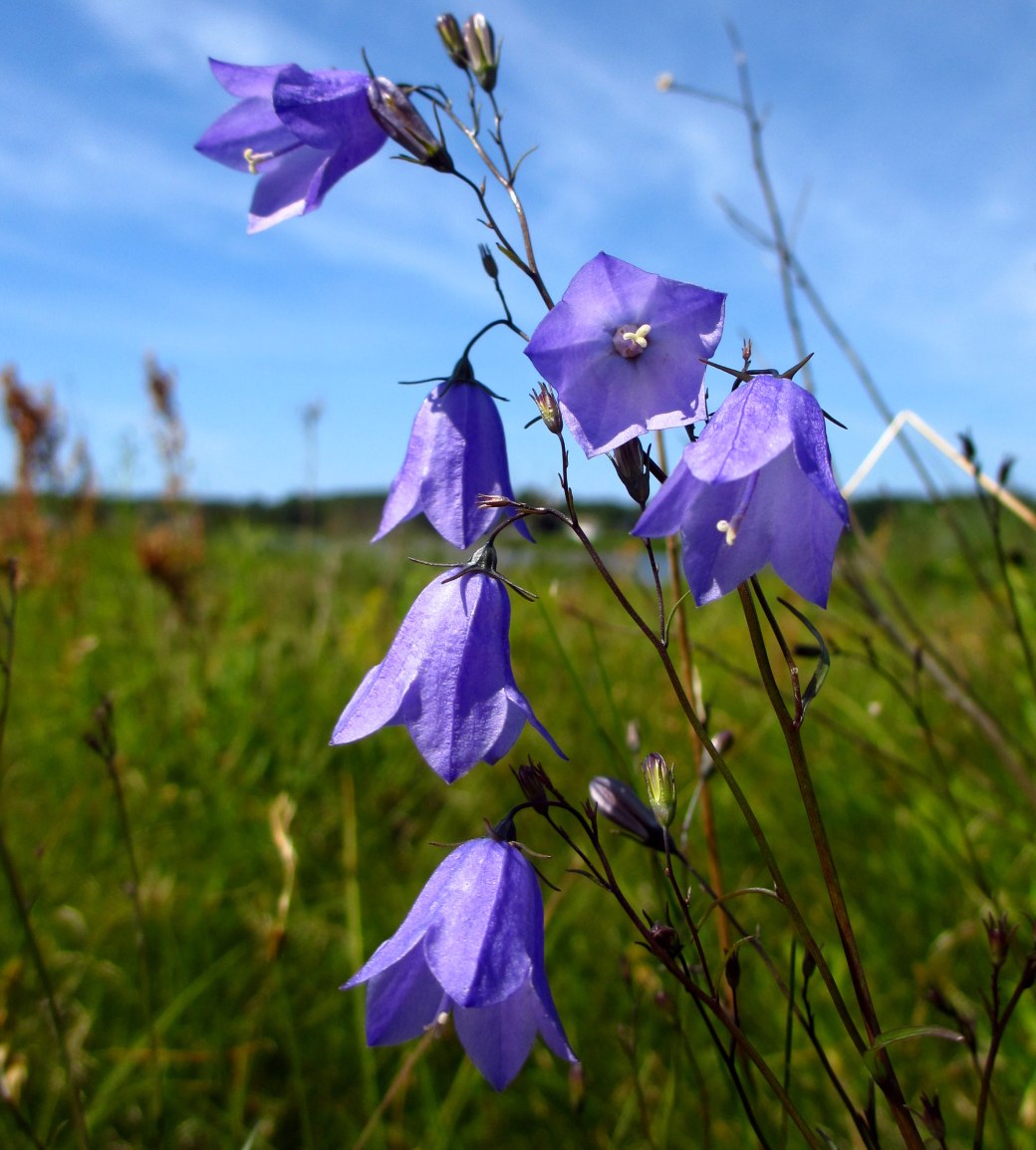
Anyhow, here’s a small tribute to some of the wonderful summerflowers of Sweden! For more flowers from Sweden, click my photoblog, faialflores.

Får man fresta; eller, kombinerat fot(o)arbete – Temptation time; or, Feet, food and photography!

Får man servera en frestare i väntan på huvudrätten? Huvudrätten serveras av min medvandrare denna dag…så den tål att väntas på! Var i världen har vi varit? Hitta oss någonstans i fotona…

Waiting for the main dish…what about a teaser? The main dish will be served by the most excellent chef, soon! So, that’s worth waiting for…Where in the world have we been visiting…and who is my excellent fellow wanderer? Look in the photos…

På denna plats finns MYCKET av allt! Men, att gå en hel dag kräver sin tribut…Så, här serveras några av de godbitar vi fick oss till livs, alltmedan fötterna domnade bort…

This city has got so MUCH of everything! But, walking a whole day demands tasty food, snacks and cappucino…Here are some good treats, while our feet slowly went numb…

Did you find us? Soon all the correct answers to all your questions will be served here by…I think you know who!

Highgate Cemetery – visit to a living beauty

Highgate Cemetery in north London, England is designated Grade I on the English Heritage Register of Parks and Gardens of Special Historic Interest in England. It is divided into two parts, named the East and West cemetery. According to Wikipedia, there are approximately 170,000 people buried in around 53,000 graves at Highgate Cemetery. Highgate Cemetery is notable both for some of the people buried there as well as for its status as a nature reserve.

The cemetery is in the London Boroughs of Camden, Haringey and Islington. The nearest transport link is Archway tube station. From there, some 20 minutes’ walking will take you to the entrance.

Highgate cemetery in its original form – the northwestern wooded area – opened in 1839, as part of a plan to provide seven large, modern cemeteries, known as the ”Magnificent Seven”, around the outside of central London. The inner-city cemeteries, mostly the graveyards attached to individual churches, had long been unable to cope with the number of burials and were seen as a hazard to health and an undignified way to treat the dead. The initial design was by architect and entrepreneur Stephen Geary.

On Monday 20 May 1839, Highgate Cemetery was dedicated to St James by the Right Reverend Charles Blomfield, Lord Bishop of London. Fifteen acres were consecrated for the use of the Church of England, and two acres set aside for Dissenters. Rights of burial were sold for either limited period or in perpetuity.

London juni 2013 215

Elizabeth Jackson’s grave

The first burial was Elizabeth Jackson of Little Windmill Street, Soho, on 26 May. Our guide told us, that in those days people believed that the first person who was buried in a graveyard became a kind of protector and guardian against evil forces.

Highgate, like the others of the Magnificent Seven, soon became a fashionable place for burials and was much admired and visited. The Victorians created a wealth of Gothic tombs and buildings that occupies a spectacular south-facing hillside site slightly downhill from the top of the hill of Highgate itself, next to Waterlow Park. Being conservative and thinking English Church, they were not very interested in the ”Egyptian area”, so it took many years before anyone bought a grave there. Another interesting fact is that Victorians didn’t fancy the use of a cross on their grave – they meant that practice was for catholics only.

In 1854 the area to the east of the original area across Swains Lane was bought to form the eastern part of the cemetery. This part is still used today for burials, as is the western part.

London juni 2013 217

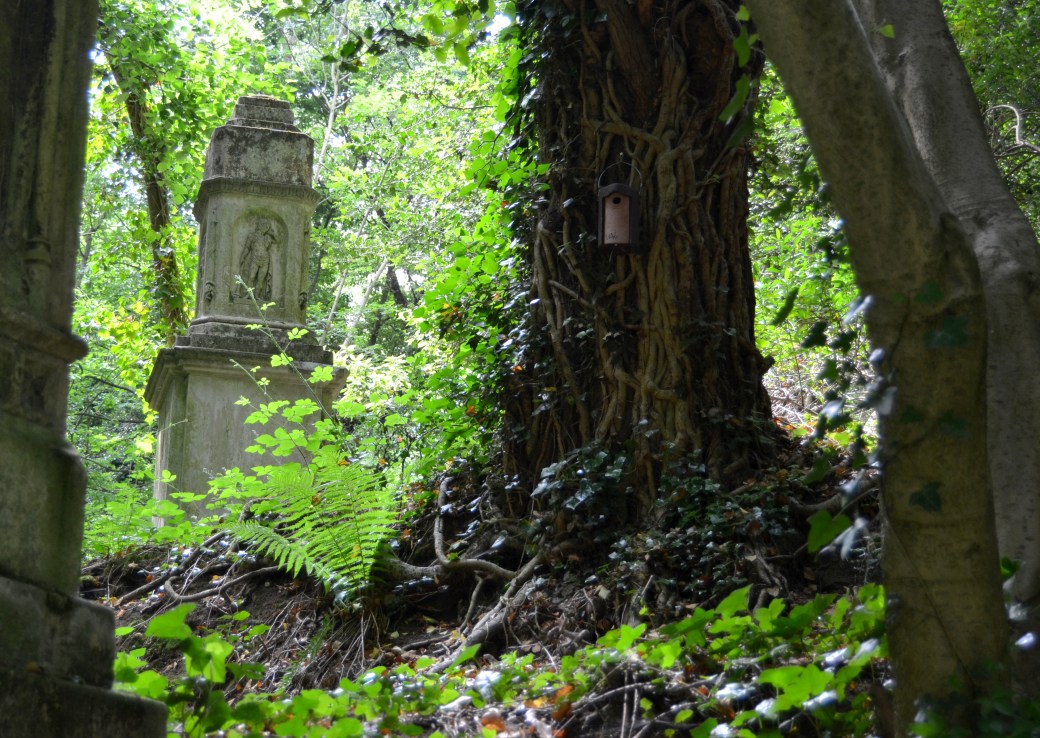
The cemetery’s grounds are full of trees, shrubbery and wild flowers, all of which have been planted and grown without human influence. The grounds are a haven for birds and small animals, and we saw many nesting boxes from the path we walked.

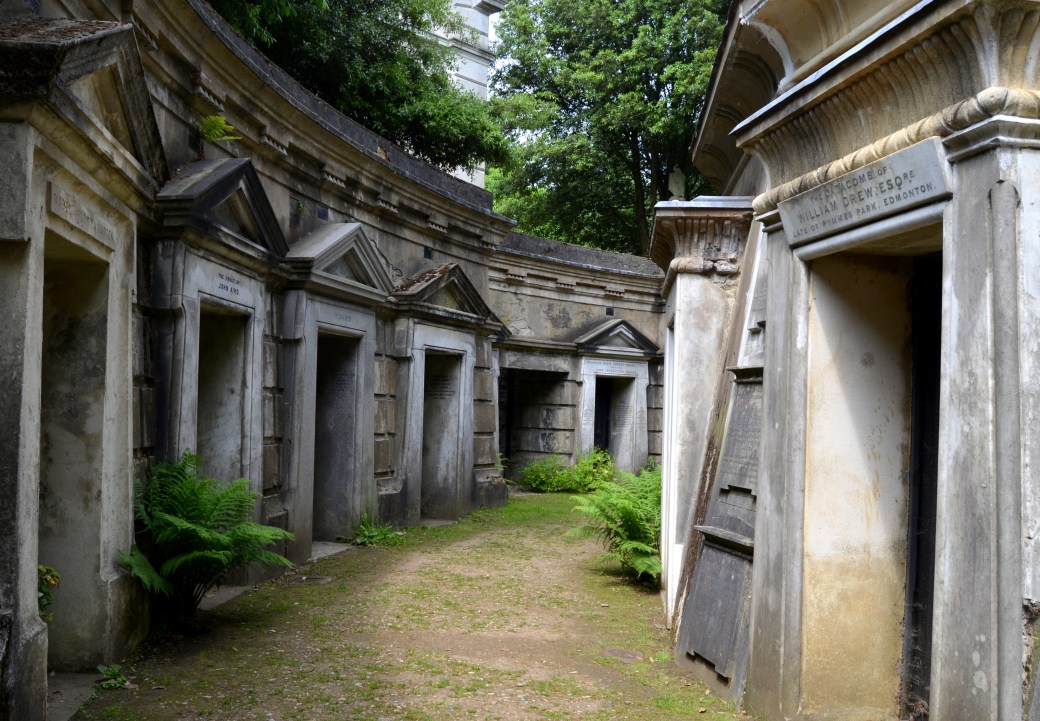
London juni 2013 218Entrance to the Egyptian Avenue, West Cemetery

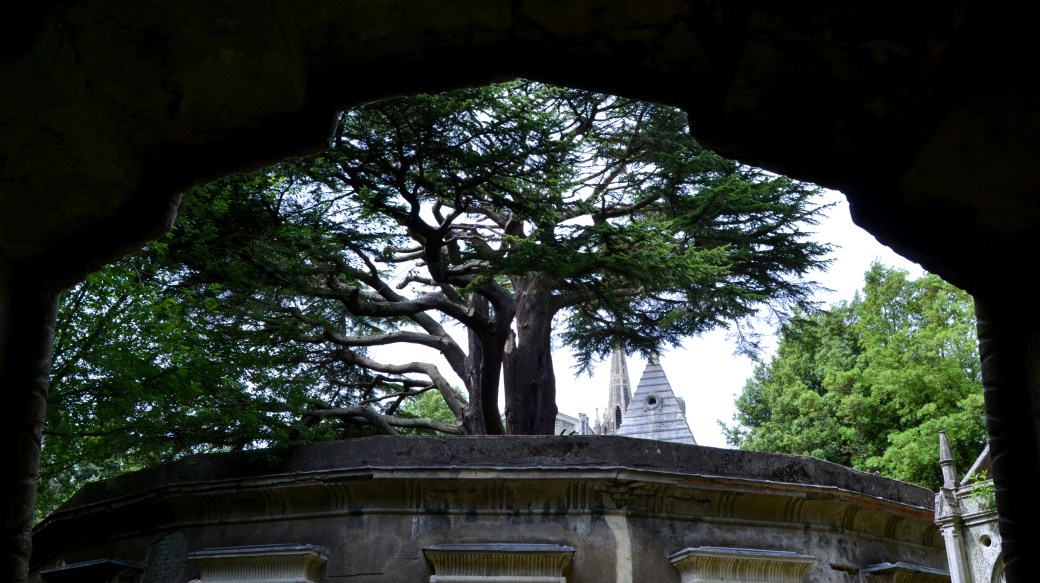
London juni 2013 222The Cedar of Lebanon

London juni 2013 230 Circle of Lebanon, West Cemetery

The Egyptian Avenue and the Circle of Lebanon (topped by a huge Cedar of Lebanon – according to our guide this tree is at least three hundred years old) feature tombs, vaults and winding paths dug into hillsides. For its protection, the oldest section, which holds an impressive collection of Victorian mausoleums and gravestones, plus elaborately carved tombs, allows admission only in tour groups. (Book in advance! ) Due to vandalism and souvenir hunters only visitors with a personal connection with the cemetery can tour without a guide. In the newer eastern section, which contains a mix of Victorian and modern statuary, you can visit without a guide though. The ticket bought for West is valid for walking on the East part as well.

London juni 2013 198

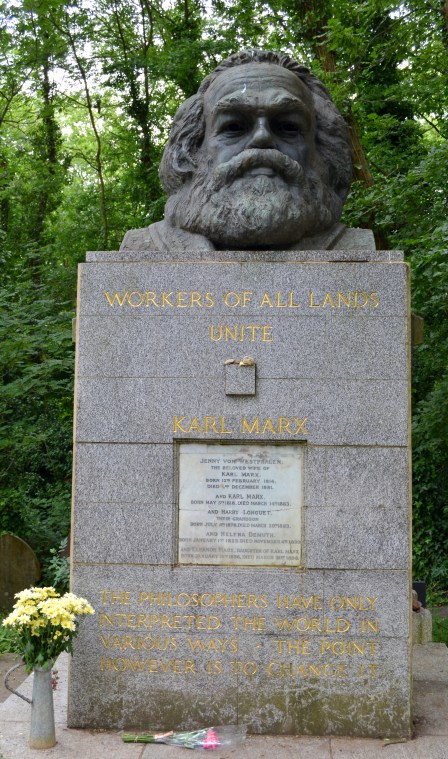
The most famous burial in the East cemetery is probably Karl Marx. The tomb of Karl Marx, the Egyptian Avenue and the Columbarium are Grade I listed buildings.

There are many other prominent figures, Victorian and otherwise, buried at Highgate Cemetery. Most of the historically notable figures lie in the Western part. Among others:

We were not allowed to take photos of new graves, so Beryl Bainbridge and Alexander Litvinenko were left in peace.

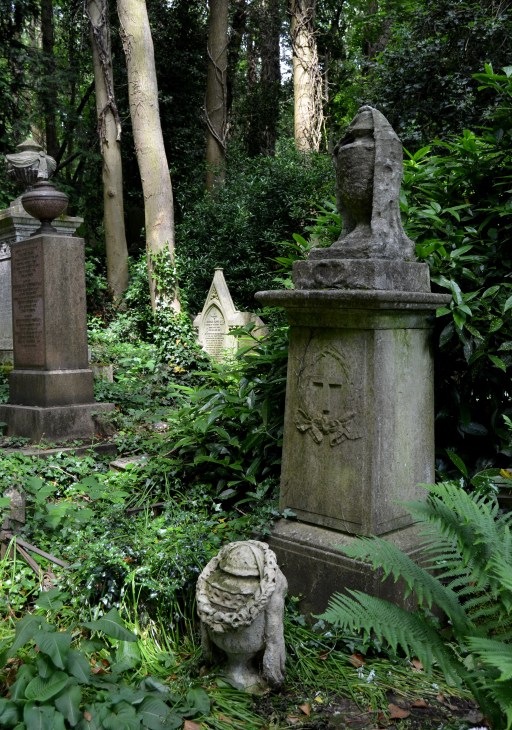
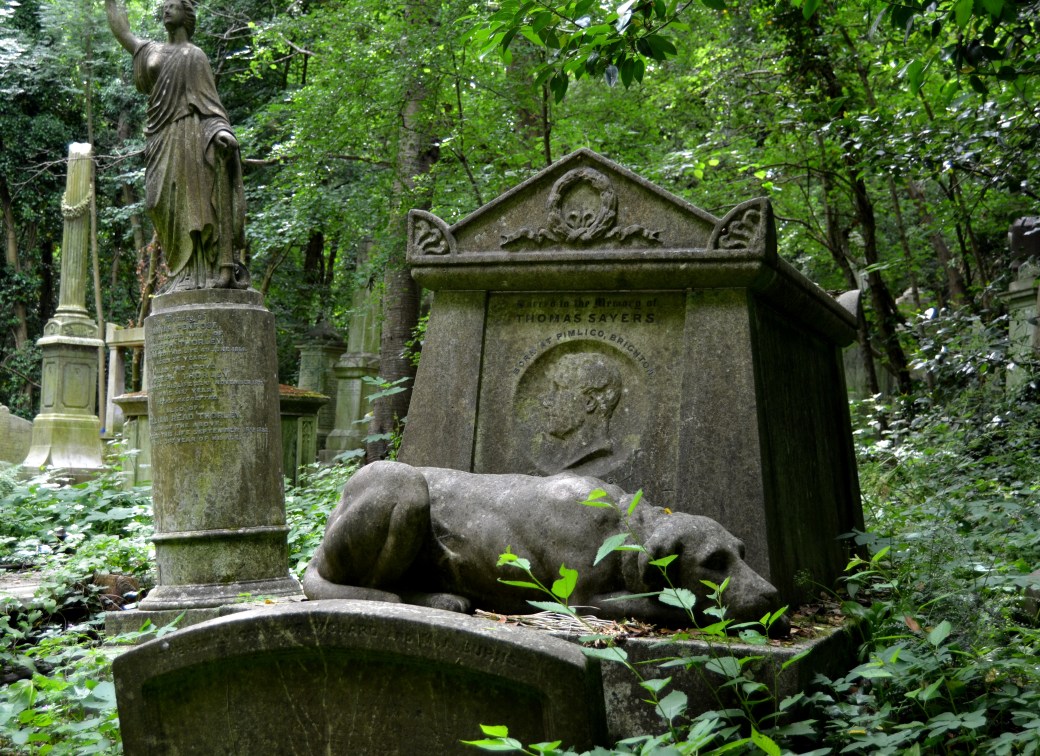
London juni 2013 249Our guide was a volunteer and very knowledgeable about the people being buried here. We got many interesting stories, and among them, one about the prize fighter Tom Sayers (1826-1865). His tomb is  guarded by the stone image of his mastiff, Lion, who also was chief mourner at his funeral. It is said that on the way to the cemetery, the dog sat in the first car with the coffin – in the front seat.

Sayers’ lasting fame depends exclusively on his final contest, when he faced American champion John Camel Heenan in a battle which was widely considered to be boxing’s first world championship. It ended in chaos when the spectators invaded the ring, and the referee finally declared a draw.

Regarded as a national hero, Sayers then retired from the ring. After his death five years later at the age of 39, a huge crowd watched his cortège on its journey to highgate Cemetery and his funeral a week later attracted some 100,000 people to Camden Town.

Highgate Cemetery was featured in the popular media from the 1960s to the late 1980s for its so-called occult past, particularly as being the alleged site of the ”Highgate Vampire”. But, as our guide said, what do vampires fear the most? Surely they would not like a place like Highgate.  Many writers of novels and film directors though, have been inspired by Highgate Cemetery. These are only a few examples:

The East Cemetery hosts some more famous names besides Karl Marx, for example:

Walking the ivy clad paths, passing old ornamented stones and silent statues, old roses and  –  a cat – follow me from East to West.

Weekly Photo Challenge: Companionable

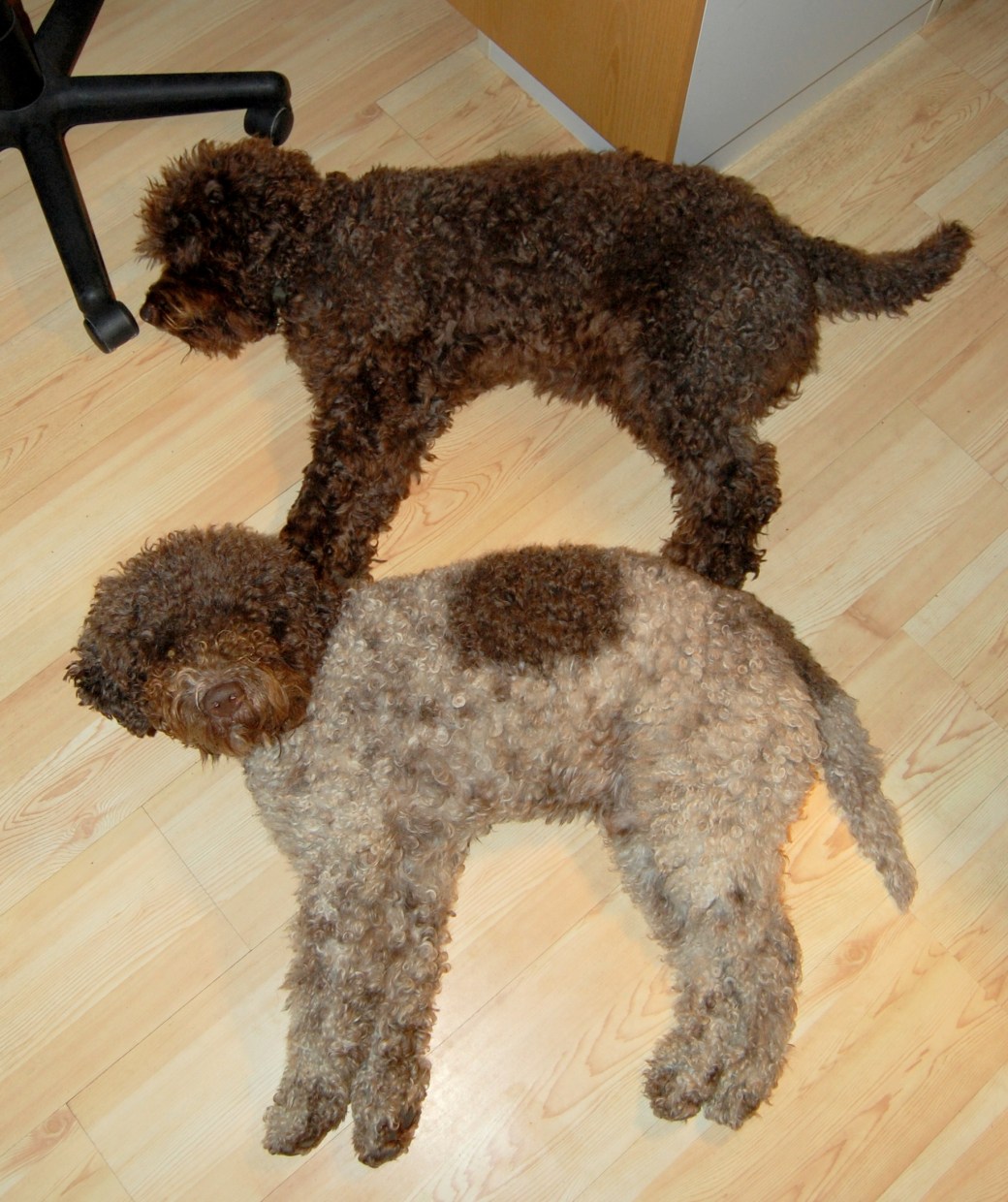
The Weekly Photo Challenge this week is companionable. These two friends are, indeed. They have each other, and here they are companions to my mother too!

Indienresenärer och bokarna slår ut 2011 059

003 Fler uteliggare 018

More lovely furs from lovely blogs are here!

Tidig morgonvandring längs Ronnebyån – Early morning walk: Ronnebyån

Sista vandringen i Ronneby för den här gången går längs den vackra Ronnebyån med dess fantastiska trävillor. Vi går längs vattnet upp mot Ronneby centrum. Tyvärr (för fotografering alltså) genomgår min favoritvilla just nu en totalrenovering och är täckt av byggnadsställningar. Men Villa Haga är en dröm i rosa med burspråk och en glasveranda som jag knappt sett maken till någonstans. Du kan nog se hur vacker villan egentligen är.

Sedan går vi tillbaka och tittar även en bit upp från vattnet mot rosor och matchande bilar…eller kanske tvärtom?

The last Ronneby walk will take us to Ronnebyån and its fantastic villas. They are all beauties in their own way, but to my disappointment (concerning photography of course), my favourite villa, Haga, is now being restored and is covered in scaffoldings. I hope you are still able to see its splendour with bay and glass veranda, all settled in a dream of pink and white.

On returning towards Ronneby Brunnspark, we will pass magnificent roses and matching cars – or maybe vice versa?

Doftträdgården, Japanska trädgården och Rosenträdgården

The Scented Garden, The Japanese Garden and The Rose Garden. I have to give you a tiny hint of their beauty as well. So, we are back in Ronneby Brunnspark. Follow me on the walk, and you will catch a glimpse of the little lake and the flea market as well! Let’s start where the gulls are sitting, pass the pondering horse (Bäckahästen) and stroll for a while in The Scented garden first…

Bergslagen, Ronneby

Bergslagen är den äldsta stadsdelen i Ronneby och ligger i stadens centrum runt Heliga Kors Kyrka.

Bebyggelsen har förskonats från de stadsbränder som drabbat Ronneby och på så vis står den äldsta bebyggelsen fortfarande kvar i en gatustruktur som härstammar från medeltiden. Husen är låga, maximalt två våningar höga och är byggda mellan allt från början av 1700-talet fram till slutet av 1800-talet. De nya hus som byggts i närheten är i de flesta fall fint anpassade till den rådande karaktären i stadsdelen.

Varje år gör vi minst en vandring här och njuter av de gamla husen. Mot mitten av sommaren är detta rosornas paradis.

Bergslagen is the oldest part of Ronneby, where the houses all were left standing in the great fires that destroyed so many buildings more than the old Ronneby Brunn hotel. Bergslagen is situated at the centre of Ronneby, close to the Church of the Holy Cross. The street architecture goes back to the Middle Ages and the houses all have a low construction, maximum two stories high, and they are built from the beginning of the 18th century to the end of the 19th century. Newly built houses close by are nicely fit into the established character.

Every year we take a pleasant walk here and enjoy the old, beautiful houses. Towards July this is a true paradise of roses as well.