And then like my dreams, A memoir – review

And then like my dreams, A memoir.

Margaret Rose Stringer

Freemantle Press, Western Australia, 2013


‘It was, it seems to me, a rather extraordinary love story…That we met at that moment, both in such dire need…’

Boken handlar om Margaret Rose och hennes älskade man, Charles ‘Chic’ Stringer – om deras liv tillsammans. Charles gick bort i lungcancer 2006, och mot slutet får vi följa hennes kamp för att försöka hjälpa Chic igenom den sista svåra tiden. Känslan av vanmakt och otillräcklighet. De fick 31 lyckliga år tillsammans.

Vi får följa med in i den australiensiska filmindustrins 70- och 80-tal, i livet med katter, husbygge, Europaresor och matlagningskonst. M.R. S beledsagar berättelserna med bilder ur det egna albumet, mest Chics foton, han var en av de mest respekterade filmfotograferna i Australien under denna period.

M.R.S berättar om sin besvärliga relation till sin mor och om kärleken till sin far, sin vilda ungdom och svårigheterna att hitta sin plats i livet. Ångest och depression. Den som ”räddar” henne är Charles, ’Chic’, Stringer. En man som älskar henne och förstår henne fullt ut. ” Chic really, really wanted and needed to look after me; and I really, really wanted and needed him to do it.” De två blir beroende av varandra, och när Chic är borta är M.R.S bara en halv människa. ”He was everything. He was life. He was knowledge. He was love.”

Författaren väver skickligt samman parets livshändelser och tar oss med på både inre och yttre resor, där vi bland annat får ta del av den gemensamma passionen för Placido Domingo. Allt med M.R’s drastiska, humoristiska, klara och direkta röst. Denna ’memoir’ är nog den mest genuina och äkta jag läst i genren. Och hon håller stilen hela vägen igenom. Hennes bakgrund inom filmindustrin är tydlig och hon använder sina kunskaper med finess.

Boken är öppet och självutlämnande/självkritiskt skriven i jagform, kryddad med manuskriptlika scener i tredje person. Genom dessa korta, filmiska sekvenser får läsaren en bild av parets jargong i varandras sällskap samtidigt som författaren målar upp mer levande personer – får oss att känna vibrationerna dem emellan. Chic och M.R. Till formen i stort består den av korta, drivna kapitel, vilket tillsammans med övriga ingredienser bidrar till att man har svårt att lägga den ifrån sig.

Boken är en unik och ärlig ’memoir’ om kärlekens himmelska glädje och avgrundsdjupa förtvivlan och sorg. Om våra innersta tankar och drömmar, om vilsenhet i livet och människans tillkortakommanden.

Länkar till parets resor finns på sidan European Travels With a Spouse och M.R. fortsätter skriva med ärlig, brutal humor i sin blogg Margaret-Rose Stringer, staying visible

Boken finns att köpa på adLibris och Bokus bland annat.


Weekly Photo Challenge: Twist

A film tunnel that twists and turns..turning back time….A big surprise where we least expected it! Kristianstad was once a real film city and renowned as ”Little Paris” This tunnel contains old film memories of the great days back then in 1905 and the 20th C. This week Kristianstad celebrated its 400 years´ jubilée – and the King and Queen attended.

The Book Thief – to read, watch and love!

När jag hade läst Markus Zusaks Boktjuven var jag förtrollad av hans språk och att en så ung författare kunde skriva så fängslande och använda så spännande grepp. Förra veckan såg jag filmatiseringen av romanen, och jag blev inte besviken. Få filmer gjorda på goda böcker blir riktigt bra – den här blev det. Gå och se den!
The Book Thief is a novel by Australian author Markus Zusak, narrated by Death and set in World War II Germany.
The Book Thief
2013 Film
  • Based on the beloved international bestselling book, The Book Thief tells the story of Liesel, an extraordinary and courageous young girl sent to live with a foster family in World War II Germany. She learns to read with encouragement from her new family and Max, a Jewish refugee who they are hiding under the stairs. For Liesel and Max, the power of words and imagination become the only escape from the tumultuous events happening around them. This film is a life-affirming story of survival and of the resilience of the human spirit.
The movie (131 minutes) was released in November 2013, directed by Brian Percival. Narrator Roger Allam.

This is a great film. The Book Thief has wonderful photography by Florian Ballhaus, an excellent musical score by Golden Globe and Oscar winning John Williams, and best of all, marvelous acting from Sophie Nelisse as the young girl, Geoffrey Rush and Emily Watson as her adoptive parents, and Ben Schnetzer as the Jewish boy they hide.  ”Death” is the narrator, just like in the novel. The power of the story and the brilliant acting compensate for any short coming you might find.

I cannot imagine a more perfect cast for this film, and I loved every moment with Rush and Nelisse together. Their friendship and love for each other sparkles. I have always enjoyed Geoffrey Rush in his movies, but here – he made my heart melt. Just go and see it!

Dame Judi Dench in ”Philomena” – based on a true story

Efter storslagen fantasy kände jag att jag behövde en mer verklighetsförankrad film – det blev den verklighetsbaserade Philomena, med en av mina favoritskådespelare, Dame Judy Dench.

Filmen är baserad på Martin Sixsmiths The Lost Child of Philomena Lee från 2009. Philomena blir gravid som väldigt ung och därmed hårt straffad av det katolska Irland. Hon placeras i kloster tillsammans med andra ensamstående,  olyckliga unga mödrar och nunnorna säljer hennes son till ett amerikanskt par. Hon tvingas skriva på att aldrig göra efterforskningar för att finna sitt barn. Som pensionerad sjuksköterska börjar hon, efter 50 år, med hjälp av den sparkade BBC- reportern Martin Sixsmith (Steve Coogan), att söka efter sonen.

Regissören Stephen Frears (”The Queen”) fokuserar mycket på Philomenas och Martins humoristiskt retsamma smågrälande under resan tillsammans och trots att de är så olika – de kommer från olika samhällsklasser och har helt olika intressen – så kommer de närmre varandra allteftersom vidden av Philomenas livsöde rullas upp.

Storyn väver skickligt samman allt från sexuella begär och religiös fanatik till dagens pressetik och ger oss en både spännande och informativ resa. Gammalreligiösa katoliker och vänner av äldre republikansk politik kan kanske stöta sig på hur historien utvecklas, men innehållet hålls historiskt och faktamässigt riktigt, samtidigt som det presenteras mycket väl balanserat. Martin reagerar starkt på nunnornas fruktansvärda synder i det förflutna medan Philomena trots allt som hänt henne är förlåtande ända till slutet.

Det här är en mycket berikande film. Judy Dench är som alltid fantastisk och tillsammans med Steve Coogan är de det perfekta smågrälande, humoristiska paret som trots grundberättelsens tragik gör att du lämnar biosalongen med både ett leende och en tår. Se den. Njut av skådespelarnas skicklighet, det lugna tempot och en fantastisk livshistoria. Du kommer inte att ångra dig.

Movies, movies, after the fantasy of Smaug, Hobbits and Dwarves I needed some reality – so I went to see Philomena with Dame Judi Dench, who is one of my favourite actresses.

From Imdb: In short, based on the 2009 investigative book by BBC correspondent Martin Sixsmith, The Lost Child of Philomena Lee, Philomena focuses on the efforts of a retired Irish nurse, Philomena Lee (Dench), mother to a boy conceived out of wedlock – something her Irish-Catholic community punished her severly for – and given away for adoption in the United States. In following church doctrine, she was forced to sign a contract that wouldn’t allow for any sort of inquiry into the son’s whereabouts. After starting a family years later in England and, for the most part, moving on with her life, Lee meets Sixsmith (Steve Coogan), a BBC reporter with whom she decides to discover her long-lost son.

This image released by The Weinstein Company shows Judi Dench, left, and Steve Coogan in a scene from ”Philomena.”

Director Stephen Frears (”The Queen”) keeps the focus on Philomena and Martin’s sweet-and-sour banter, making “Philomena” a marvelous movie, a heartwarming drama with plenty of comedic pathos that features Judi Dench playing a simple Irish woman who doesn’t get the jokes of her traveling companion.

This odd-couple road trip tale is based on an incredible true story. Philomena has kept a secret for 50 years — when she was a teen, nuns sold her baby and those of other “shamed” young women to wealthy American couples. Now Philomena Lee is ready to find her son, and her own peace of mind, but she’s going to need some help on this journey. That’s when her daughter finds Sixsmith (Steve Coogan) at a party.

Coogan is co-star, screenwriter and producer — plays just-sacked government press secretary Martin Sixsmith, who takes on Philomena’s human-interest story as a journalistic assignment, despite it being the kind of article that he says only “weak-minded, vulnerable” people appreciate. He’s crass, and the two of them are divided by class – but on their journey together, they bond.

The story neatly weaves in themes such as sexual desires, religious beliefs, regrets of a lifetime and journalistic ethics, making for an intriguing as well as informative experience. Those of the Catholic faith and old American Republican politics will find matters to dislike here. The story is tough on these points and historically accurate, but neatly balanced as well: Martin is furious with the long-ago sins of the nuns, yet Philomena is the one with forgiveness in her heart to the end.

The journey of “Philomena” is an enriching one. It’s pure joy seeing Judy Dench – as always – and Dench and Coogan provides just the right touch of friction as well as humor. “Weak-minded, vulnerable” people as well as those more sophisticated will not regret they took this trip. At least I don’t.

See the trailer here:

http://www.youtube.com/watch?v=4DBPqcp6Hc4


The Hobbit: The Desolation of Smaug

”Hobbit: Smaugs ödemark”

Richard Armitage som Thorin Ekensköld i ”Hobbit. Smaugs ödemark”.

Bild ur SvD

Del två av trilogin gör Tolkien rättvisa

Hobbit: Smaugs ödemark är fortsättningen på Bilbo Baggers äventyr då han färdas tillsammans med Gandalf och de tretton dvärgarna som leds av Thorin Ekensköld för att återkräva dvärgarnas förlorade rike Erebor.

Regi: Peter Jackson I rollerna: Martin Freeman, Ian McKellen, Richard Armitage, Orlando Bloom m fl 2 tim 41 min. Från 11 år

Precis som många andra unga blev jag på 70-talet helt förtrollad av Tolkiens värld. Mest trilogin om Ringen, men också Bilbo och de underbara kartor som fanns tryckta på böckernas innerpärmar. Kartor över det okända gjorde fantasin mer verklig, för genom dem föddes känslan av att det fanns mer att upptäcka och möjligheten att dessutom skapa något helt nytt och eget.

Som alla bra attraktioner i den rörliga bildens historia introducerar Jackson hela tiden nya filmiska uppfinningar, och det slutgiltiga slaget i Sagan om konungens återkomst var nog det häftigaste som gjorts för bio när den kom. Men effekter och filmteknik åldras snabbt och science fiction- och fantasyfilmer som rider på de senaste datoreffekterna drabbas hårt.

Jag tror att det var denna fixering vid ny filmteknik och nya effekter som gjorde att Hobbit: en oväntad resa blev så svårtillgänglig.  Den blev till ett enda sammelsurium av oborstade dvärgar som myllrade fram i gruvgångar över hela duken och stundtals skötte sina kroppsliga funktioner med all (o)önskvärd tydlighet.

Men i uppföljaren Smaugs ödemark (som börjar in medias res och slutar i en snygg cliffhanger) ser vi äntligen ett mål och en mening i storyn. Bilbo är inte lika framträdande utan vi får istället följa dvärgarnas ledare, Thorin (Armitage), på närmare håll. Och ju närmare Thorin kommer skatten under berget och sitt förlorade hemland, desto mer tycks vittringen av makt få ett obehagligt grepp om honom. Storyns nerv sätts i dallring av att både han och Bilbo – som ju bär på den upphittade härskarringen – blir märkbart och påtagligt påverkade. En påverkan som följer 3D-versionen som en rysning rakt ut i biosoffan. Filmen introducerar också den kvinnliga alven Tauriel (Evangeline Lily från bl.a Lost), ett nytillskott som uppfunnits av Jackson och manusförfattaren Fran Walsh för att inte Smaugs ödemark ska bli totalt mansdominerad. Vi får se hur detta utvecklar sig i den sista delen av trilogin.

Smaugs ödemark bjuder alltså på en mer tydlig, genomarbetad och rak story med bättre stridsscener än The Hobbit. En central sådan är forsränningen i tunnor (se bilden ovan) och den bjuder på både häftig akrobatik och action som gör 3D-djupet befogat. Här gör alverna Legolas och Tauriel oförglömliga tricks som inget annat folkslag skulle kunna utföra. I en helt annan miljö går hjältarna vilse i en mardrömslik skog fylld av jättespindlar – en sekvens som riskerar konvertera spindelvänner  till spindelfobiker med eviga mardrömmar…Själv hukade jag i soffan och kunde inte titta när det var som värst. En helt ny miljö är den dimhöljda staden på vattnet, vilken byggdes i verkligheten med stor detaljrikedom.

Mikael Persbrandt gör en övertygande – om än kort – version av björnmannen Beorn. En karaktär som säkerligen återkommer i den sista delen av trilogin. Och alla vi som älskar Sherlock Holmes älskar också att den slipade Smaug lånat röst av Benedict Cumberbatch  – eller tvärtom…mycket passande!


”The Hobbit: The Desolation of Smaug”

From Imdb:

The dwarves, along with Bilbo Baggins and Gandalf the Grey, continue their quest to reclaim Erebor, their homeland, from Smaug. Bilbo Baggins is in possession of a mysterious and magical ring.

Watch Trailer

In The Desolation of Smaug, the dwarves march to take back their homeland, Erebor, and to accomplish this Bilbo (Freeman) and the dwarves must pick their way through a phantasmal forest, navigate raging rapids and escape Lake-town’s corrupt Master (Fry). After that, they must face the dragon…

The Hobbit: The Desolation Of Smaug
Browse more images »

The dwarves and Bilbo get tangled with hissing spiders, a giant bear-man (Swedish Michael Persbrandt)and other perils. The heroes hide in wooden casks and are lobbed into what’s not so much an action sequence as an ”unrelenting pile-up of lunatic, barrel-based gags.” On their bumpy way down-river, they are pursued by elves and orcs (who are simultaneously at war in the branches above), and this is where the 3D-version works at its best: when oak cylinders fly at the camera, the barrels bounce off rocks and the agile Legolas and Tauriel perform stunts no other nation of people could even think of.

While An Unexpected Journey felt oddly inconsequential,  The Desolation Of Smaug is a much more satisfying film. The effects are not that central, and some events are even left somewhat ”unfinished”. For example Beorn (Mikael Persbrandt), the aforementioned bear-man, is left behind before we’ve really had a chance to get to know him (though no doubt he’ll be back in the last part of the trilogy).

One problem with the former film was that it moved too much in the same area as the Fellowship of The Ring: we had already been there, so it was, for example, difficult to identify with Bilbo’s awe at entering the beauty of Rivendell. Here, Jackson has entirely new worlds to work with. The forest domain of the Silvan Elves has beauty edged with menace, and Lake-town and Erebor, contrasting but equally stunning showcases of production design. The former, ”a fog-shrouded, Dickensian burg” that we’re informed “stinks of fish oil and tar”, represents a new, earthy flavour for Middle-earth. Like Edoras in The Two Towers, it was largely built for real, which is visible in every detail. Kingdom-under-the-mountain Erebor, on the other hand, is a location weird enough to exist only on a Weta mega-computer.

The group splits in two and Gandalf (Ian McKellen), is off trying to fight the evil resident of Dol Guldur. Of the dwarves, besides Thorin (Richard Armitage), whose facade of nobility is beginning to crumble – the only one who gets much attention is Kili (Aidan Turner), an elf-like dwarf who (together with Legolas) fights for the attention of Tauriel (Evangeline Lilly). Tauriel, an elf ninja character created for the film solely to bring something female into it…, fights bravely by Legolas’ side and gets to do magical stunts only 3D elfs could manage.

The standout new character is, of course, Smaug himself. Benedict Cumberbatch (much loved here in Sweden as ”Sherlock”) has lent his voice successfully to the ” blazing-eyed, honey-voiced, spike-helmed ‘serpent of the north’”. Never have we seen a dragon with this much personality: Smaug is such a well-executed creation, ”toggling between arrogance, indolence and rage”. After the last rough half-hour finale we cannot imagine what Jackson has in store for the last part of the Hobbit trilogy…

Familjen Persson i främmande land

I går kväll tittade vi på Johan Palmgrens dokumentär ”Familjen Persson i främmande land”. Den handlar om hur Pelle Persson, från lilla Ballingslöv här i Skåne, som ung for ut i världen och hamnade i Pakistan i 40 år. Där gifte han sig och fick två döttrar. Hans sätt att uppfostra dem till fria kvinnor stämde inte överens med det gängse sättet att uppfostra flickor på i Pakistan och när släktingar hotade att tända eld på flickorna bestämde han sig för att flytta tillbaka till Sverige med sin familj för en tryggare framtid. Men ingenting blir som de tänkt sig.

Det här är en film som alla skulle ha glädje och nytta av att se. Den handlar om hur svårt det är att bryta upp och byta livsmiljö så totalt och hur mycket familjen betyder i livet. Och det handlar om den vanliga, lilla människan och våra grundläggande rättigheter till ett värdigt liv. Vi ser hur krånglig byråkratin är i Sverige och hur svårt det kan vara att komma in i gemenskapen med alla oskrivna regler som finns. Pelle har till exempel inte använt någon klocka på 40 år…

Klicka på länken och se trailern! http://www.moviezine.se/video/205099

Yesterday we watched the documentary about the Perssons who had lived in Pakistan for 40 years, and how the father, Pelle (actually from a little village close by where we live), seeing his two girls being dangerously threatened because of their western upbringing, now decided to return to his home country for a more safe and secure life for them. Their dreams do not that easily come true and Sweden is not the Sweden he left forty years ago. Bureaucracy and hidden agendas are not easily managed, and the language is difficult for his wife. Pelle has not even used a watch for more than 40 years – and Time is everything here in Sweden. Nothing really comes out the way they had hoped…

This is a documentary everybody should see. It’s about life and how difficult it is to break up even if you must. It’s about how much your family means and about human rights, but also about all the obstacles you have to face with a totally different lifestyle.

Click the link and see the trailer! http://www.moviezine.se/video/205099

Highgate Cemetery – visit to a living beauty

Highgate Cemetery in north London, England is designated Grade I on the English Heritage Register of Parks and Gardens of Special Historic Interest in England. It is divided into two parts, named the East and West cemetery. According to Wikipedia, there are approximately 170,000 people buried in around 53,000 graves at Highgate Cemetery. Highgate Cemetery is notable both for some of the people buried there as well as for its status as a nature reserve.

The cemetery is in the London Boroughs of Camden, Haringey and Islington. The nearest transport link is Archway tube station. From there, some 20 minutes’ walking will take you to the entrance.

Highgate cemetery in its original form – the northwestern wooded area – opened in 1839, as part of a plan to provide seven large, modern cemeteries, known as the ”Magnificent Seven”, around the outside of central London. The inner-city cemeteries, mostly the graveyards attached to individual churches, had long been unable to cope with the number of burials and were seen as a hazard to health and an undignified way to treat the dead. The initial design was by architect and entrepreneur Stephen Geary.

On Monday 20 May 1839, Highgate Cemetery was dedicated to St James by the Right Reverend Charles Blomfield, Lord Bishop of London. Fifteen acres were consecrated for the use of the Church of England, and two acres set aside for Dissenters. Rights of burial were sold for either limited period or in perpetuity.
London juni 2013 215

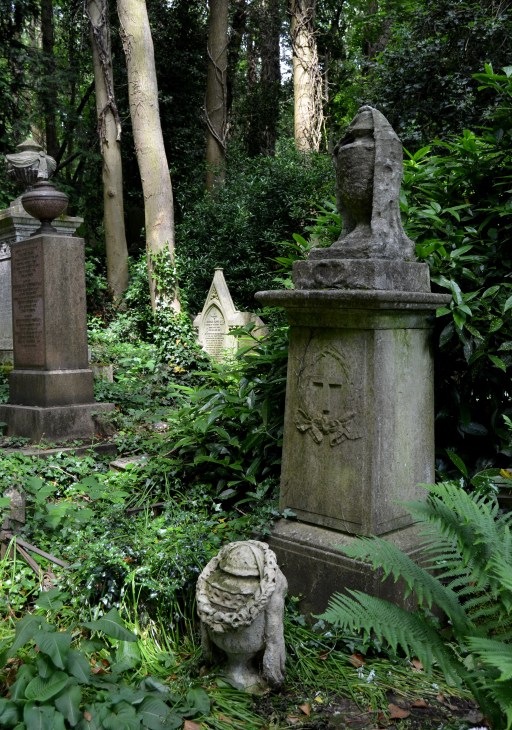
Elizabeth Jackson’s grave

The first burial was Elizabeth Jackson of Little Windmill Street, Soho, on 26 May. Our guide told us, that in those days people believed that the first person who was buried in a graveyard became a kind of protector and guardian against evil forces.

Highgate, like the others of the Magnificent Seven, soon became a fashionable place for burials and was much admired and visited. The Victorians created a wealth of Gothic tombs and buildings that occupies a spectacular south-facing hillside site slightly downhill from the top of the hill of Highgate itself, next to Waterlow Park. Being conservative and thinking English Church, they were not very interested in the ”Egyptian area”, so it took many years before anyone bought a grave there. Another interesting fact is that Victorians didn’t fancy the use of a cross on their grave – they meant that practice was for catholics only.

In 1854 the area to the east of the original area across Swains Lane was bought to form the eastern part of the cemetery. This part is still used today for burials, as is the western part.
London juni 2013 217

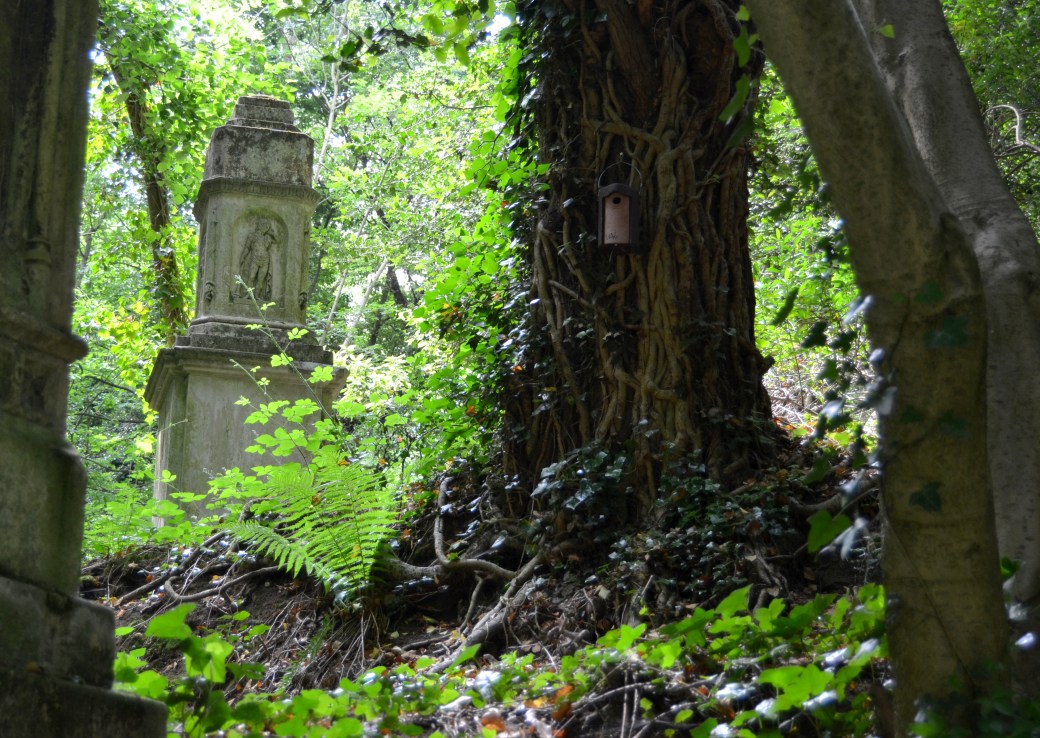
The cemetery’s grounds are full of trees, shrubbery and wild flowers, all of which have been planted and grown without human influence. The grounds are a haven for birds and small animals, and we saw many nesting boxes from the path we walked.

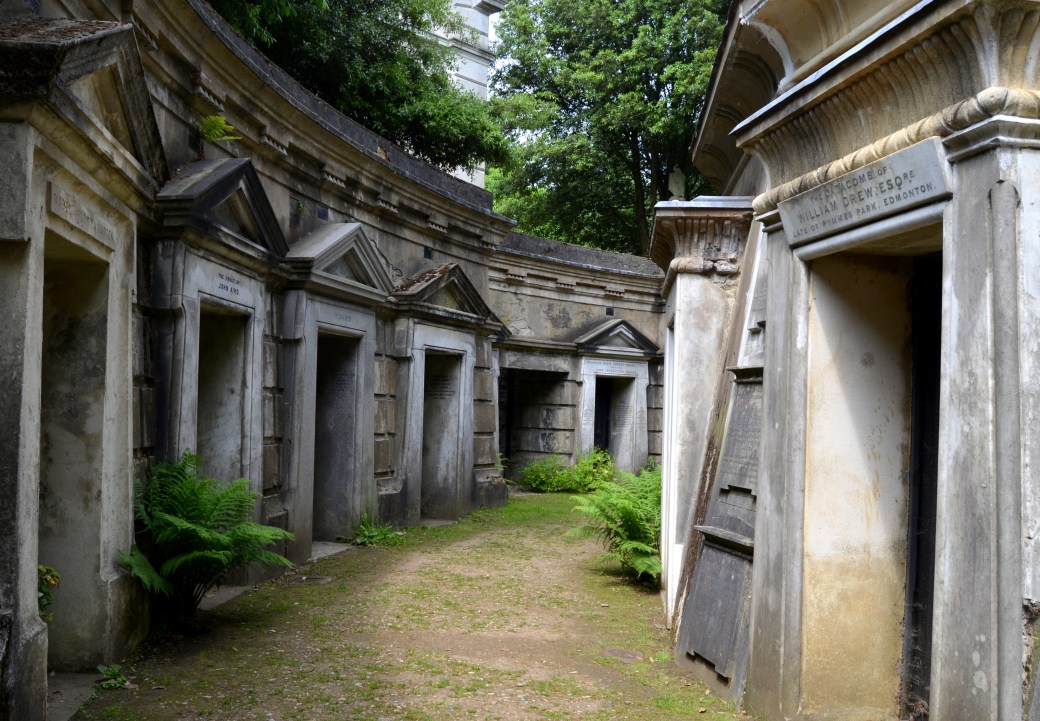
London juni 2013 218Entrance to the Egyptian Avenue, West Cemetery

London juni 2013 222The Cedar of Lebanon

London juni 2013 230 Circle of Lebanon, West Cemetery

The Egyptian Avenue and the Circle of Lebanon (topped by a huge Cedar of Lebanon – according to our guide this tree is at least three hundred years old) feature tombs, vaults and winding paths dug into hillsides. For its protection, the oldest section, which holds an impressive collection of Victorian mausoleums and gravestones, plus elaborately carved tombs, allows admission only in tour groups. (Book in advance! ) Due to vandalism and souvenir hunters only visitors with a personal connection with the cemetery can tour without a guide. In the newer eastern section, which contains a mix of Victorian and modern statuary, you can visit without a guide though. The ticket bought for West is valid for walking on the East part as well.
London juni 2013 198

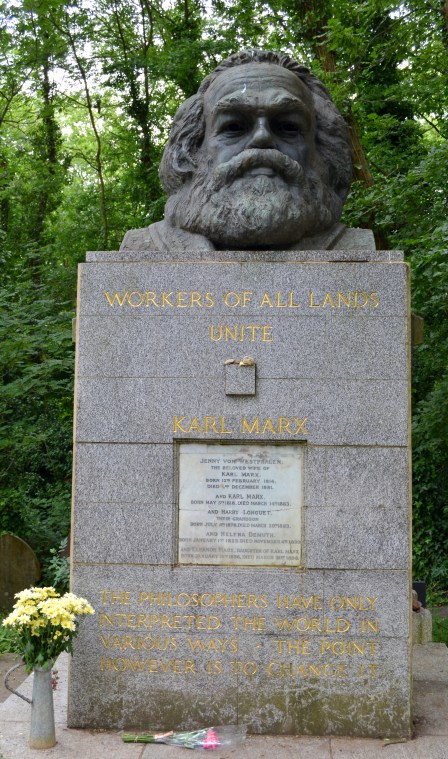
The most famous burial in the East cemetery is probably Karl Marx. The tomb of Karl Marx, the Egyptian Avenue and the Columbarium are Grade I listed buildings.

There are many other prominent figures, Victorian and otherwise, buried at Highgate Cemetery. Most of the historically notable figures lie in the Western part. Among others:

We were not allowed to take photos of new graves, so Beryl Bainbridge and Alexander Litvinenko were left in peace.
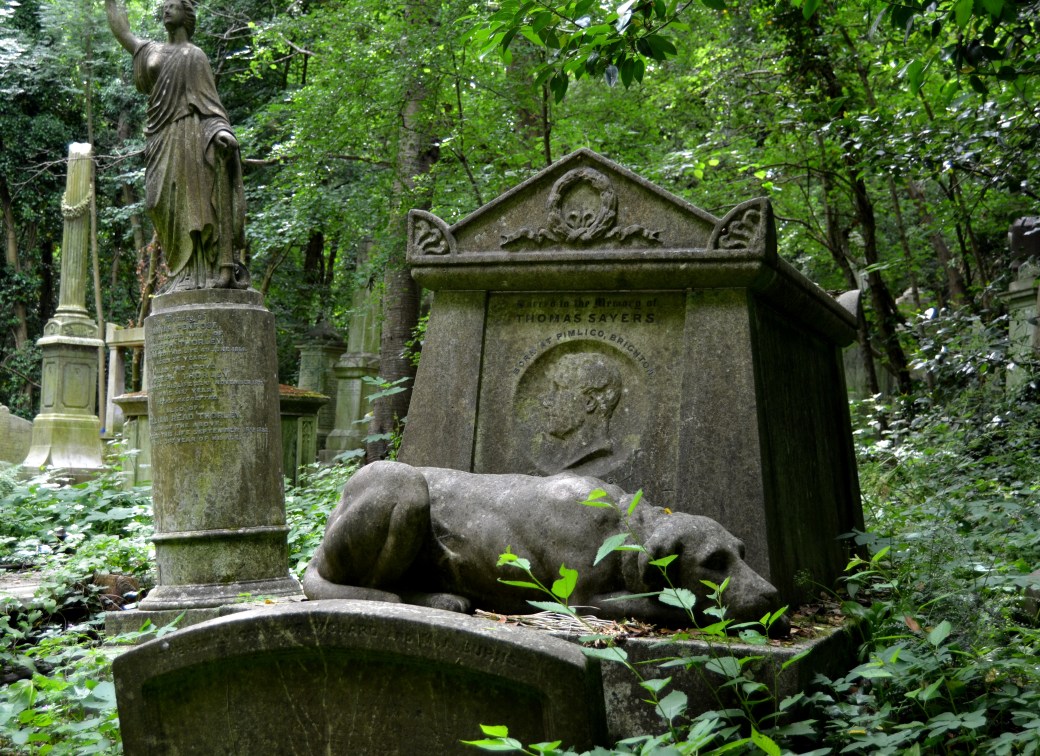
London juni 2013 249Our guide was a volunteer and very knowledgeable about the people being buried here. We got many interesting stories, and among them, one about the prize fighter Tom Sayers (1826-1865). His tomb is  guarded by the stone image of his mastiff, Lion, who also was chief mourner at his funeral. It is said that on the way to the cemetery, the dog sat in the first car with the coffin – in the front seat.

Sayers’ lasting fame depends exclusively on his final contest, when he faced American champion John Camel Heenan in a battle which was widely considered to be boxing’s first world championship. It ended in chaos when the spectators invaded the ring, and the referee finally declared a draw.

Regarded as a national hero, Sayers then retired from the ring. After his death five years later at the age of 39, a huge crowd watched his cortège on its journey to highgate Cemetery and his funeral a week later attracted some 100,000 people to Camden Town.

Highgate Cemetery was featured in the popular media from the 1960s to the late 1980s for its so-called occult past, particularly as being the alleged site of the ”Highgate Vampire”. But, as our guide said, what do vampires fear the most? Surely they would not like a place like Highgate.  Many writers of novels and film directors though, have been inspired by Highgate Cemetery. These are only a few examples:

The East Cemetery hosts some more famous names besides Karl Marx, for example:

Walking the ivy clad paths, passing old ornamented stones and silent statues, old roses and  –  a cat – follow me from East to West.

Nerds

Nörd kommer från engelskans slangord nerd och är en stereotypisk benämning på en person som har ett fixerat intresse eller intresseområde. Enligt Wikipedia användes ordet första gången 1950 i Dr. Seuss bok If I Ran the Zoo, men då med betydelsen av en särskild djurart. På tidigt 60-tal var slanguttrycket spritt i USA och ända bort till Skottland. Fram till slutet av 1900-talet användes ordet nörd oftast negativt, men idag används ordet minst lika ofta positivt.

Nördar kan antingen beskrivas utifrån sina hobbies och intressen, eller via sin personlighet, status, sociala kompetens eller till och med sitt utseende. En vanlig uppfattning är att nördar ofta intresserar sig mer för teknik eller naturvetenskap än socialt umgänge. Det ironiska begreppet social nörd används ibland av nördar om personer som har ett starkt fixerat intresse av socialt umgänge och mänskliga relationer. Nörd kan du eventuellt kallas om du är/har:

  • Datorintresserad
  • Intelligent
  • Enkelspårig
  • Tekniskt kunnig
  • Låg social kompetens

Nördar finns naturligtvis med i populärkulturen, bland annat i filmerna Nördarna kommer! och i dokusåpor som Beauty and the Geek och FC Z. Andra exempel på nördar är Simpsons-karaktärerna Professor Frink, Lisa Simpson och Jeff Albertson.

Den internationella nörddagen firades den 25 maj…men den glömde i alla fall vi bort! Till London hade jag sällskap av två andra nördar i familjen…så vad sägs om ett allmänt nördigt galleri…?

London juni 2013 005

A nerd is a person, typically described as being overly intellectual, obsessive, or socially impaired. They may spend inordinate amounts of time on unpopular, obscure, or non-mainstream activities, which are generally either highly technical or relating to topics of fiction or fantasy, to the exclusion of more mainstream activities. Additionally, many nerds are described as being shy, quirky, and unattractive, and may have difficulty participating in, or even following, sports. ”Nerd” is a derogatory, stereotypical term, but it has also been reclaimed and redefined by some as a term of pride and group identity. Nowadays it’s often used positively as well.

According to Wikipedia, the first documented appearance of the word ”nerd” is as the name of a creature in Dr. Seuss’s book If I Ran the Zoo (1950). The slang meaning of the term dates back to 1951, found in Newsweek magazine. By the early 1960s, usage of the term had spread throughout the United States, and even as far as Scotland. At some point, the word took on connotations of bookishness and social ineptitude.

Nerds can either be described by their hobbies and interests, or by abstract qualities such as personality, status, social skills, and physical appearance. Some interests and activities that are likely to be described as nerdy are:

  • Intellectual, academic, or technical hobbies, activities, and pursuits, especially topics related to science, mathematics, engineering, linguistics, history and technology.
  • Hobbies, games, and activities that are described as obsessive and ”immature”, such as trading cards, comic books, fantasy and science fiction novels, role-playing games, tabletop games.
  • Interest in the fine arts, non-mainstream music, hobbies (i.e., collecting), or other ”obscure” interests.
  • Heavy obsession with a topic that would otherwise be mainstream (such as a popular TV show or a sport).

Well, in London I was accompanied by two other nerds in my family, and what about a short trip through some nerdiness?

Hela listan: Årets Sommarvärdar i P1 – DN.SE – Summer in the Radio

Hela listan: Årets Sommarvärdar i P1 – DN.SE.

Så är sommarens underhållning avslöjad…eller vilka som ska hålla i den i alla fall. Listan på sommarvärdarna i P1 är här.

Förr i tiden visste man lite mer – eller anade – vilka som kunde komma i fråga. Intressanta författare och berömda artister. Människor som hade något att säga och berätta om. Att ligga i hängmattan eller att sitta ute i trädgården med en kopp kaffe och lyssna på signaturen Sommar, sommar, sommar... ger fortfarande en sådan där känsla som inte går att beskriva. Visst har det med tradition att göra! Varje sommar.

Min absoluta favorit genom alla år jag lyssnat är Lars Ulvenstam. Mannen som var sommarvärd 22 gånger i detta program och som ofta avslutade det. Det var en sant högtidlig känsla att sätta på radion just den där sista gången, när jag visste att hans lugna, trygga stämma skulle ta hand om mig och låta mig föras bort i den sista ljumma sommarvinden.

Sommar inleds traditionsenligt på midsommardagen och i år sänds serien för 55:e gången. Programmet har sänts sedan 1959 i Sveriges Radio och idén kom från den dåvarande underhållningschefen Tage Danielsson. Denne briljante man som gick bort alldeles för tidigt.

– Det ska vara lätt musik med prat med mening i, sa Tage Danielsson till producenten Jörgen Cederberg, och därmed föddes programmet som blivit en institution i Sveriges Radio.

Från att ha handlat om väder,  praktiska råd och musik i en lättsam ton, utvecklades programmet till att på 70-talet bli politiserat, på 80-talet ganska kändisfixerat och på 90-talet mer samhällsorienterat. Genom det dryga halvseklet som Sommar sänts har ett stort antal personer pratat och valt musik och gett lyssnarna ett ofta personligt program – inte sällan med humor, närhet och eftertanke.

Och programmet har genom åren fått både ris och ros av lyssnarna. Kritiken har bland annat handlat om att värdarna har varit för förutsägbara, eller för kontroversiella, som i fallet med Annika Östberg. Hon sommarpratade 2010, strax efter att hon kommit hem till Sverige efter 28 år i amerikanskt fängelse, dömd för medhjälp till mord. Men det blev ett gripande program om hennes 28 år i amerikanskt fängelse och om hennes hemkomst till Sverige.

I år röstades Martha Ehlin fram av lyssnarna. Hon fick en livshotande diagnos när hon var i 30-årsåldern, och ska berätta om kampen för att överleva en femorganstransplantation. Som vanligt under senare tid är det inte så många kända namn på listan, men det brukar för det mesta bli bra ändå. Själv ser jag fram emot bland andra Annika Hagström, Malik Bendjelloul och Joey Tempest.

Länge leve radion!


There’s a Swedish radio program called Sommar (Summer) being sent every week from Midsummer’s Day throughout the whole summer. This program has been on the air every summer since 1959, and it’s totally addictive. When the music, the theme, Sommar, sommar, sommar…is on, many people in Sweden feel the magic – if you are lying in the sun or in your bed, if you’re having coffee or driving your car – it’s that magic wand you feel… sweeping you away…There’s nothing special with this tune, but to us, it says that summer is finally here. I think it’s a feeling of freedom in some ways, because most Swedes have their summer vacation then. Myself, I can see red strawberries falling down from above making a delicious splash in my bowl of milk!

A famous Swedish comic, writer and actor called Tage Danielsson started this program and since then it has developed into something close to our heart, our Swedish heart. Actors, authors, singers, artists – even politicians (with charisma…) might be asked to host one of the programs. And, it’s a great honour being asked. If you are asked, you do not say no. Humour, heart, warmth, sympathy and wisdom of life are often characteristics for the content of Sommar.

My absolute favourite host through all these years is  Lars Ulvenstam. He was in fact one of the hosts for 22 summers! His soft, friendly voice became special to many of us, and as he often hosted the very last summer program, it was a solemn moment when the radio was turned on. I would say, he represented a kind of, what we today call mindfulness.

So – above is the list of hosts for this summer! Personally, I’m looking forward to listening to the journalist Annika Hagström, the Oscar winner Malik Bendjelloul and the old rock band leader for Europe,  Joey Tempest.

”Searching for Sugar Man” – a masterpiece!

Searching for Sugar Man är ett måste för alla att se! Storyn är outstanding och Rodriguez röst och texter är något långt utöver det vanliga. Man vill mena att han är bättre än Dylan. Rösten är definitivt makalös och någon jämförelse med Dylan kan inte göras…Dylan når aldrig upp till Rodriguez! Att Rodriguez aldrig blev en megastjärna är omöjligt att förstå. Största anledningen måste vara att världen helt enkelt inte var mogen för honom…

Denna dokumentär är helt otroligt välgjord och bär hela vägen fram. När eftertexterna rullar klarar man inte att resa sig upp utan sitter kvar helt uppfylld av filmen – och av mannen Sixto Rodriguez. Fantastiskt arbete av Malik Bendjelloul som är så välförtjänt av sin Oscarsstatyett. Även om det har diskuterats varför han utelämnat delar av Rodriguez karriär, så kan detta ändå både förklaras och förlåtas. Bendjelloul har gjort ett enastående arbete med dokumentären och byggt den så att spänning och känsla ständigt stegras. Ingenting behöver filas på mer här – det vi ser är helt enkelt ett mästerverk. Och – om det är möjligt ska jag köpa Rodriguez plattor. De bör ges ut på CD efter det här.