Weekly Photo Challenge: Letters

Letters – letters and words, combined they make language.  One of the things separating us from animals – the written language. What would happen if we didn’t have it? Letters and words give you power. Not only for Love. They are the strongest weapon. Burning books is still done…, leaking written facts…, starting and ending wars. Letters.

The most beautiful letters I know of are the Tibetan letters. The skill of making them is pure art. This is not a full alphabet, but called an alphasyllabary. It is a segmental writing system in which consonant–vowel sequences are written as a unit: each unit is based on a consonant letter, and vowel notation is secondary. Read more about the alphabet here.

These pilgrim stones are placed on the path leading up to the Pothala Palace in Lhasa, Tibet. Even if I don’t know the exact meaning of what’s written on them, I think I know something of their content.
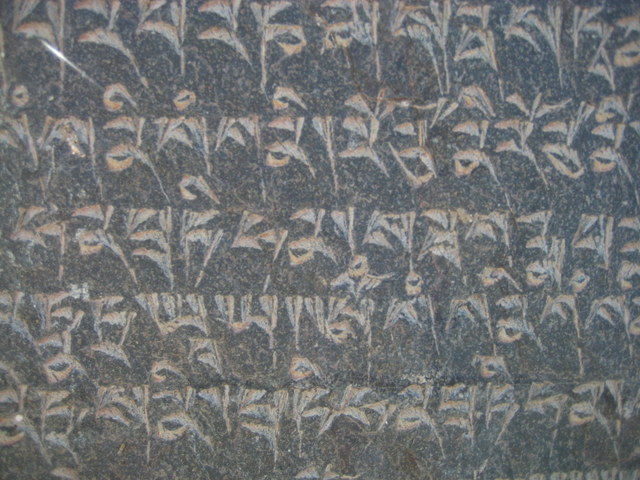
I know that somewhere on these stones is carved the primary mantra of  Tibetan Buddhism. It is commonly carved onto rocks or written on paper that’s inserted into prayer wheels. When the wheels are spinned the prayers will find their right way without someone constantly reciting them.  Oṃ Maṇi Padme Hūṃ  (Tibetan: ༀམཎིཔདྨེཧཱུྃ )

Om-mani-padme-hum 02.svg

The mantra in Tibetan with the six syllables coloured. The exact meaning of the words is discussed, but below is the interpretation by the 14th Dalai Lama:

14th Dalai Lama

”It is very good to recite the mantra Om mani padme hum, but while you are doing it, you should be thinking on its meaning, for the meaning of the six syllables is great and vast… The first, Om […] symbolizes the practitioner’s impure body, speech, and mind; it also symbolizes the pure exalted body, speech, and mind of a Buddha[…]”
”The path is indicated by the next four syllables. Mani, meaning jewel, symbolizes the factors of method: (the) altruistic intention to become enlightened, compassion, and love.[…]”
”The two syllables, padme, meaning lotus, symbolize wisdom[…]”
”Purity must be achieved by an indivisible unity of method and wisdom, symbolized by the final syllable hum, which indicates indivisibility[…]”
”Thus the six syllables, om mani padme hum, mean that in dependence on the practice of a path which is an indivisible union of method and wisdom, you can transform your impure body, speech, and mind into the pure exalted body, speech, and mind of a Buddha[…]”
Quotation  from Wikipedia


LIOLI#2

Stekt lever anglaise eller suédoiseFoto: Martin Hanner, Spisa.nu

Fried liver anglaise or suédoise

2-3 persons

Ingredients

Liver 700,0 gram

Bacon 280,0 gram

Flour 0,5 dl

Butter 100,0 gram

Salt

More:

Potatoes 0,8 kilo

Creme 4,0 dl

Lingonberry jam (fresh berries – not boiled)

or capers (pickled)

How to: (25 min )

  1. Peel and boil potatoes.
  2. cut the liver into fine slices, about a centimetre. turn in flour and salt.
  3. Fry bacon and let the fat run off on a piece of paper.
  4. Heat up butter in a frying pan. When no bubbles left, put in the slices – not too close to each other. Fry 2-3 minutes on one side and 1 minute on the other.
  5. Warm the capers in the butter if ”anglaise”, or if ”suedoise” pour the cream in the pan and heat it up.
  6. Serve with capers (anglaise) or with lingonberries (suédoise).

Frying tips: Important to fry the liver fast in hot butter and not too long ( we have all tasted ”rubber”, haven’t we…) , the slices should be pink inside.

Thanks to:  Spisa.nu

This of course means that I like liver – when I cook it myself! I remember those ”rubber soles” we had to eat at school lunches…impossible for anything but shoes. But I always liked the smell and the creme sauce. My husband also loves liver, so when we’re alone I sometimes surprise him with it. And, not only for the smell. Our children are not that interested though…they were also served rubber soles at school.

So, it’s never too late – follow the frying instructions and enjoy!

And why not join in? http://margaretrosestringer.com/2014/03/04/lioli-2/

lioli

81 dancers and some crumpled paper…

BBC – Culture – JR flyposts the New York City Ballet building.

Beauty is in the eye of the beholder

This saying first appeared in the 3rd century BC in Greek. In 1588, the English dramatist John Lyly, in his Euphues and his England, wrote:

”…as neere is Fancie to Beautie, as the pricke to the Rose, as the stalke to the rynde, as the earth to the roote.”

Shakespeare expressed a similar sentiment in Love’s Labours Lost, 1588:

Good Lord Boyet, my beauty, though but mean,
Needs not the painted flourish of your praise:
Beauty is bought by judgement of the eye,
Not utter’d by base sale of chapmen’s tongues

Benjamin Franklin, in Poor Richard’s Almanack, 1741, wrote:

Beauty, like supreme dominion
Is but supported by opinion

David Hume’s Essays, Moral and Political, 1742, include:

”Beauty in things exists merely in the mind which contemplates them.”

The person who is widely credited with coining the saying in its current form is Margaret Wolfe Hungerford (née Hamilton), who wrote many books, often under the pseudonym of ‘The Duchess’. In Molly Bawn, 1878, there’s the line ”Beauty is in the eye of the beholder”.

Ese’s Weekly Shoot & Quote Challenge – Imagination

Imagination – life would be unbearable without it. I was an imaginative child, and much of it was sparkled by books and all those stories hidden inside…

I have always imagined that Paradise will be a kind of library.
Jorge Luis Borges

Personally, I would sooner have written Alice in Wonderland than the whole Encyclopedia Britannica.

Stephen Leacock

This piece of Encyclopaedia Britannica was bought by my daughter, who used her imaginative creativity  to make it end up as my birthday present!

Weekly Photo Challenge: Unexpected

The WordPress challenge this week is about the unexpected. Walking along the beach I met these two friends where the unexpected had already happened…

 317

Ese’s Weekly Shoot & Quote Challenge: Spread

Spread is the word from Ese this week. Being a book lover that just had to be IT didn’t it?

May books spread the world over!

Yann Martel

Hand Me Down World

I had some days off…and that’s when I always read a good book – or try to find a good book to read. This October week I was lucky, because I brought Lloyd Jones’s Hand Me Down World.

Gran Canaria 2013 007

A woman washes ashore in Sicily. She has come from north Africa to find her son, stolen from her by his father when the boy was just days old and taken to Berlin. With nothing but her maid’s uniform and a knife in a plastic bag, she relies on strangers— some generous, some exploiting—to guide her passage north.
These strangers all tell their story about her, and each account gives a different view of the truth, just like the versions of truth we all create to accomodate our lives. These fragments of a life piece together to create a spellbinding story of her, this woman and mother, who crosses continents searching for her missing child. Not until towards the end, we also get her own version of the story.
It’s haunting and beautiful, because ”Sometimes a person passes through your world and you don’t forget them.” She is one of them, and this is her story. I suggest you read it.

Ese’s Weekly Shoot & Quote Challenge: Loneliness

Time for a new shoot and quote – click here.

London juni 2013 082

A man in a bookstore buys a book on loneliness and every woman in the store hits on him. A woman buys a book on loneliness and the store clears out.

Doug Coupland

Cee’s Fun Foto Challenge: White and Purple

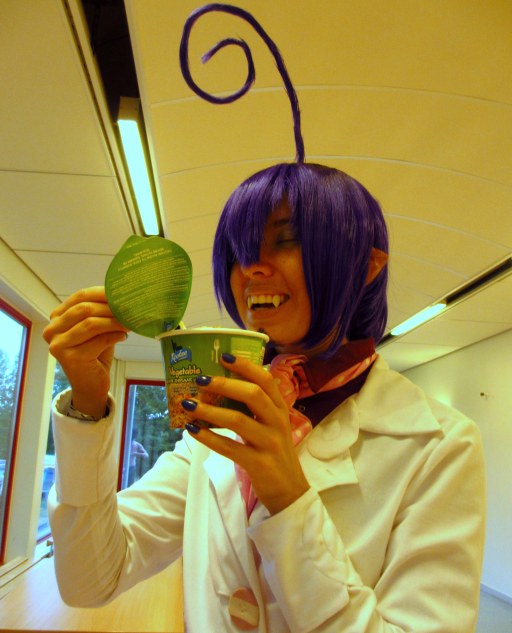
Well, what about this photo of my daughter cosplaying the famous Mephisto! I knew it would come in handy some day… Costume play – so, she made the costume herself, even the teeth and the hairdo…and the ears…

Sommaren går mot sitt slut 2013 001For more White and Purple entries at Cee’s – click here.

We didn’t know…

Under Londonbesöket åkte vi ut till Highgate – den fantastiskt fina kyrkogården vid Hampstead Heath. Den östra delen får man gå utan guide, vilket vi också gjorde. Ganska snart, i en slänt uppe på vänster sida om gången, fann vi denna gravsten. En mycket enkel sten, nästan oansenlig, men ett litet krus med pennor väckte vårt intresse…

During this London visit we went to Highgate, the famous cemetery near Hampstead Heath. Highgate East you are allowed to walk alone, without any guide. So, we did. Only maybe 100 metres in on the path, on our left hand, we saw this rather insignificant and undecorated stone standing on the slope, but a small jar filled with pencils soon attracted our attention…

London juni 2013 188Vi hade en mycket bra penna med oss, men den fick sin sista vila i detta krus. Ingen av oss visste att denne fantastiske berättare var begravd på Highgate.

We had only brought one good pencil that day, but it got its last rest here, in this jar. None of us knew that this fantastic author was buried here.