Ailsa’s travel theme this week is all about Yellow!


Ailsa’s travel theme this week is all about Yellow!
Juxtaposition är ett roligt ord, nästan onomatopoetiskt eller ljudhärmande, om du upprepar det några gånger…I Madrid hittade jag ett flertal exempel på sådana kombinationer av levande eller döda ting som befinner sig intill varandra och medvetet eller omedvetet bildar kontraster. Några fler, och bättre, finns i ett tidigare inlägg, här i the green wall.
Idag har jag valt fyra andra exempel. Det första sida vid sida, det andra ovanpå varandra, det tredje omringande varandra och i det sista exemplet klänger de sig fast vid varandra…
Juxtaposition is a funny word, and it sounds almost onomatopoetic when you pronounce it a couple of times…In Madrid I caught some of them…the juxtapositions. I know I used the green wall in an older post with (more and better than these…I won a competition with that one) juxtapositions, but this time I have picked another four examples. They do stand in contrast, the first one side by side, the second one on top of the other, then almost surrounding each other, and in the last picture they are clinging to one another.
Somehow it’s easy to find buildings and architecture showing this, but of course you find it everywhere if you just take a look around…Find more of juxtapositioning here!
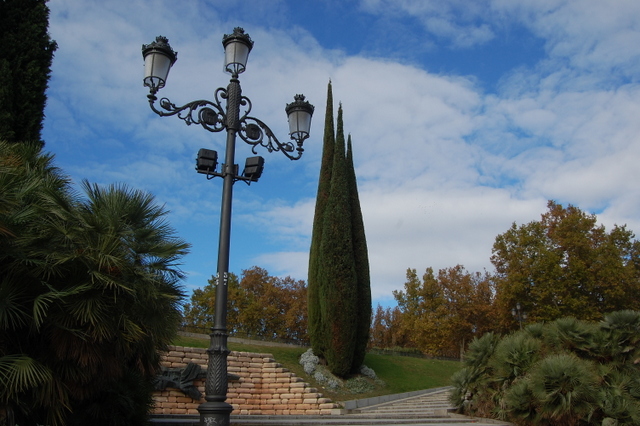
Side by side
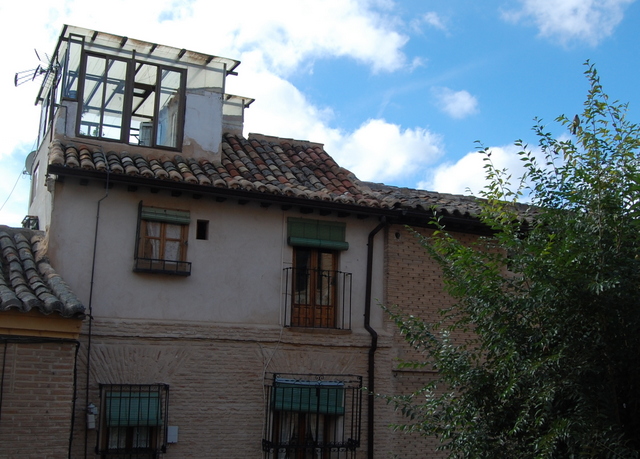
On top of each other

Side by side and surrounding
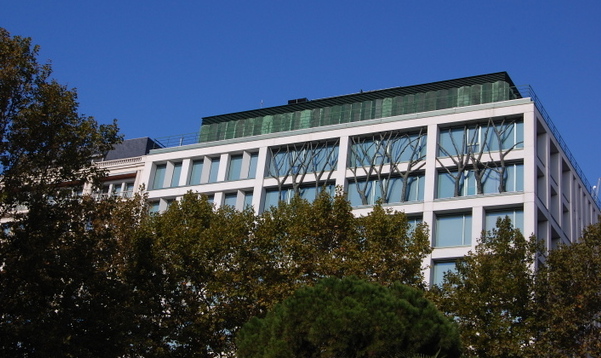
Clinging to…
On my walks I often find things in Nature that have been put there by man, but still look like they really belong there.
Cee’s Fun Foto Challenge: Found in Nature gives an opportunity to share some of them …
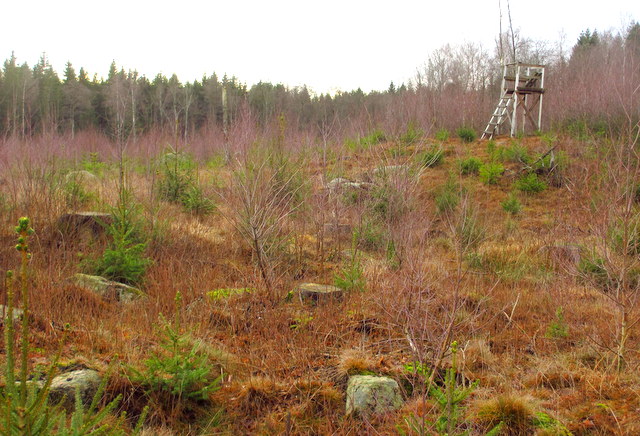
This open space in the forest is most certainly well travelled by many animals. The tower is for the moose hunters.
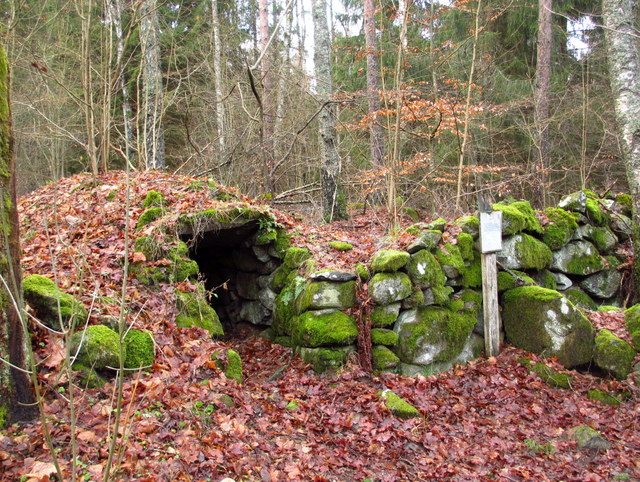
Following a narrow path, I came upon the old cellar that is all that’s left from ”Anna’s Cottage”. She lived here until about 1930.
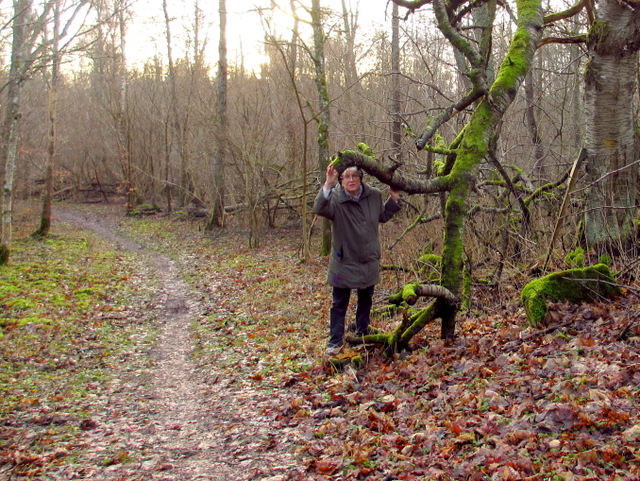
Not ”Anna”, but another mum found in the same forest…
NZ – Silver fern!
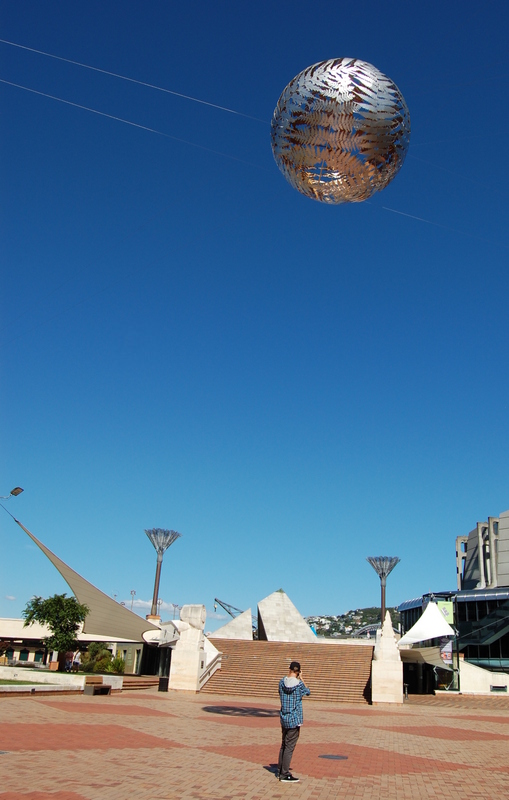
For more of Silver, go to Ailsa on Where’s My Backpack? – just click the link above – or why not join in yourself!
Fönster har alltid varit viktiga för oss – inte minst i länder där ljuset behöver komma in under de mörka vintermånaderna. När jag var barn hade man dubbla fönster med bomull/ull emellan och ibland eterneller därpå.
Inga fönster är mig kärare än de enkla fönster vi har i sommarstugan. De är mycket gamla, med flagnande färg och gistet trä som gör dem svåra att öppna och stänga. Men de är – Sommar. Det andra fotot visar S’t Mary’s Church i Scarborough, som har sällsynt vackra fönsterbågar.

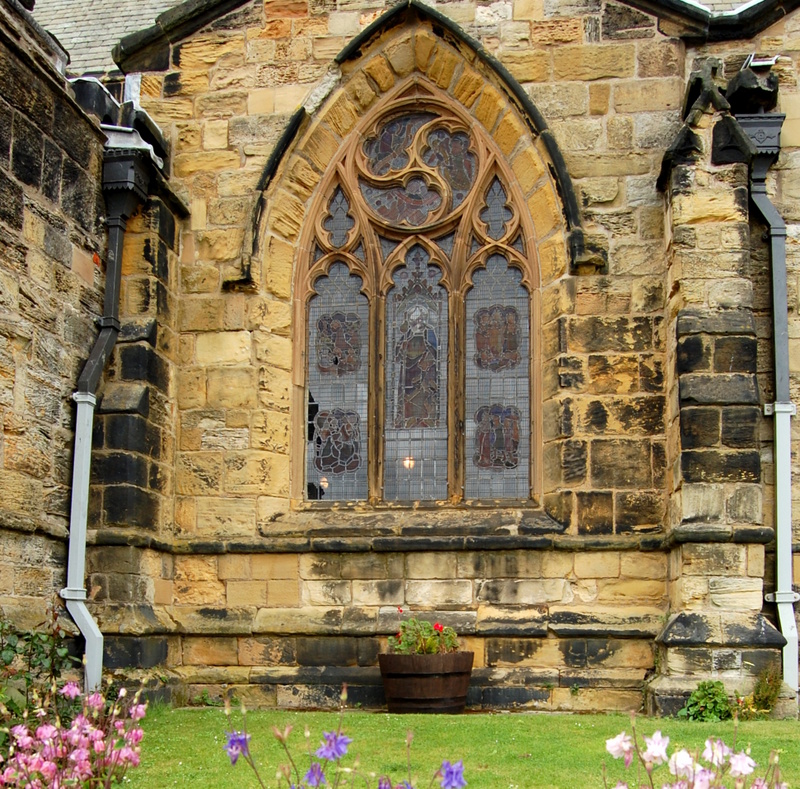
Windows have always been important to us, and I think maybe especially in countries where they are much needed for the light during the dark winter months. When I was a child many windows were double and had a string of cotton or wool in between the two window glasses. Sometimes people decorated with flowers or herbs there as well.
To me, no windows are more beautiful than the simple old windows of our summer house. Their colouring is fading and their wooden frames so worn that they are no longer easy to open and close…but they are – Summer. The second photo shows St Mary’s church in Scarborough – where I simply fell in love with both the windows and their frames.
Ailsa’s theme this week is Illuminated
– and that is what you could say about Cervantes and his heroes Don Quijote and Sancho Panza in Madrid. Walking home a soft night, we lingered here for at least an hour. Peaceful. He lives on into the future, standing illuminated against a modernistic building.
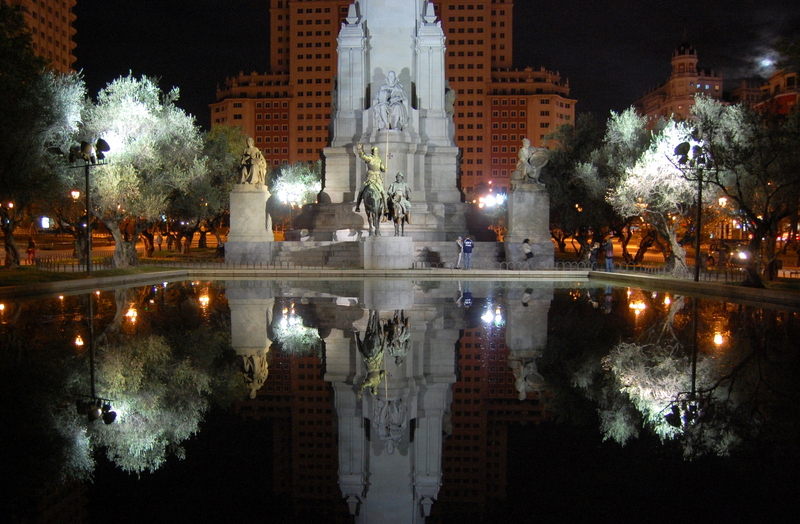
Music is an important part of our lives – and Music is also Ese’s challenge this week. Young people today have music plugged in their ears all day it seems…which would be a bit too much for me… I love silence.
I do love silence, but I also love almost all kinds of music, from bird song to heavy metal. I have a sweet tooth for music coming up spontaneously among people, for big voices like Freddie Mercury’s and tenors as Andrea Bocelli’s, for clear and soaring ones like Mireille Mathieu’s and Sara Brightman’s – and also for odd instruments.
Music is everybody’s possession. It’s only publishers who think that people own it.
John Lennon


Last year we saw the beginning of a new building further down our street. A rather dilapidated old house was torn down and a magnificent old garden with a giant apple tree had to go. I still miss that apple tree…There used to lie tons of apples under it in Autumn – for anyone to pick and use.
This company sets up a new house in a couple of days only – now there are people living in all of its apartments. Lights in every window this grey winter.
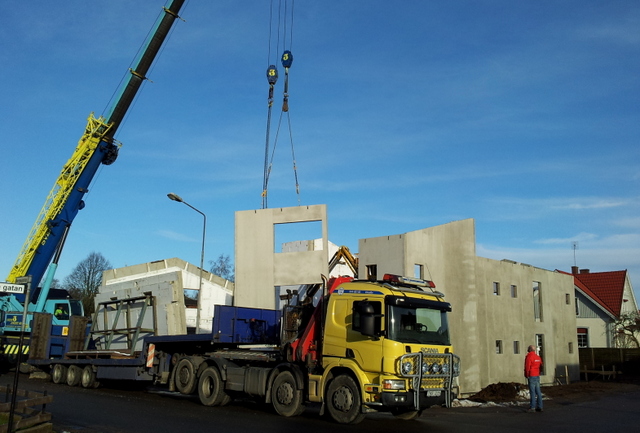 Find more beginnings here.
Grand – a concept with many enterpretations. A moment I will never forget, is when I was walking down this street and first layed eyes on the Aqueduct in Segovia, Spain. In front of me were these two grand old gentlemen too, and I could listen to them discussing everyday problems.
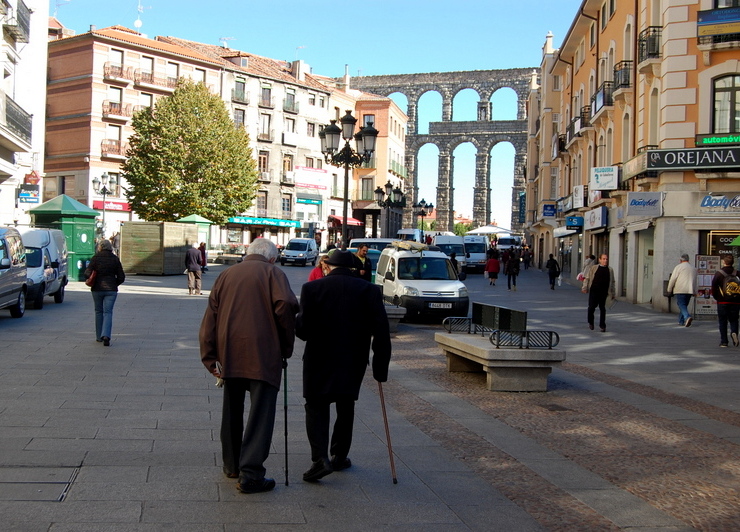
The Aqueduct’s date of construction cannot be definitively determined, but at the end of the 20th century, a German archaeologist managed to determine that actually it was the Emperor Domitian (AD 81-96) who ordered its construction.
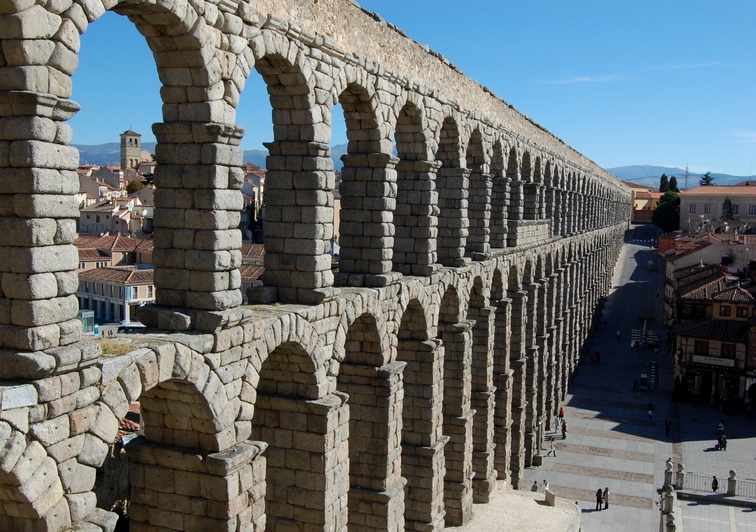
The aqueduct transports water from Fuente Fría river, situated in the nearby mountains, some 17 km (11 mi) from the city in the region La Acebeda. It runs another 15 km (9.3 mi) before arriving in the city.
The water is first gathered in a tank known as El Caserón (or Big House), and is then led through a channel to a second tower known as the Casa de Aguas (or Waterhouse). There it is naturally decanted and sand settles out before the water continues its route. Next the water travels 728 m (796 yd) on a one-percent grade until it is high upon the Postigo, a rocky outcropping on which the old city center was built. Then, at Plaza de Díaz Sanz (Díaz Sanz Square), the structure makes an abrupt turn and heads toward Plaza Azoguejo (Azoguejo Square). It is there the monument begins to display its full splendour.
At its tallest, the aqueduct reaches a height of 28.5 m (93 ft 6 in), including nearly 6 m (19 ft 8 in) of foundation. There are both single and double arches supported by pillars. From the point the aqueduct enters the city until it reaches Plaza de Díaz Sanz, it includes 75 single arches and 44 double arches (or 88 arches when counted individually), followed by four single arches, totalling 167 arches in all. The construction of the aqueduct follows the principles laid out by Vitruvius as he describes in his De Architectura published in the mid-first century.
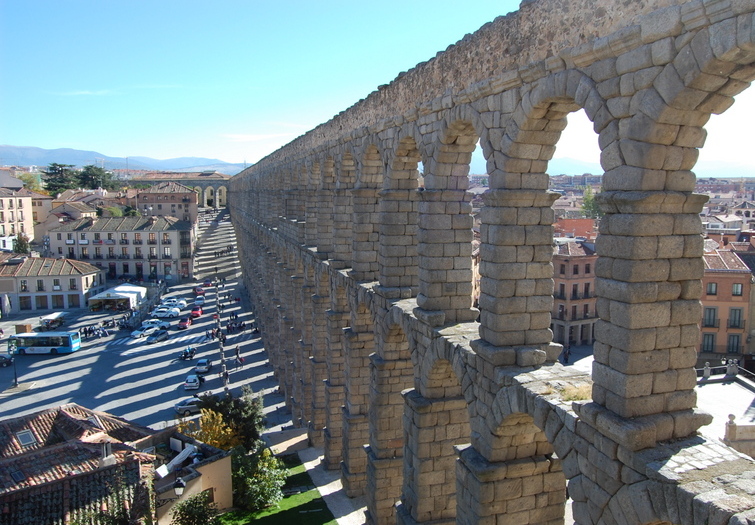
For me, this meeting with the ancient Aqueduct was a truly grand moment.
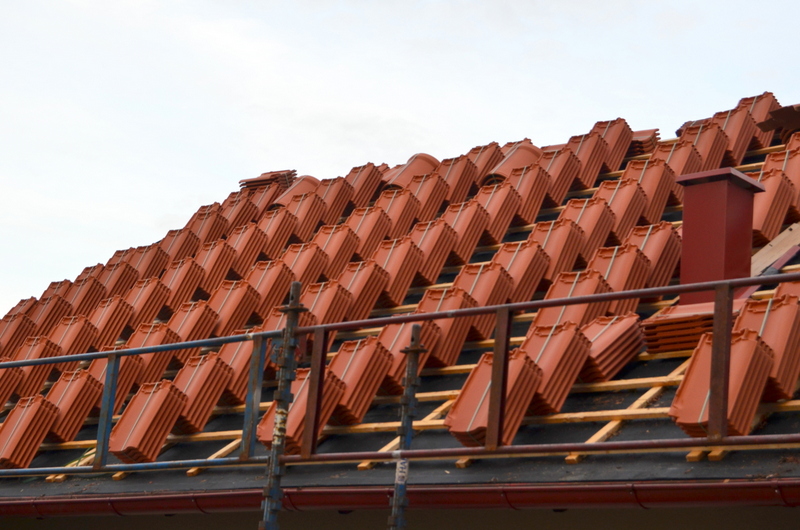
To get a new roof you need more than 5 items…


Du måste vara inloggad för att kunna skicka en kommentar.