Canary Pearls

Montaña de Arucas on the north coast of Gran Canaria boasts a view of the town as well as almost the whole island. An early morning view from up there is not bad. The church (Not a cathedral!) San Juan is a real beauty. From the narrow streets its spires look almost unreal.

We continued our roadtrip to some northern pearls, Teror and Firgas.

Teror is the religious heart of the island, and every year, September 8, pilgrims come here from the whole of Gran Canaria. They all come because of Nuestra Señora del Pino, their patron saint.

The church, with the same name, was built in the 18th century in Moorish and baroque style. Very special.

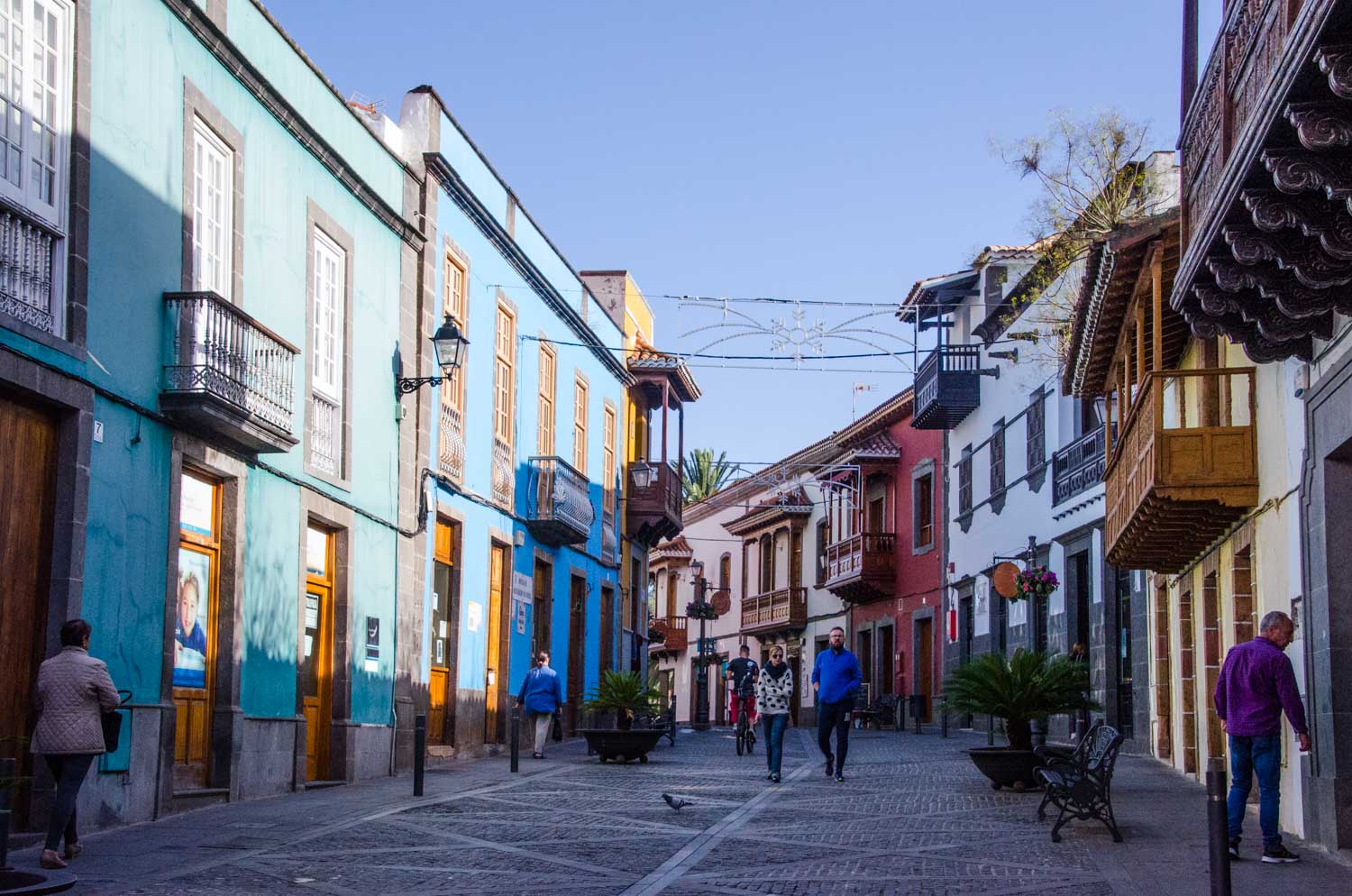
Some of the 16th century houses along the street. Many famous for their skillfully carved balconies.

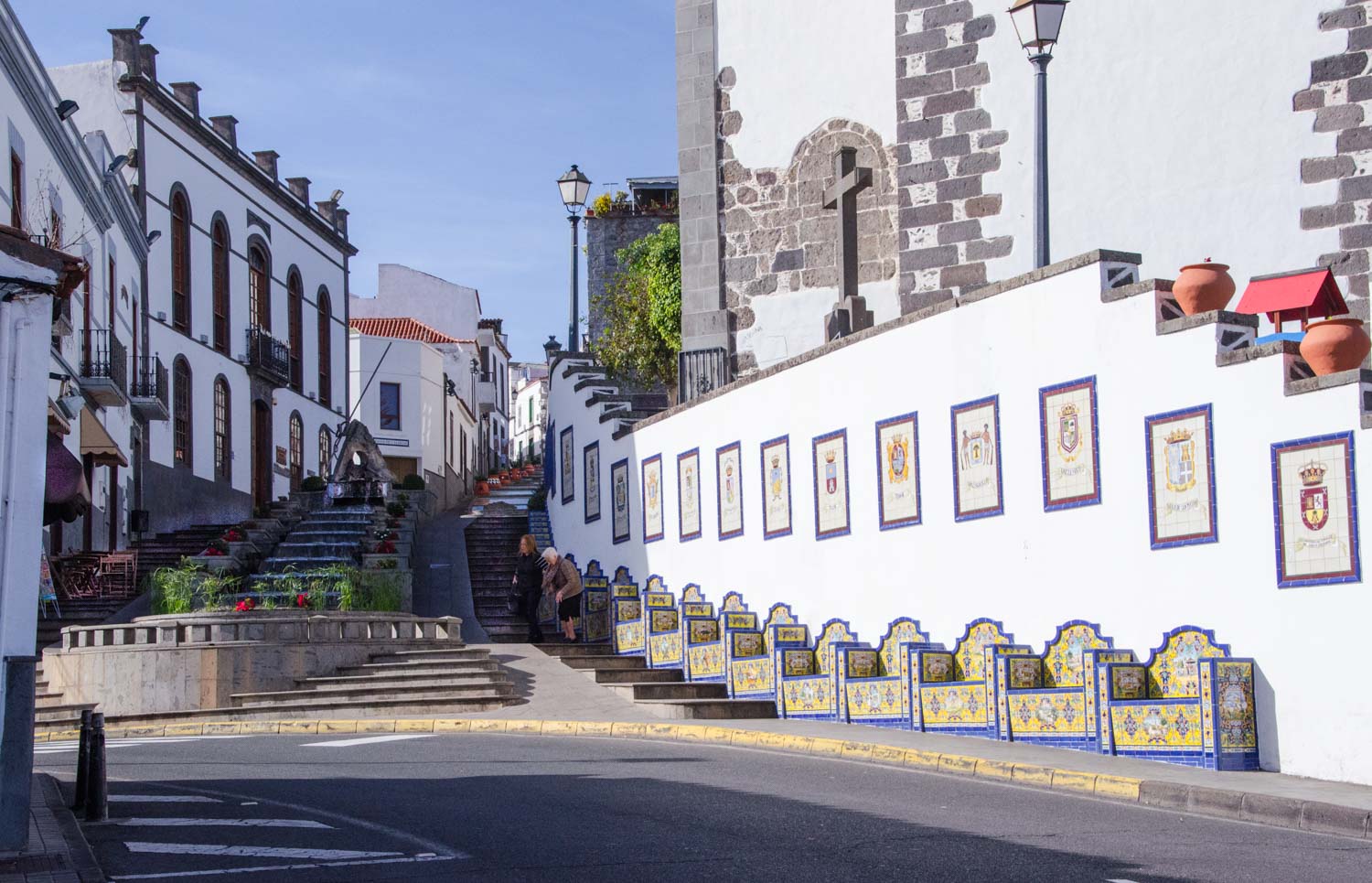
After a slow and meditative walk through Teror, we headed for Firgas. Mineral water con gas, was my first thought – but the small town is also known for Paseo de Gran Canaria with its cascading water and tiled benches decorated with landscapes and historical symbols of Gran Canaria. On the walls – city arms.

A closer look at the cascades in the header!

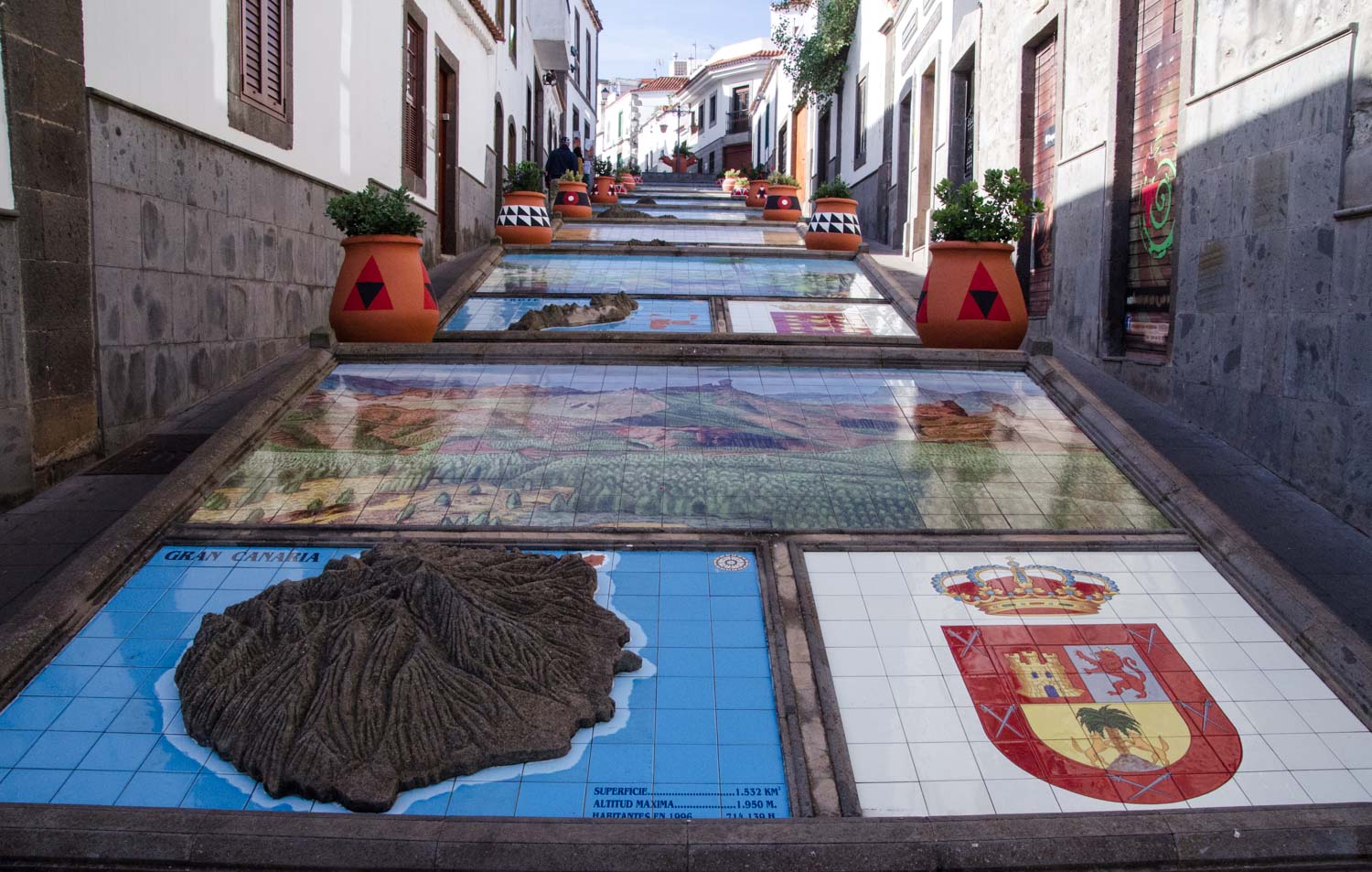
If you walk further up the stone steps, above Plaza de San Roque, you will find tiled maps of the largest 7 islands in the archipelago. A geography lesson well worth a visit!


Lost – and Found

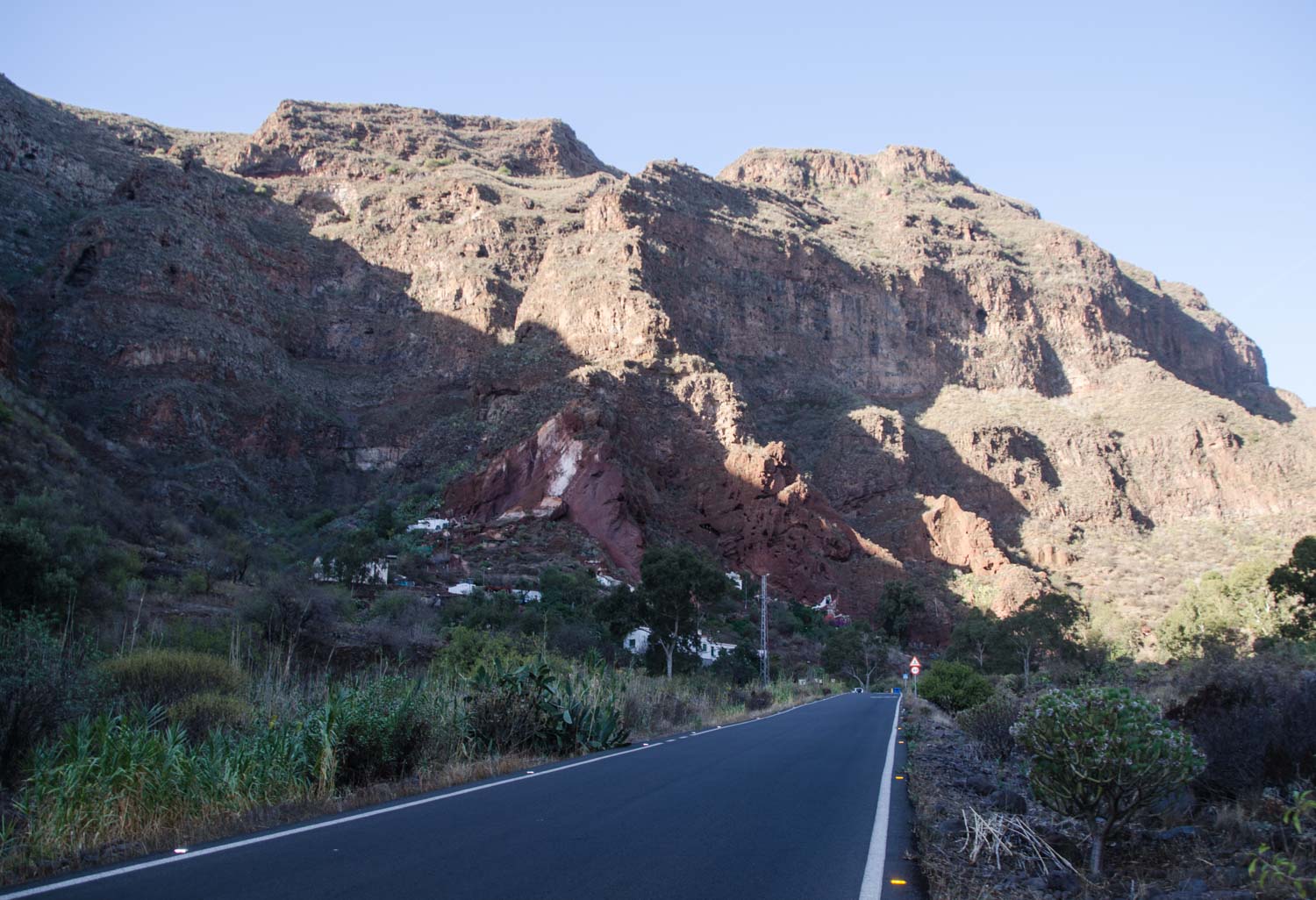
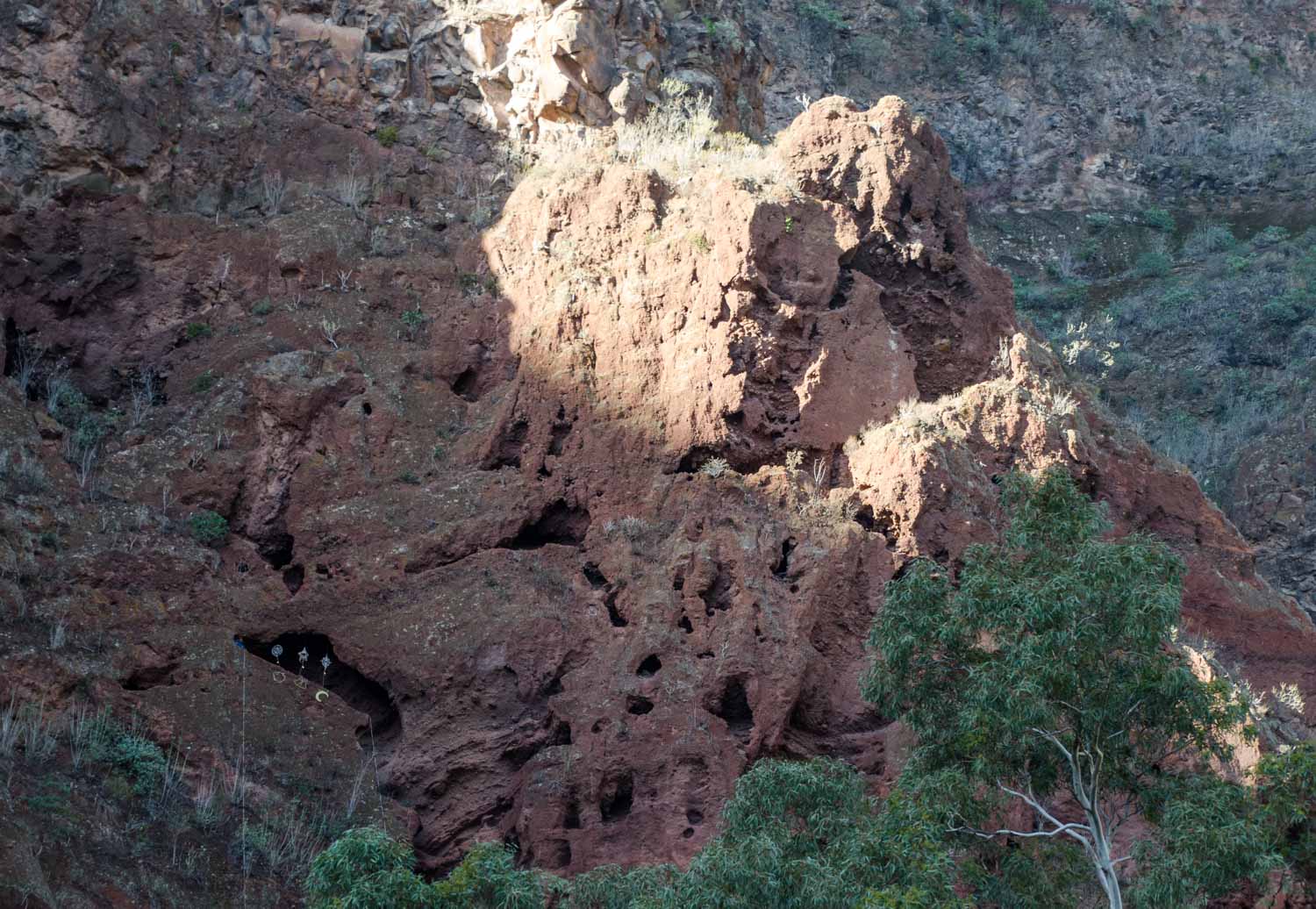
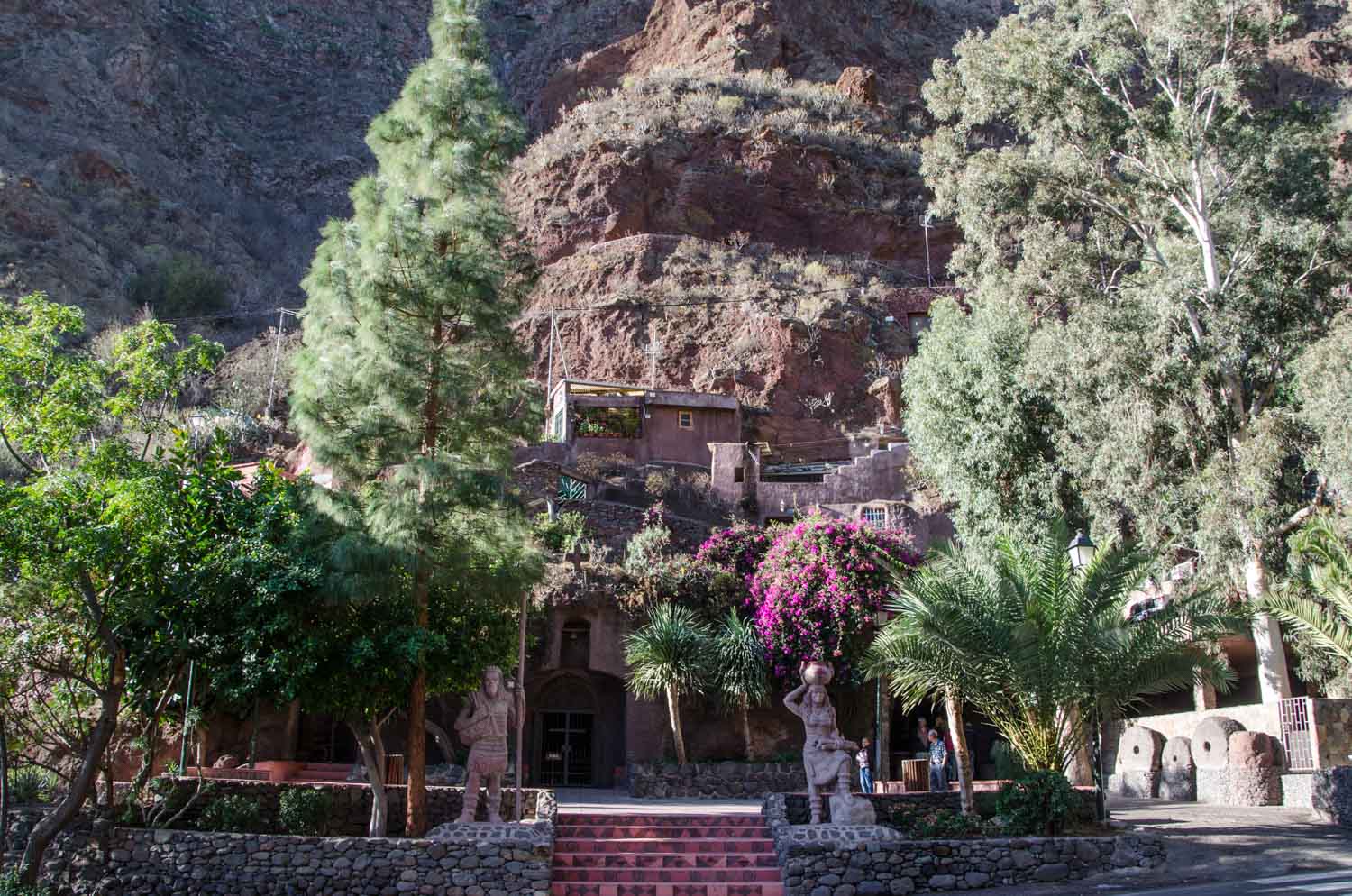
On our way in the early morning for another mountain hike – we suddenly came upon this strange settlement. A set of caves with real doors and windows. Dogs barking and people up and on the move.

Guanches? Strictly speaking, the Guanches were the indigenous peoples of Tenerife, but  the name came to be applied to the indigenous populations of all the seven Canary Islands, those of Tenerife being the most important or powerful.

Guanches refer to the aboriginal Berber inhabitants of the Canary Islands, and it is believed that they migrated to the archipelago around 1000 BC or perhaps earlier.

The population probably lived in relative isolation up to the 14th century, but after the Spanish conquest of the Canaries they were (almost totally) ethnically and culturally absorbed by Spanish settlers.

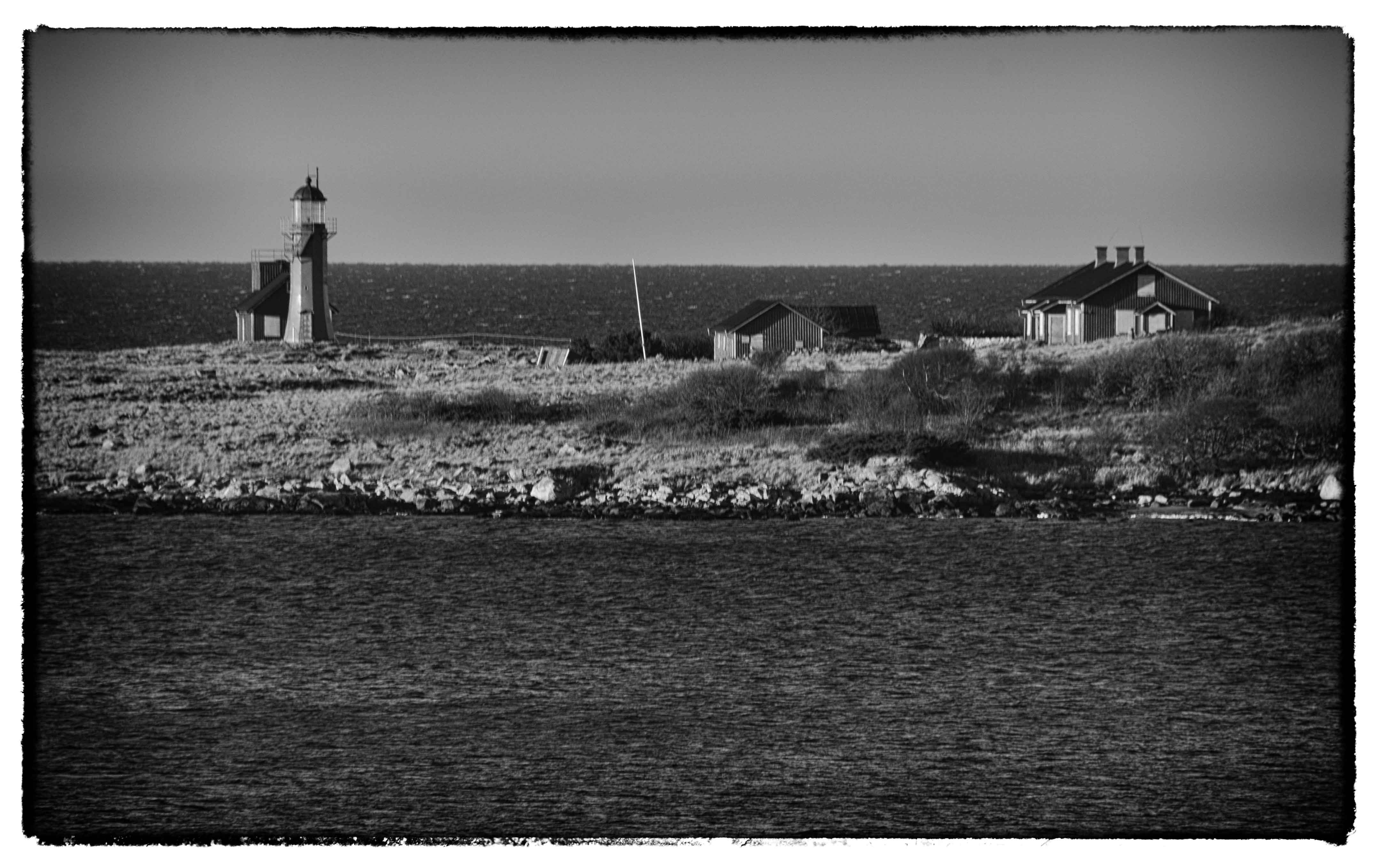
A bit touristy this settlement…and yes, soon a bus arrived with camera people swarming out…But, on the other side of the road, people were, for real, living in caves. Nobody looked that way…And if you look closely at the header picture, you will find the dog standing there – the one I used for Abandoned or Alone in Cee’s B&W challenge.

Detta bildspel kräver JavaScript.

Well, when we continued driving towards the mountains, we realized we were lost – this was a dead end road –  and not at all the road leading to our planned hike….But, instead we had found these interesting caves!

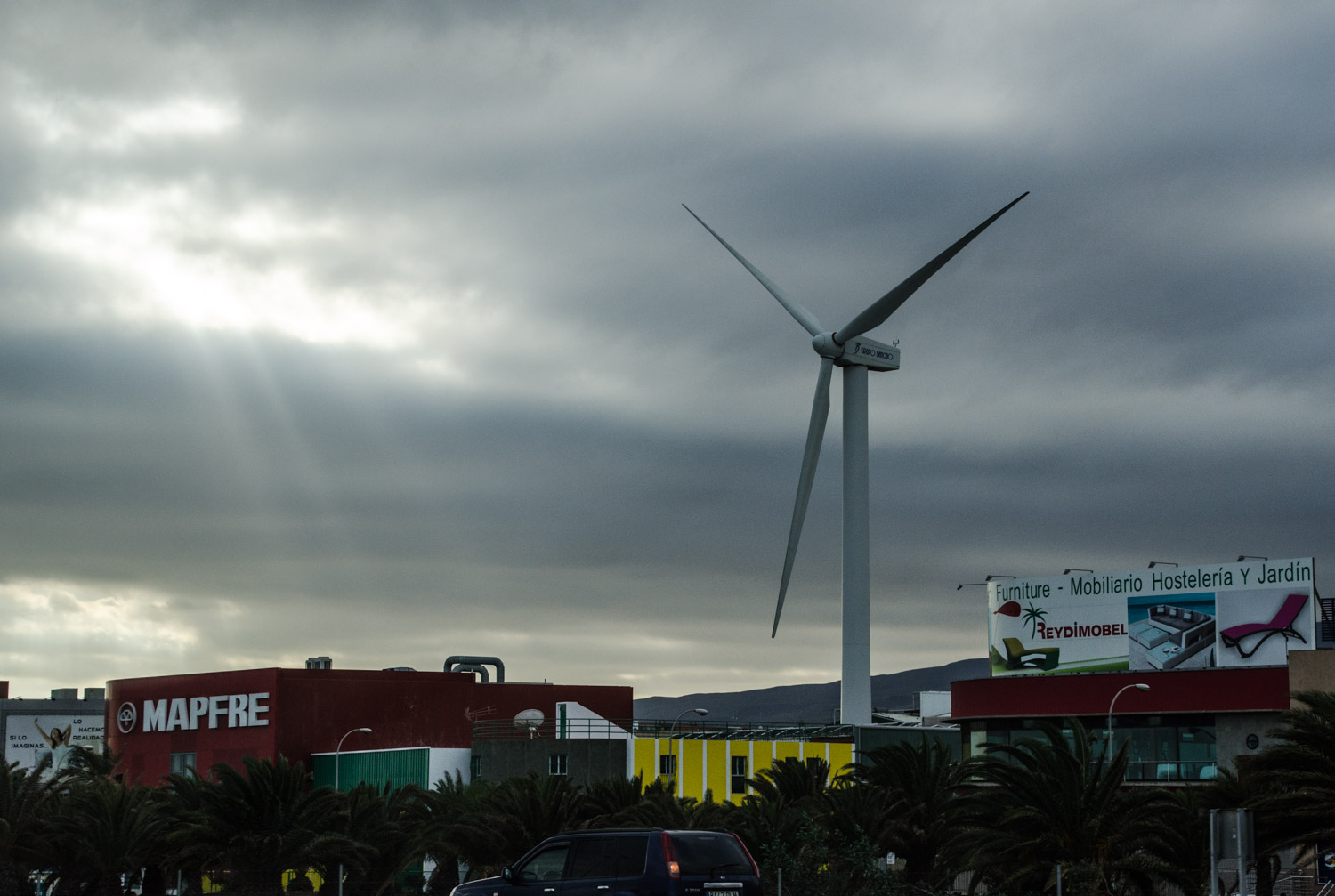
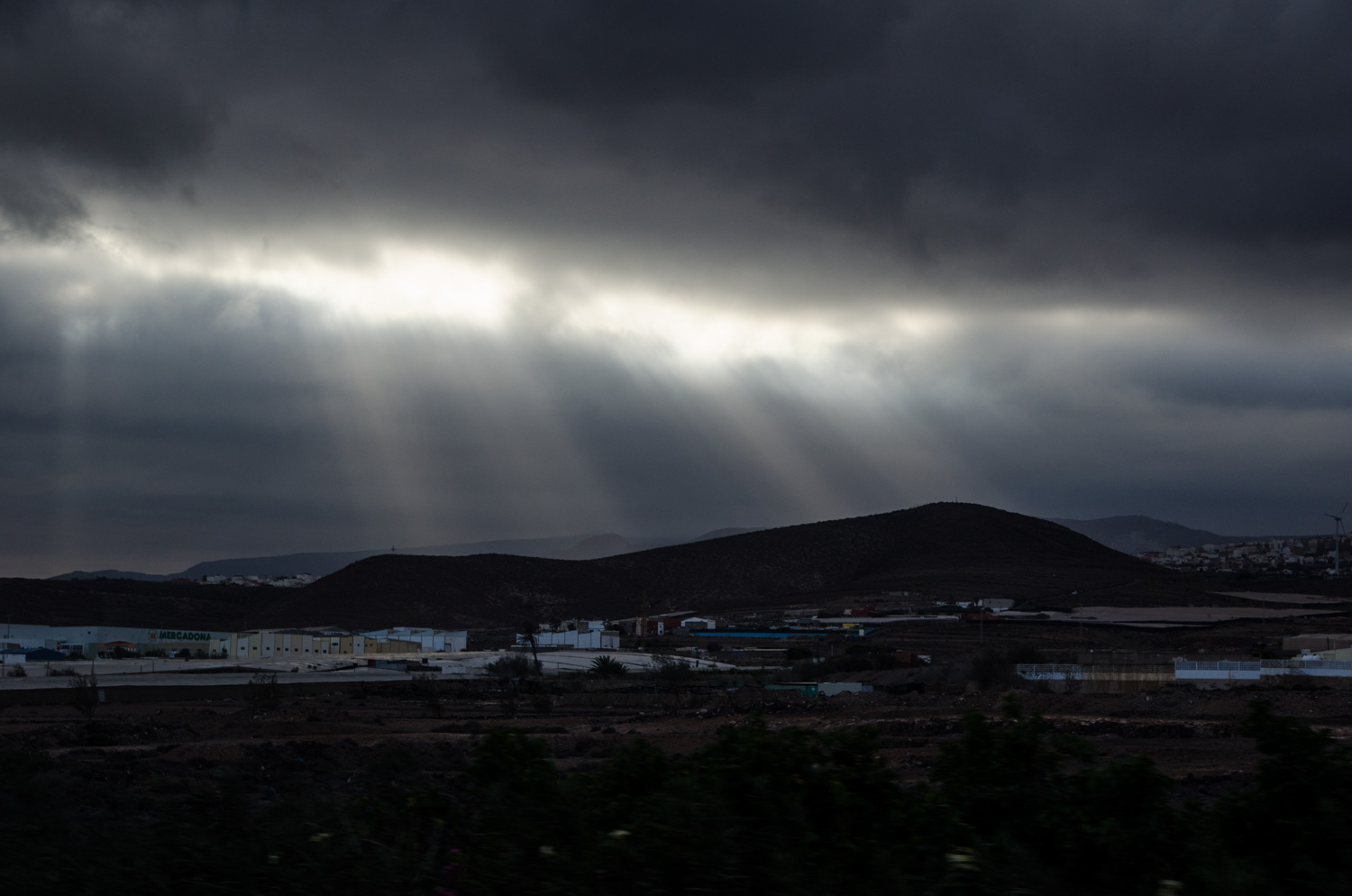
They day was turning into evening, so we had to return to our apartment. Again passing this strange wind mill. Why do you build one right in the factory- and shopping ghetto?


WPC: Experimental

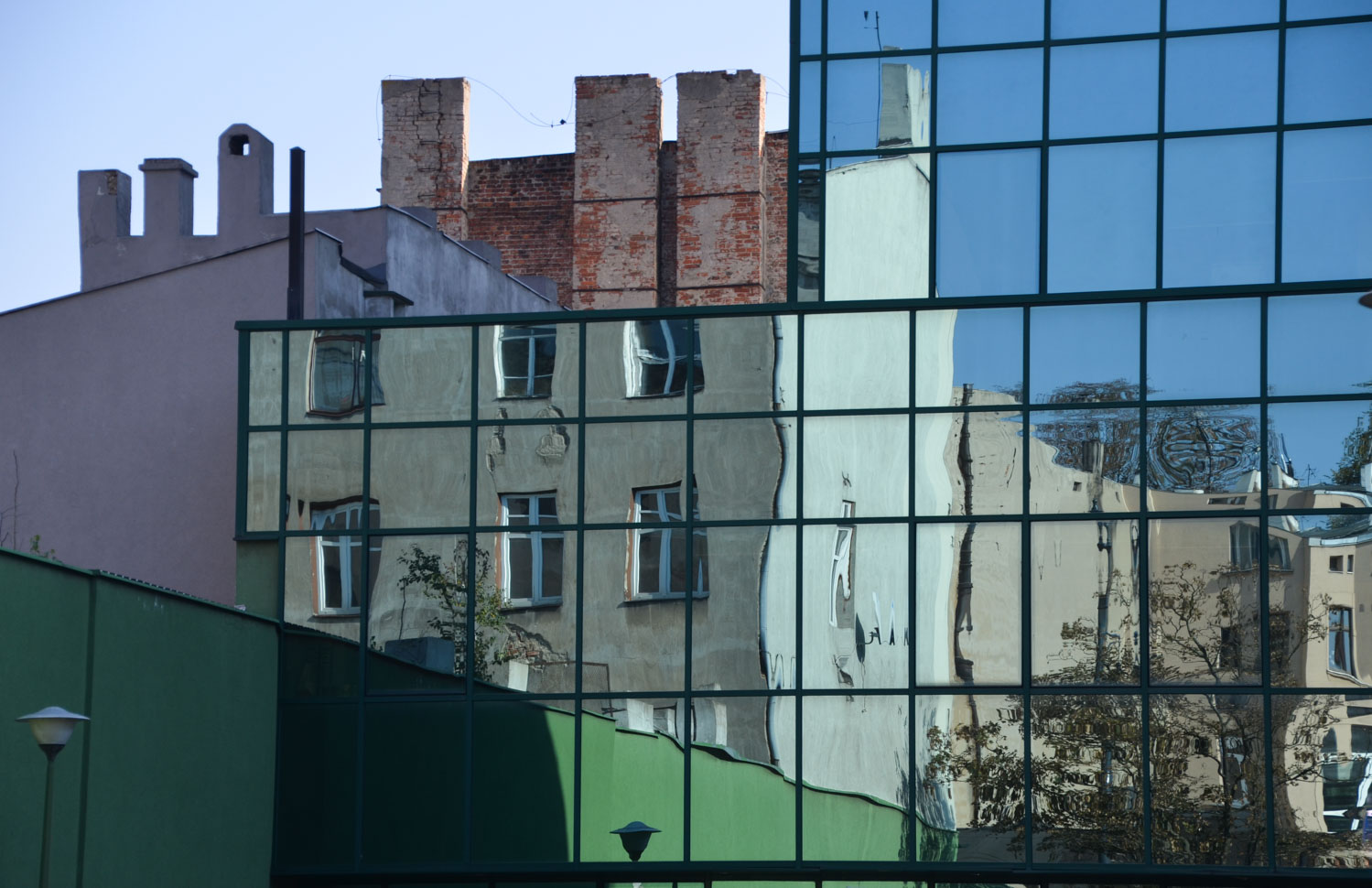
Experimental…at least maybe a little. I love mirrored motifs, and often cannot resist taking a photo. Here, in Lodz, I was just going to press the button…when I realized the photo might be a bit more intriguing if I chose to enclose the ”real” buildings to the left of the house as well. What is really ”real” in the picture and what is ”unreal”?

Was the result of the experiment a more fun/interesting picture or not? Well, as I did not shoot an alternative picture, we do not know, but we can still have an opinion!

When Is A House Abandoned?

What if you found an old house, seemingly abandoned – but…

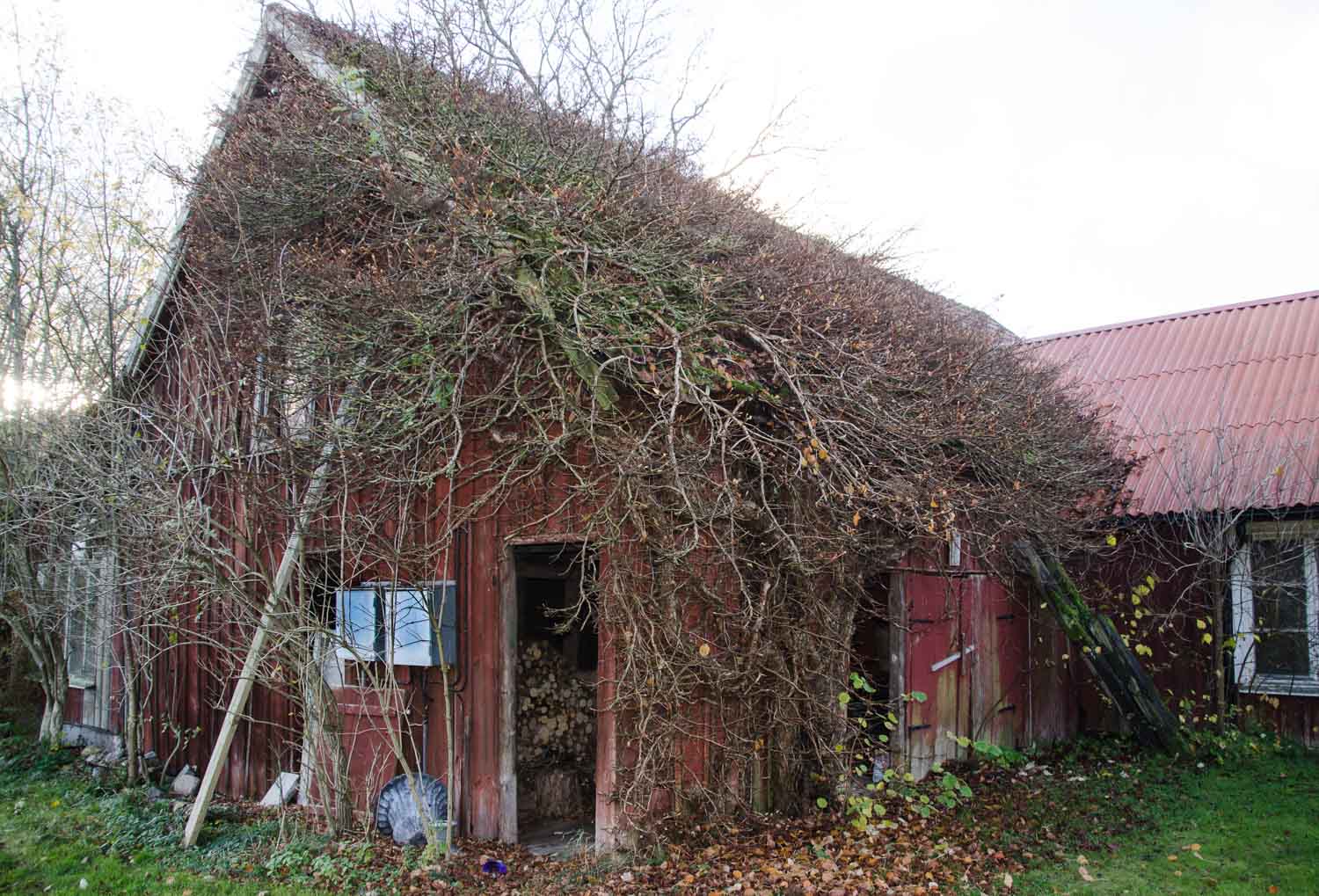
…how do you really know if it is? I walked in to this old farmyard, with houses built  around it on every side. I remember the place from when I was young, it was really beautifully painted and the garden roses were well kept – I always admired it from the roadside. Unfortunately,  nobody remembers the old owner’s name.

For many years it was the home of an artist, named Thomas, who worked pottery and was rather famous in the southern part of Sweden. I think I still have some of his cups and mugs at home. When he sold the house, nobody lived there for some years. We always thought it was a pity to let go of such a lovely place.

In later years it was used by a theater group for outdoor performances during summertime. The building to the left is only a  backdrop, while the right one is a real house. As you can see…someone is still keeping the grass at bay, even mowing the lawns.

When is a house really abandoned? When nobody lives there, or when nobody even bothers to keep it ”alive”? Inside the yellow, main building, I could see (through the windows…) that there was a rather modern kitchen, carpets on the floor and even a bowl of walnuts on the table.

And, someone has stored a whole winter supply of firewood in the dilapidated shed.

So – somehow I do not think the house is totally abandoned, but I haven’t seen a living soul here for the last 15 years. Maybe I should keep an eye on it from now on – just because I am curious about its history. What do you think about abandoned houses?

Thursday Thoughts – Rila Monastery – More Than a Peek

Rilski Manastir – or Rila Monastery – I let you have a peek some days ago…now, let us go inside – hopefully you will love it as much as I did!
An old friend of mine left us a hint about it… and so we went for a day to the Rila mountains and the monastery. This turned out to be the most fantastic experience we had during our four days in Bulgaria.

The Rila Monastery is the largest and most famous Eastern Orthodox monastery in Bulgaria. 1,147 m (3,763 ft) above sea level, hidden inside Rila Monastery Nature Park. The monastery is named after its founder, the hermit Ivan Rilski, or Ivan of Rila, (876 – 946 AD), but today houses 8 monks only.

According to Wikipedia, and our guide, the Rila Monastery is regarded as one of Bulgaria’s most important cultural, historical and architectural monuments and is a key tourist attraction for both Bulgaria and Southern Europe.
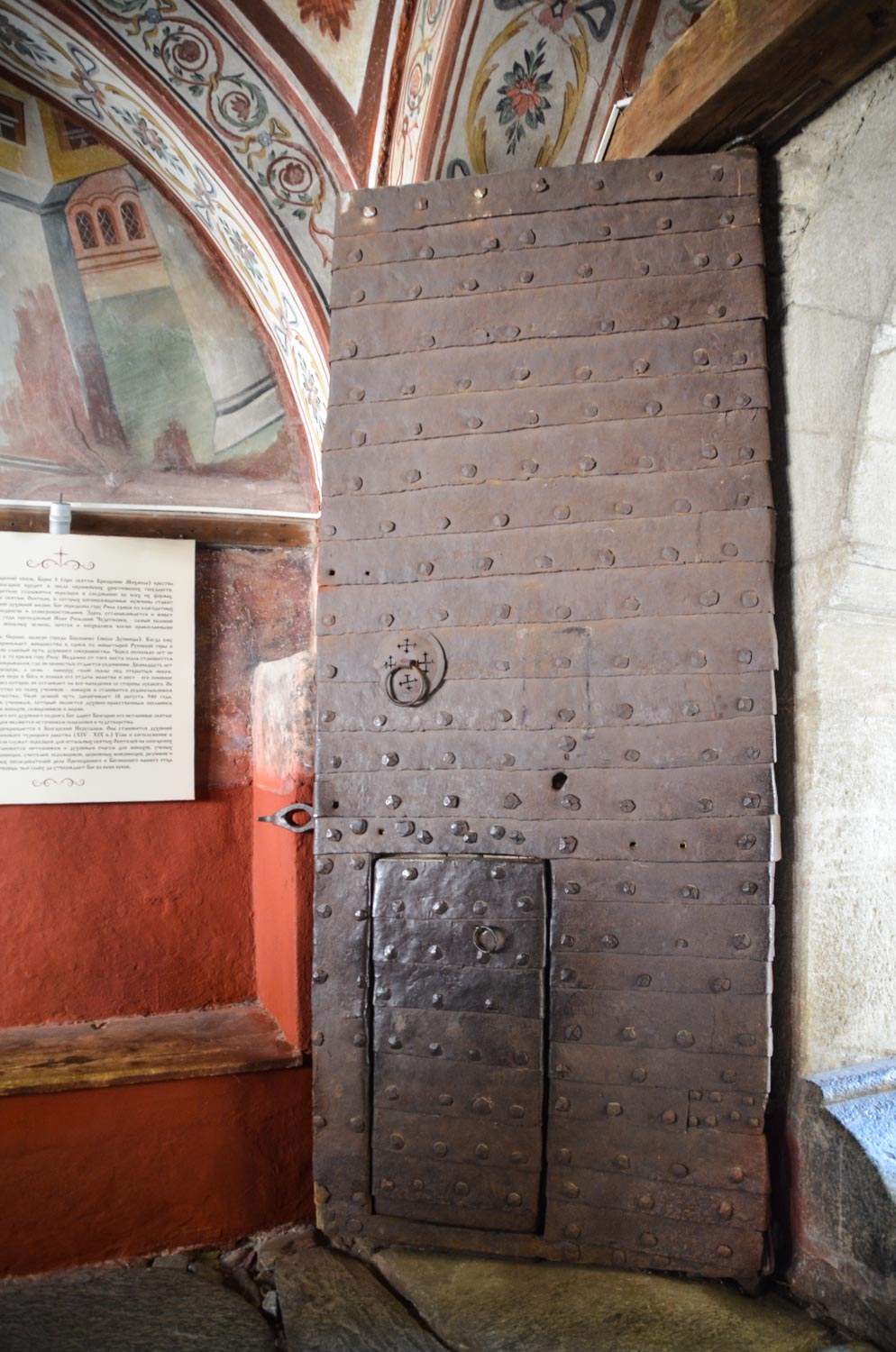
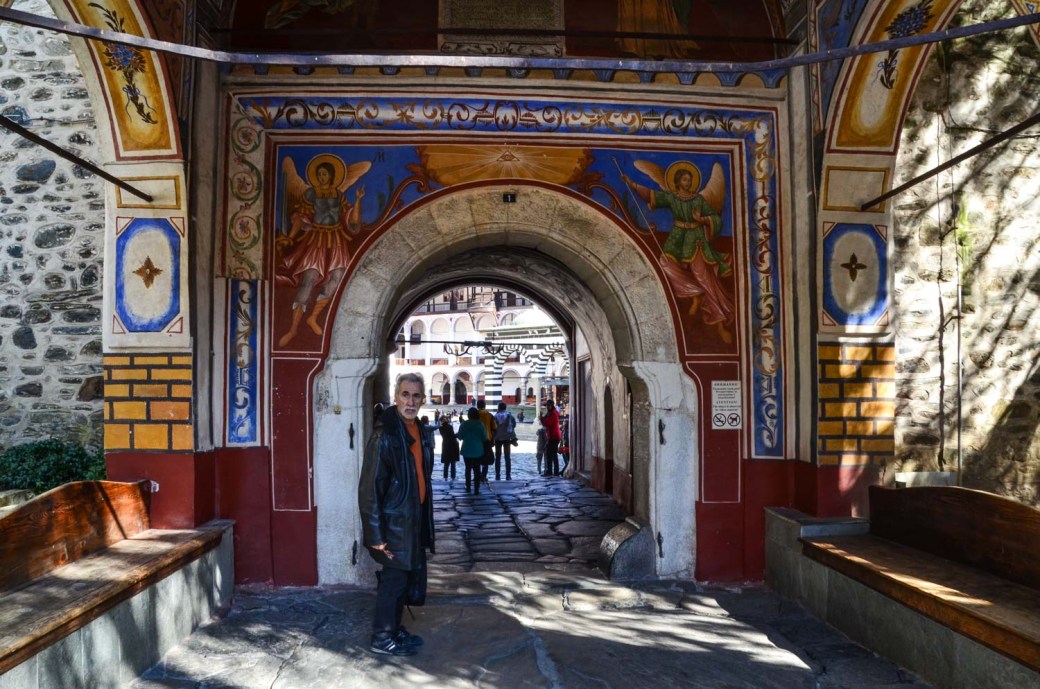
The old doors of the monastery were huge, to protect them from intruders. No weapons or armor were tolerated inside, so visitors had to enter through a tiny door, unarmed.

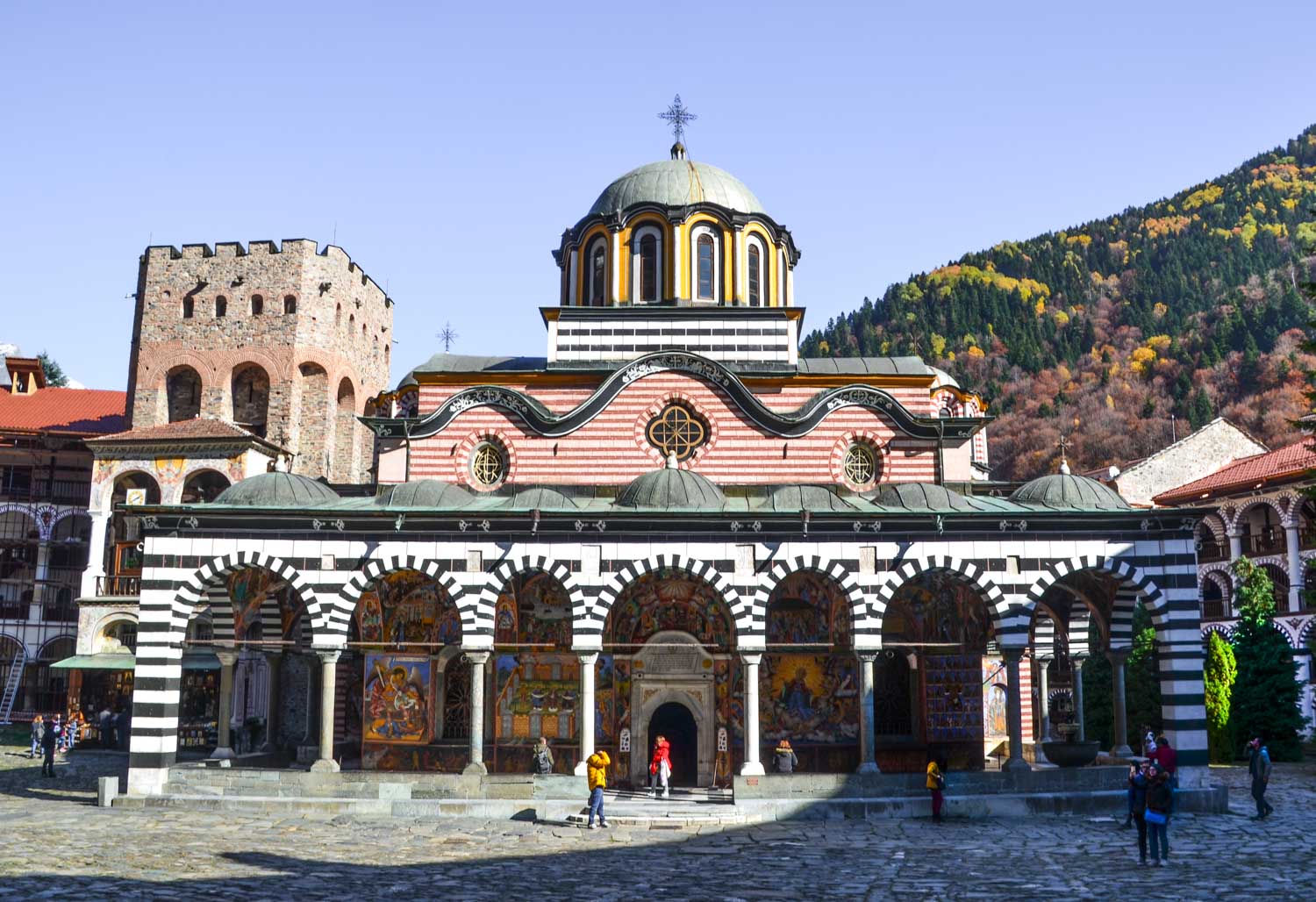
This is what you will find when you enter through the door. Burnt down and ravaged through the centuries, the buildings have been rebuilt several times to its former glory.

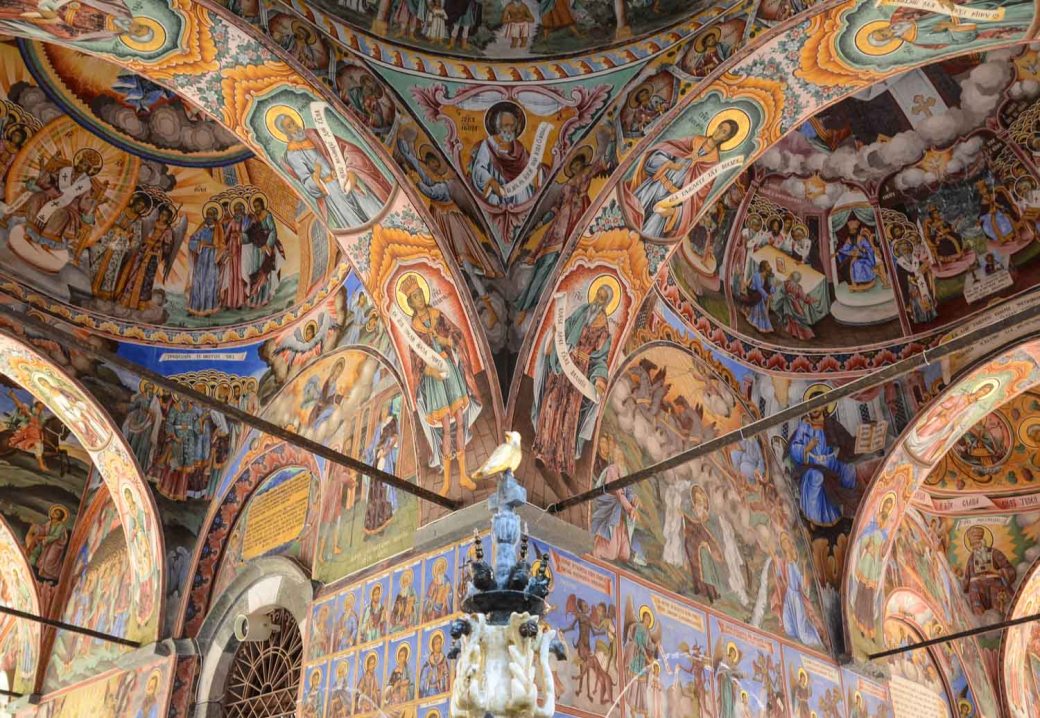
The main church of the monastery was erected in the middle of the 19th century. Its architect is Pavel Ioanov. The church has five domes, three altars and two side chapels, while one of the most precious items inside is the gold-plated iconostasis, famous for its wood-carving. No photos allowed, of course… The beautiful frescoes, finished in 1846, are the work of many, for me unknown, masters from Bansko, Samokov and Razlog, including the famous brothers Zahari Zograf and Dimitar Zograf. The church is also home to many valuable icons, dating from the 14th to the 19th century. Porticos in the courtyard have Mamluk influence with the striped painting and the domes, which became more popular in the Ottoman Empire after the conquest of Egypt.

The Rila Monastery was re erected at its present place by Hrelyu, a feudal lord, during the first half of the 14th century. The oldest buildings in the complex date from this period -— the Tower of Hrelja (1334–1335) and a small church just next to it. The bishop’s throne and the rich-engraved gates of the monastery also belong to the time. However, the arrival of the Ottomans in the end of the 14th century was followed by numerous raids and a destruction of the monastery in the middle of the 15th century.

The museum of the Rila Monastery is particularly famous for housing Rafail’s Cross, a wooden cross made from a single piece of wood (81×43 cm). Magnificent – but No photos allowed of course. The cross was whittled down by a monk named Rafail using fine burins and magnifying lenses to recreate 104 religious scenes and 650 miniature figures. He worked for 12 years to finish the cross, and it was completed in 1802, when the monk lost his sight. Stock photos.

The monastery complex, regarded as one of the foremost masterpieces of Bulgarian National Revival architecture, was declared a national historical monument in 1976 and became a UNESCO World Heritage Site in 1983.

On 25 May 2002, Pope John Paul II visited Rila Monastery during his pilgrimage to Bulgaria.

Seldom have I taken so many photos of one single building complex, but I also waited a long time…to finally catch one of the 8 monks on a photo!

My favorite fountain – and I would return to it at the end of the day…

Not to be forgotten is that this monastery is ”alive” and working. You can rent a room for the night  – simple or luxury – and we saw the laundry coming out and the gardener pruning his pot plants.

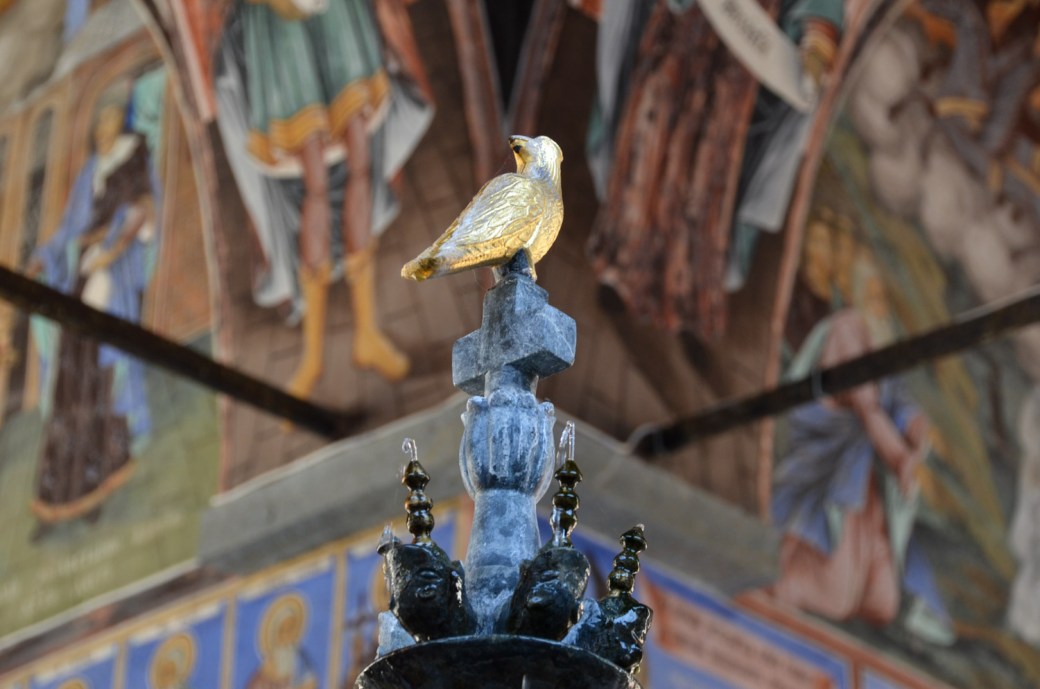
I had seen a golden bird sitting somewhere, in a broschure? – I was sure… The whole day I was on the lookout for this bird, but could not find it. Just before the car was taking us back to Sofia, I saw him. He was just a little one, perched on top of the fountain.
Saying my goodbyes…I almost think I heard him answer –
 

Plovdiv – New Town – A Perfect Combo

The history of Plovdiv spans more than eight millennia. The numerous nations that lived here have left their traces on the twelve-metre-thick (39 feet) cultural layers of the city. The earliest signs of habitation on the territory of Plovdiv date as far back as the 6th millennium BC…

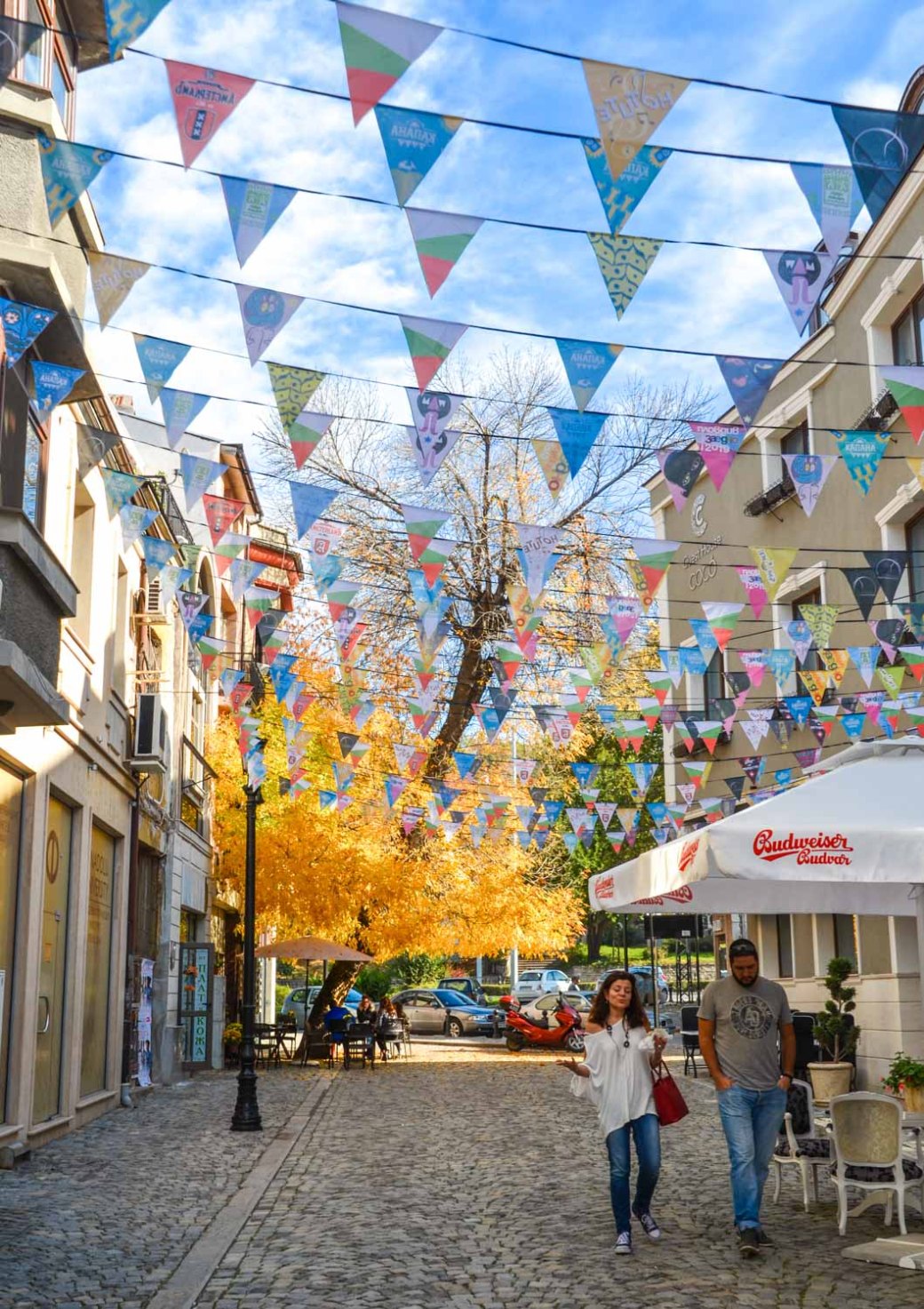
As we left the Old Town and entered the New…we realized that the whole city is a gem. Walking down the main street, a warm and sunny afternoon, the surprises unfolded – one after the other.

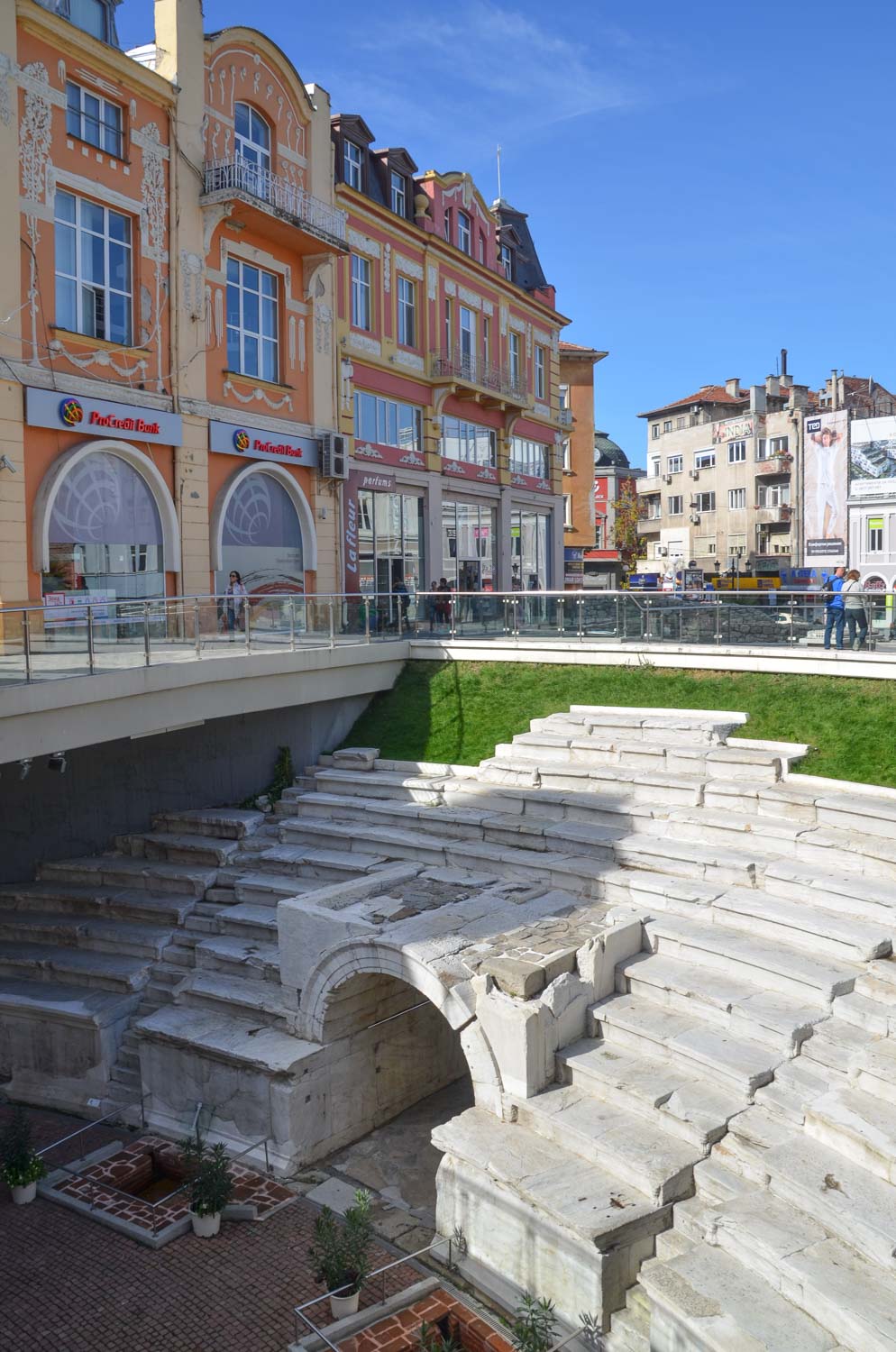
The Ancient Roman Stadium of Plovdiv was built in the 2nd century, during the reign of Emperor Hadrian, and lies beneath the main street from Dzhumaya Square to Kamenitsa Square. It was modeled after the stadium in Delphi. The Plovdiv stadium was approximately 240 metres (790 feet) long and 50 metres (160 feet) wide, and could seat up to 30 000 spectators. Below is the entrance to the stadium.

The athletic games at the stadium were organised by the General Assembly of the province of Thrace. In their honour the royal mint of Philippopolis coined money featuring the face of the ruling emperor as well as the types of athletic events held in the stadium.

Only a small part of the northern section with 14 seat rows can be seen today; the larger part lies under the main street and a number of buildings.

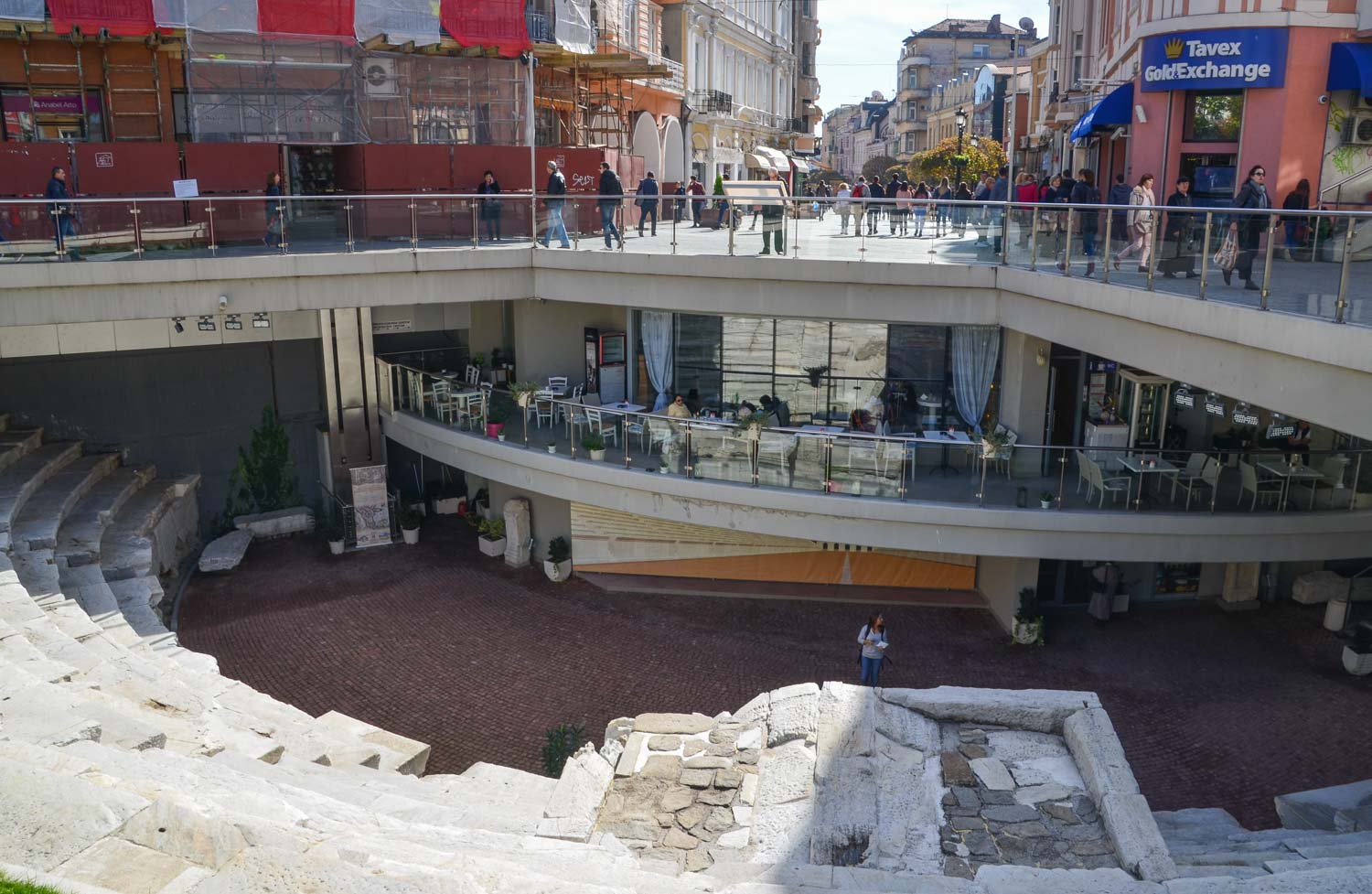
But, you can step down through the layers and meet the combination old/new in a very fascinating setting, with café’s, shops and …steps and stairs from different times.

Atlas? Keeping us safe. Holding the World.

Detta bildspel kräver JavaScript.

I do not think I have ever visited a city that manages to combine the Old with the New as gracefully and innovatively as Plovdiv. I more than understand the choice of this city for European Capital of Culture in 2019. I might return then… there is much more to discover here! Maybe I will see you there – 2019?

Plovdiv – Old Town, 6th Millenium BC

Plovdiv is the second largest city in Bulgaria, with a population of about 342 000 inhabitants. Plovdiv has evidence of habitation since the 6th millennium BC, and is said to be one of the oldest cities in Europe.

The city of Plovdiv has a long history – and almost as many names as rulers – best known for Philippopolis, ”Philip’s Town”, as Philip II of Macedon conquered it in the 4th century BC and gave his name to it. The city was originally a Thracian settlement, later being invaded by Persians, Greeks, Celts, Romans, Goths, Huns, Bulgarians, Slav-Vikings, Crusaders and Turks.  On 4 January 1878, Plovdiv was liberated from Ottoman rule by the Russian army. It remained within the borders of Bulgaria until July of the same year, when it became the capital of the autonomous Ottoman region of Eastern Rumelia. In 1885, Plovdiv and Eastern Rumelia joined Bulgaria.

Having read this…and more – we just had to go there. What would a city like this look like? So many conquerors and rulers, so many different ideas, art and architecture.

So, contemplating this on the bus, the beauty of the landscape and the snow capped mountains kept our eyes open.


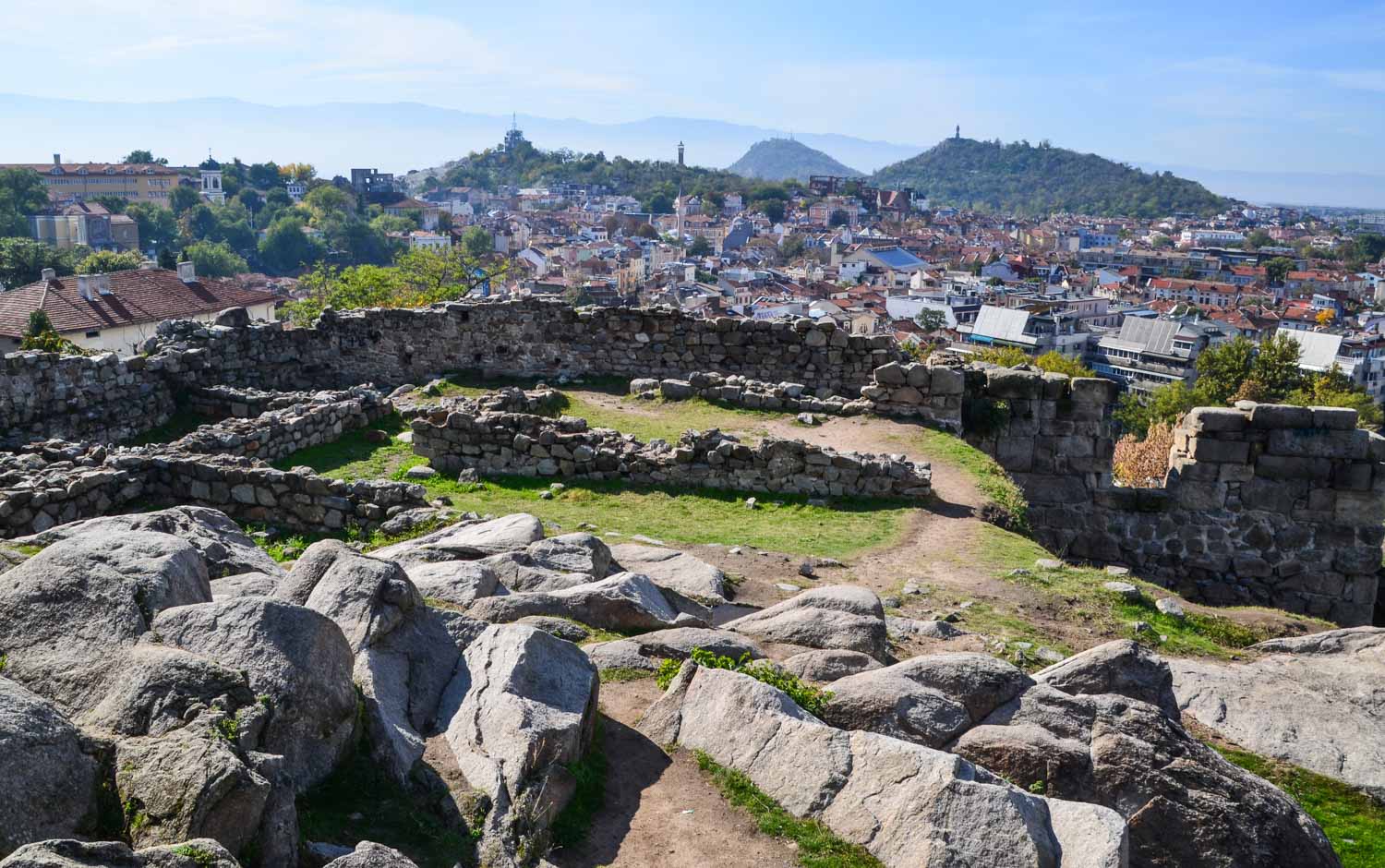
The old town in Plovdiv is located on three of Plovdiv’s (originally seven) hills: Nebet Tepe, Dzhambaz Tepe and Taksim Tepe. Today there are only six hills left, because the seventh one was taken down to become cobble stones for the streets.  The old town in Plovdiv is included in UNESCO World Heritage tentative list since 2004.

At first we could walk peacefully in the quiet streets…but then it seemed every school in the neighborhood flooded the alleyways.

Our main goal was the ancient theatre – with seats today for 3500 people. (Originally for 5000-7000 people).

The Roman theatre of Plovdiv is one of the world’s best-preserved ancient theatres. It was constructed during Roman Emperor Trajan (reigned 98–117 AD), and it is currently in use for operas, concerts, plays and more. The theatre was restored in the 1960’s, and is one of the most valuable monuments from the ancient city of Philippopolis.


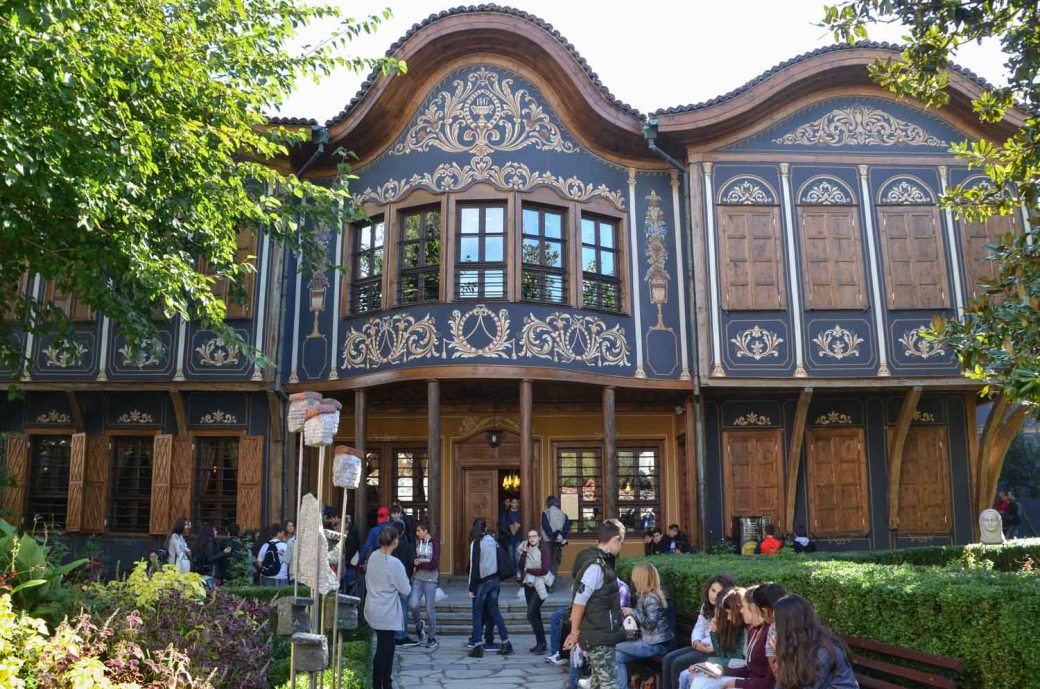
The house of Argir Hristov Kuyumdzhioglu, a merchant from Plovdiv, was built in 1847, and has been described as a prime example of Plovdiv’s mid-19th century Baroque architecture. The house has a symmetric facade; it is two stories tall on its west side and four stories tall on its east side. The Kuyumdzhioglu House spreads over 570 square metres and has 12 rooms and airy salons (where each room has a carved wood ceiling)- and 130 windows. Both the house’s interior and exterior boast sophisticated floral motives. The municipality bought the house in 1838, carried out renovations, and organized it as an ethnographic museum.

The lonely tree might not be very old, but it stands overlooking the remains of the olden days as well as the newer city. I wonder what he/she is thinking?


It Is All About… Books!

Books, books…art and culture. One of the reasons to why I love visiting the eastern countries in Europe is just that. I get my share of childhood joy and my faiblesse for books.

Inside, there are more than 8 million books. Just think about all the catalogues there must be…these were only a few. Do you remember the era before the digital boom?


This is the outside of the National Library. Slightly resemblance to…books on shelves?

The outdoor book market was a dream – even though I did not understand much and could not buy that many books. You can always look, and be tempted! As you can see in the header, many other things could be bought here as well.


The ordinary library for grown-ups had a typical touch of the communist era. (Bulgaria was not liberated until the 1980’s.) Colours, shelves, floor and …books. Almost all the books were paperbacks – no hardbacks. And they were all ”well” read.

Even the benches outside were dedicated to books!

The entrance to the childrens library had an unmistakable sign…our Swedish Pippi Longstocking. Did you know she has been translated into 92 different languages? Astrid Lindgren still belongs to the future!

The children’s library was much more modern, and the reading rooms had furniture and curtains from IKEA.

The ladies working here were very helpful and informative. We had an invigorating chat about children and books. No problem in this country with reading – most children love it. And for small children the books are free to borrow. Older children had to pay a very small sum/year.

Beware of book worms – Bulgaria is a dream country!


Cultural Café

We wanted to visit the National Palace of Culture in Sofia, but it was closed and a veritable construction site. I was dying for a nice cup of coffee along with some cultural events…but the building seemed totally abandoned.

Nothing wrong with a construction site…if you can find a place like this when you step down into the underground..

A slight drizzle, and my stomach was making sounds…but when we had totally given up on this place and walked down some steps to get to the street again – suddenly there emerged a big window with BOOKS. From nowhere. Nothing with books can go wrong, so we opened the door and stepped inside…

…a café! A place reminding me of my university years with not too expensive coffee’s, nice company and working in two’s or more. My eyes and spirits went up and I just took it in…..feeling the coziness and the warmth instead of the by now rather chilly, hostile weather outdoors.

We stayed for an hour at least and left with big smiles on our faces ;-D

It went on drizzling – but we felt good all the way home! Keep reading! And…some tea is OK as well…

Seven Day B&W Photo Challenge – Day 7

I was invited by Raj (XDrive) to join the Seven Day B&W Photo Challenge. (Thank you, Raj)

The Rules are
• Seven days.
• Seven black and white photos of your life.
• No people.
• No explanation.
• Challenge someone new each day
Today, the last day,  I would also like to challenge everyone who thinks it would be fun to participate!