This week Elizabeth of Albatz Travels is our guest host – and she has got an exciting task for us! Please visit her site for excellent guiding to diptychs:
A diptych is two images placed in proximity to one another, forming a pair. To make a successful pairing there should be several things in common, and something very different, contrasting.
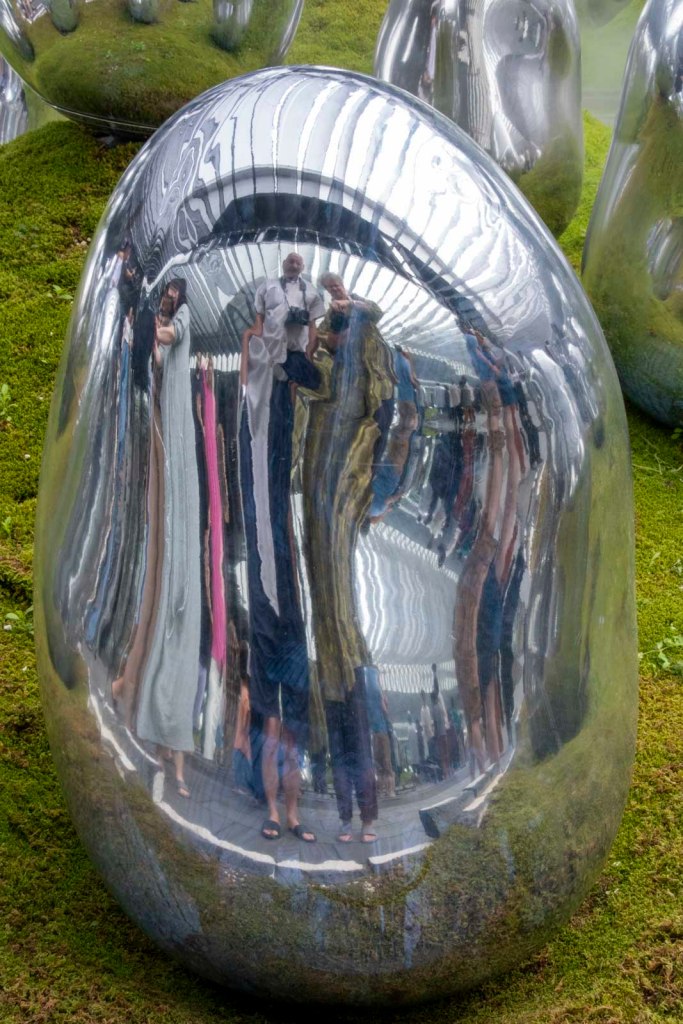
How about using mirrors?
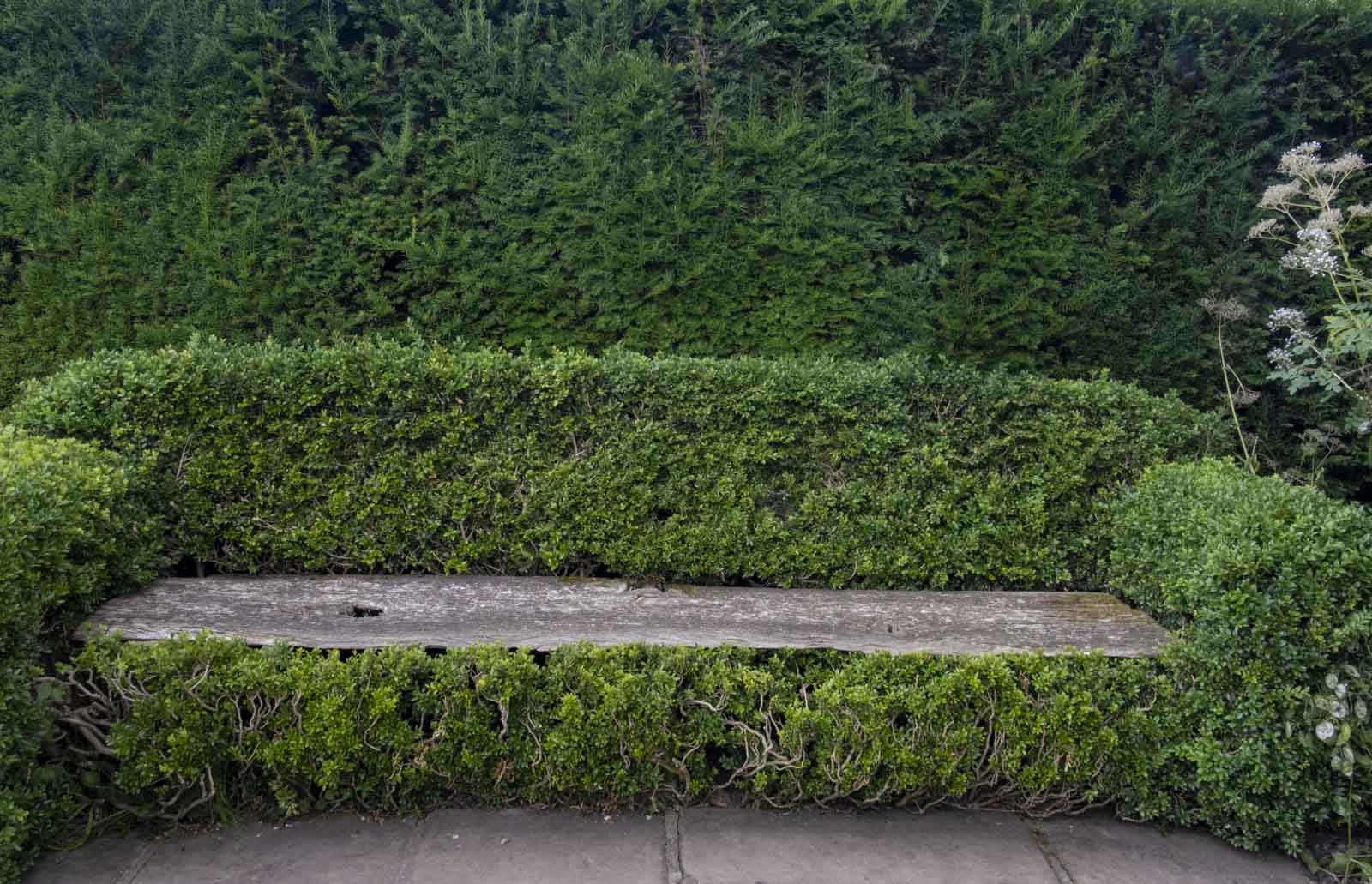
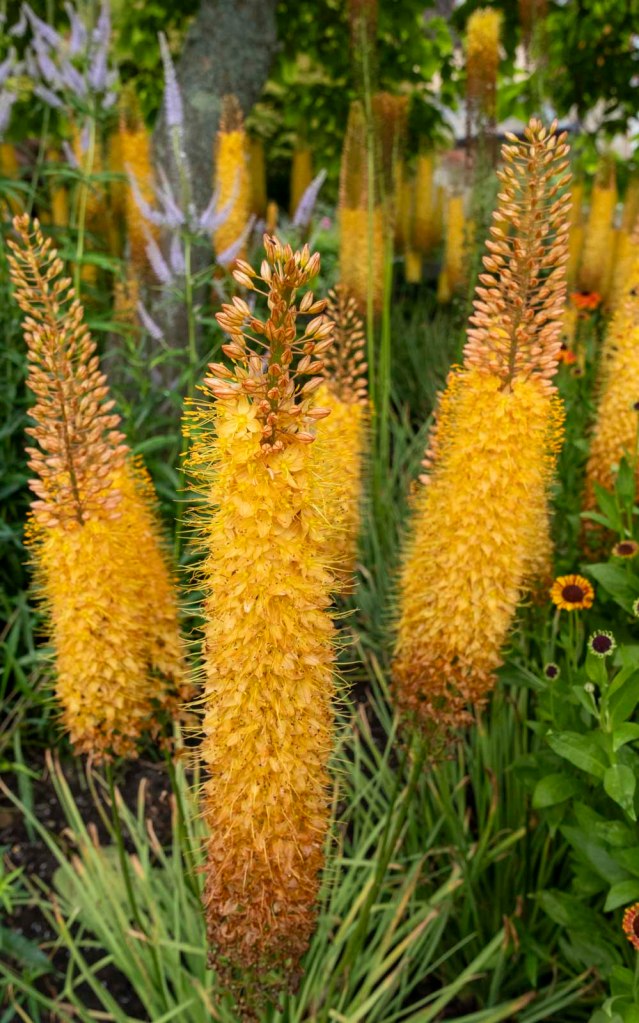
My natural(!) choice is flowers and trees. And flowers from English gardens this time.
And throughout the paths of flowery fireworks, there were Castles interspersed…
So, we will move over to totally manmade art, where wonderful wallpapers in the castles created indoor gardens as well, and a different dimension through mirrors.
Artworks are interesting, for pairings too. In Japan our visit to the teamLabs exhibition with mirroring ”eggs” was fascinating.
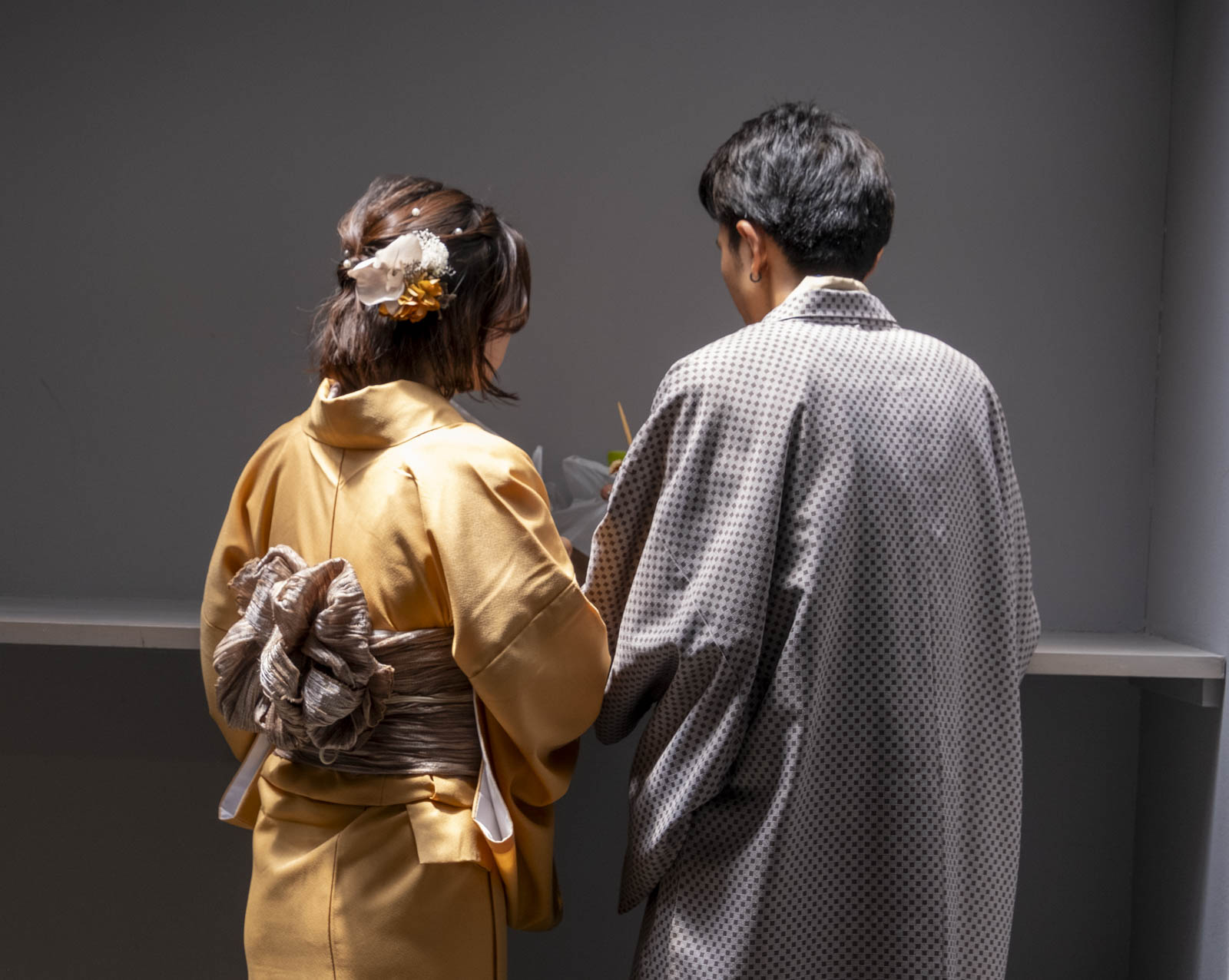
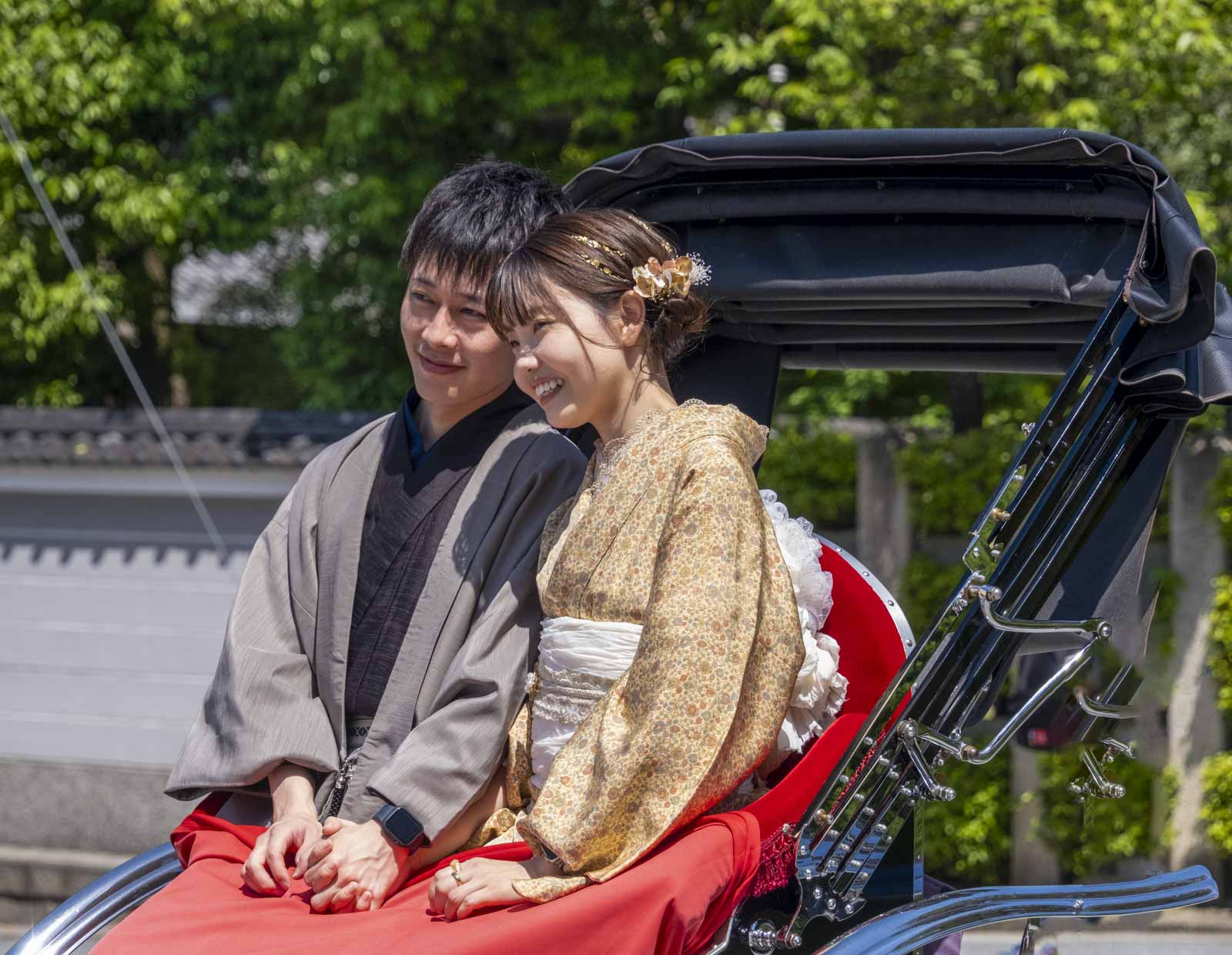
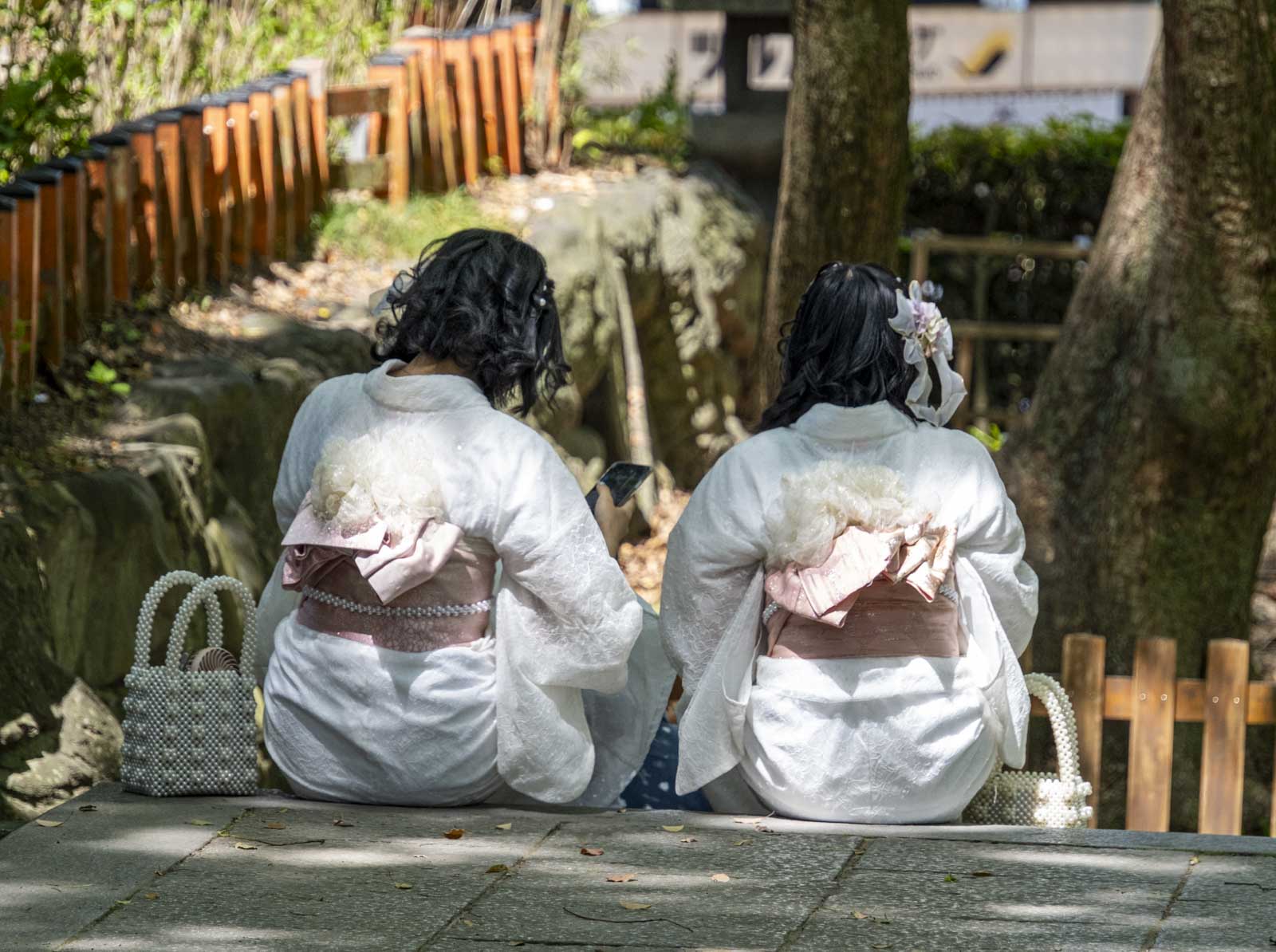
And finally, people. The Golden Week in Japan gives you endless opportunities to enjoy beautiful people and clothes. This lovely young couple is not the same as the couple in the carriage – but their outfits go so well together. In my eyes, they make the perfect pair – and pairs.
Thank you, Elizabeth for a great learning challenge!
Last week, Leanne lead us through wonderful and different “Tourist Attractions”, capturing the essence of a place. Next week, PR will explore “Balconies,” so be sure to visit Flights of the Soul next Saturday.
Leanne Cole is our fantastic host this week, and she invites us to show what the normal tourist wants to see – but in another way. ”You might go to the same place, but you are after something different.”
So her challenge is to look for those photos that are of tourist attractions, but where we have tried to get the untypical image of it. They can be near or far away in other countries.
I have just returned from a trip to England, so I am a bit late, but here we go…with Japan! Japan was a delightful country to visit this spring, and the first gallery shows some famous attractions – my way:
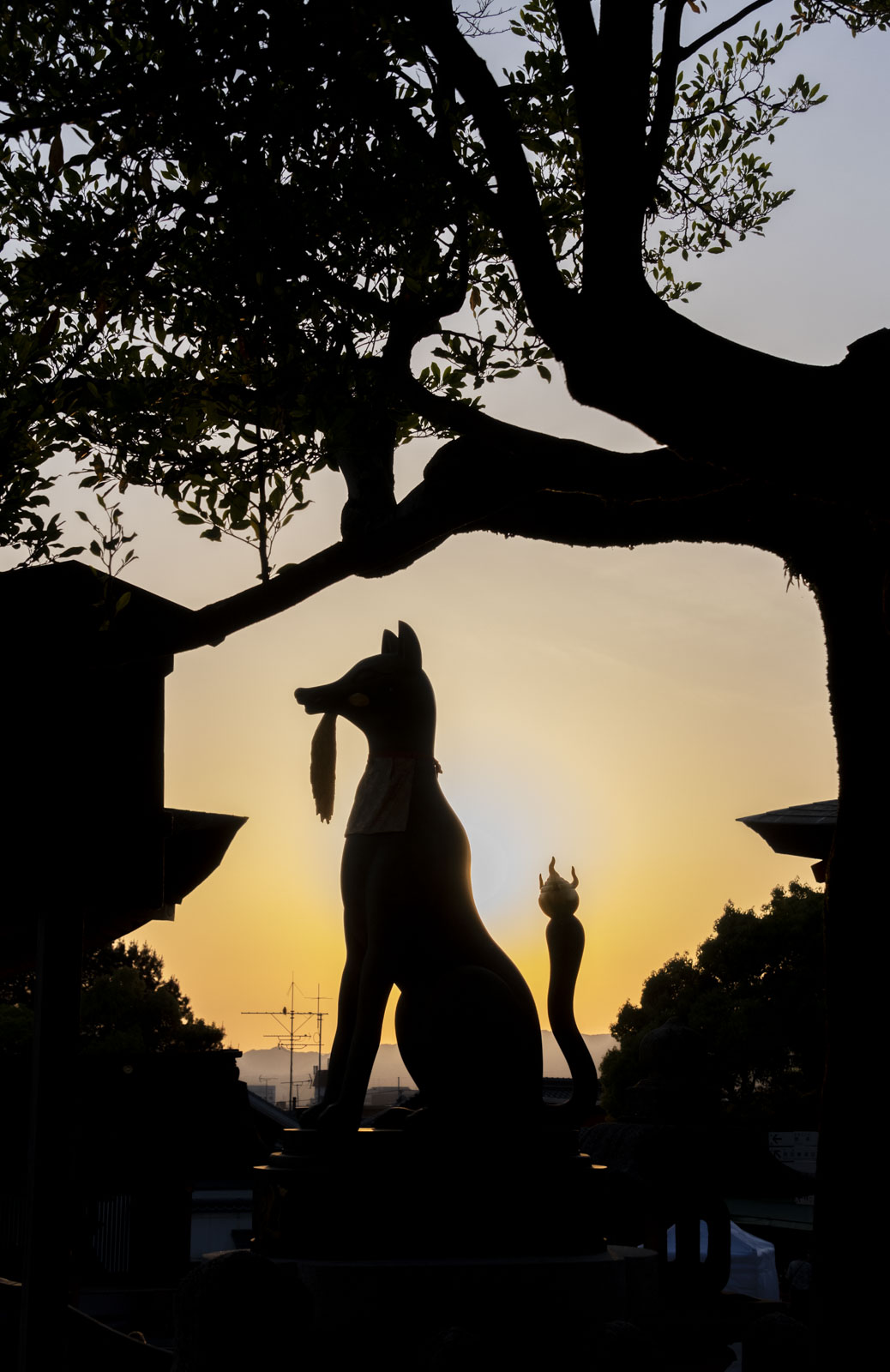
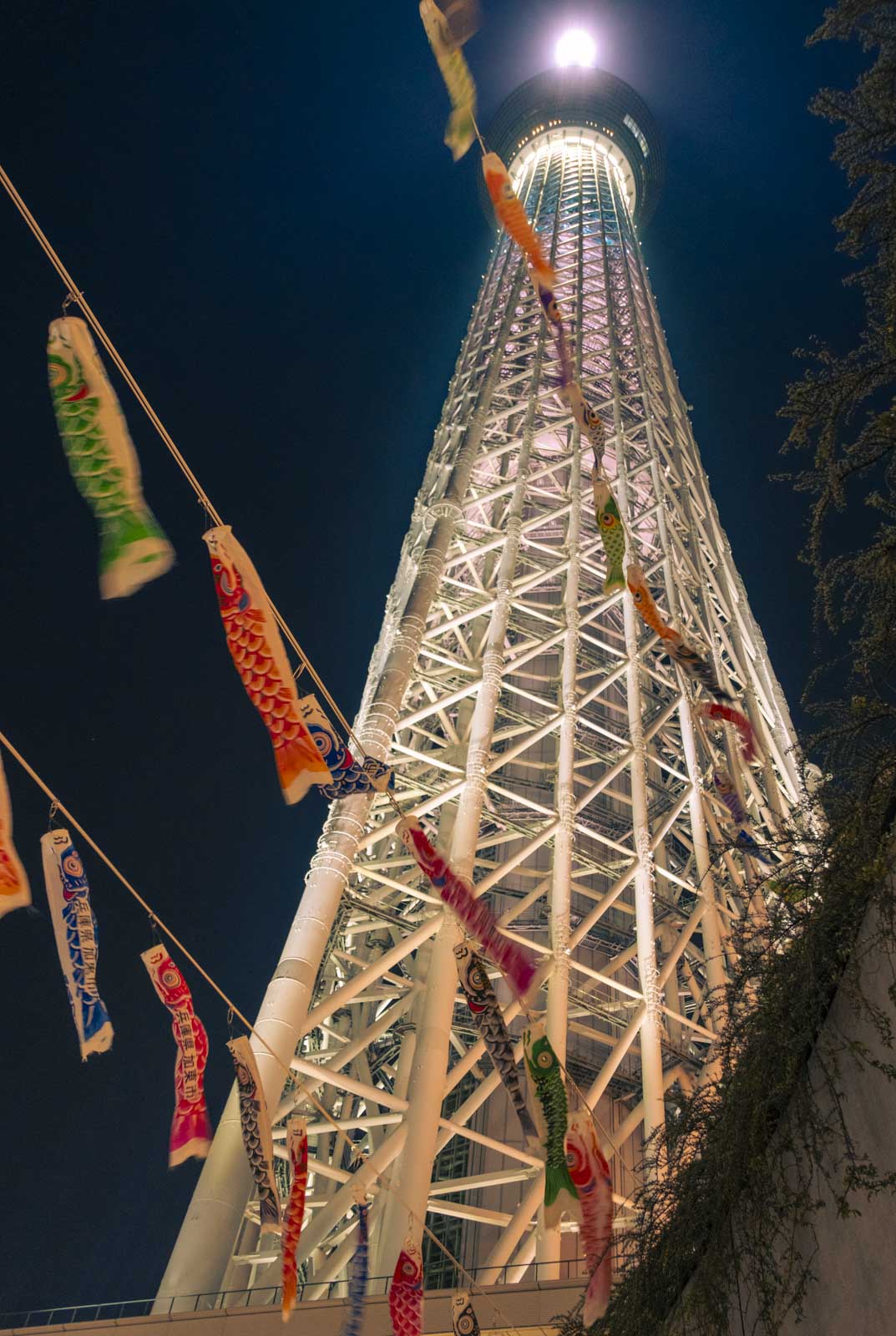
The superfast Shinkansen train, Fushimi Inari-taisha in Kyoto (Inari is the god of rice and sake and the messenger is a fox), Kawachi Fujien (The world famous wisteria garden in Kitakyushu), the Shibuya crossing in rain (- the busiest pedestrian crossing in the world with about 2300 crossings every 3,3 minute) and lastly, Tokyo Sky Tree.
From Sweden then, not that many:
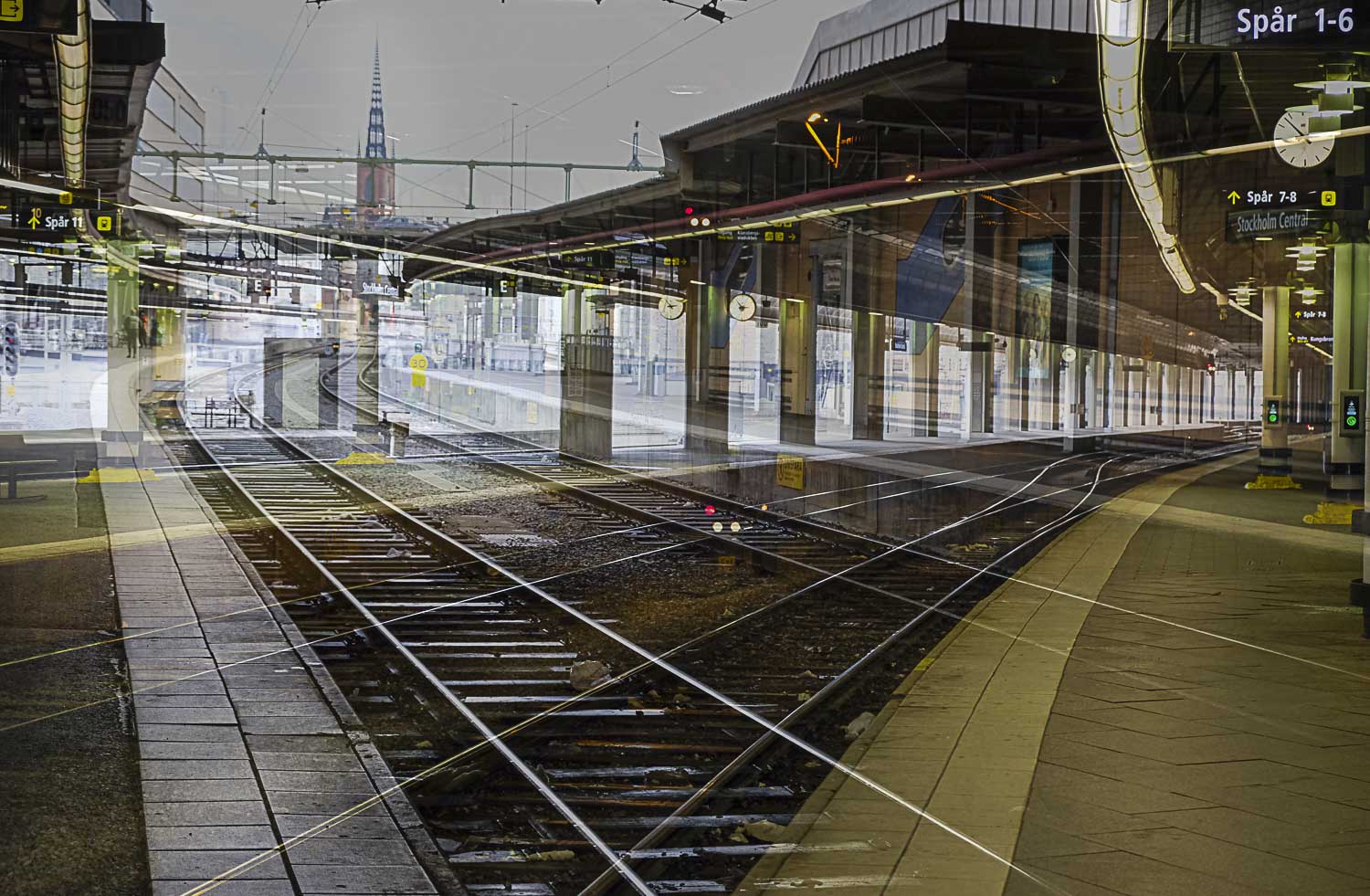
Stockholm in double exposure (City Hall and Central Station). The Doll Museum was closed, but my shot was taken through the window.
Thank you to Tina for her beautiful and thought provoking challenge on Habitats two weeks ago, and I hope you all had a lovely week off too! Thank you again to Leanne Cole for leading us this week – please visit her site for always amazing photography.
I hope you want to join in next week when our next guest host, Elizabeth of Albatz Travel Adventures, challenges us to share Pairs.
The reality today is that we are all interdependent and have to co-exist on this small planet.
– The Dalai Lama
Tina is our host this week, and she has chosen the theme Habitat. A theme close to my heart. Without habitat, there is no wildlife, and in fact, no real life. What affects a habitat are mainly two factors: biotic and abiotic factors. Biotic factors are living things within an ecosystem, (and how different species interact and work together, which decides the number of each species) and abiotic are non-living components (mainly geology and climate).
We all know what is happening to our planet and to us and our fellow inhabitants. So, What can we do…what Do we do?
The one process now going on that will take millions of years to correct is the loss of genetic and species diversity by the destruction of natural habitats. This is the folly our descendants are least likely to forgive us.
– E. O. Wilson
As ordinary humans, we might think we cannot do much, but personally I support several nature organisations, and I try to keep my footprint as small as possible. (With a bad conscience everytime I fly…) Our pollinators are crucial to our planet, and the bee is considered our most valuable species. In my little world, I strive to plant only bee and pollinator – friendly plants in the garden. About half of it is never cut down and left wild. It thrives.
Dead trees are left were they fall – and I plant climbers for them.
This is my small contribution for increasing the habitats for insects and birds. A great outcome was my find of a leopard moth here. Dead, but a rare species with gardens and orchards as their habitats. Dead trees are home to many insects.
The only way we can reduce the number of these endangered species is to improve and provide additional habitat where they can live and reproduce.
– Lorne Greene
I hope my garden will steadily become an even better habitat for many plants, insects and birds. I believe we all can do something – following the old saying ”Small streams make great rivers”. To me, this thinking makes my habitat in this world much more alive and useful.
Outside my own garden, a country that comes to mind for having sustainable habitats, is Bhutan. Bhutan is the world’s first carbon negative country. Mainly because of its extensive forests, covering 70% of the land, the Kingdom is able to absorb more carbon dioxide than it produces. How did Bhutan get here and how can the country be an example for the rest of the world? Listen to Bhutan’s Prime Minister in a TED talk on youtube .
In Bhutan, the forest is protected by law, they use their rivers to get clean energy and they subsidise the more eco-friendly LED lamps. To me maybe the most impressive thing is their biological corridors connecting protected areas with each other. Thus, the vast diversity of animals is free to roam around the country. It helps them better adapt to climate change and increase their population naturally. When we were there, we were informed that some tigers were tagged and could be followed from the south part bordering to India, and through corridors up to the snowy Himalayas. In only a few days.
It seems in Bhutan everything living coexist in a smoother way – maybe because of their faith and because of their government’s decisions on the importance of biodiversity. In the cities too, we found space was gladly shared among different species. A comfortable, common habitat.
I hope you’ll join us this week to explore the habitats of both human and animal ”residents”. Be sure to link to Tina’s post, and to use the Lens-Artists Tag to help us find you. Also, our big thanks to Egidio whose 2 Rectangles challenge gave us a chance to learn something new, and proved that many of us did not know about this, but were often using it anyway.
As in previous years, the Lens-Artists team will be on hiatus for the month of July. There will be no challenge on the 6th, but the rest of the month will be led by several amazing Guest Hosts. They include:
July 13: Leanne of Leanne Cole explores TOURIST ATTRACTIONS
The Lens-Artist team will be back on August 3 when Patti once again leads us on her Pilotfish Blog. Until then as always please stay safe, be kind and enjoy the adventure.
Looking for more information on joining our challenge? Click here.
Egidio goes for rectangles, and once again I’m finding I’m following a compositional rule without knowing it! He challenges us to show how we use rectangles in our photographs and how they help our composition.
This is an image from Cisternerne in Denmark, an underground water reserve.
It is somewhat similar too these beautiful Tori’s in Japan.
I don’t know if you can say these are rectangular – because they end up in a curve – but, yes, I think they are.
Back home, these are strawberry tents, covering up the plants to make them grow faster.
And there are loads of rectangles in this one, caught at Kyoto Railway Station, Japan.
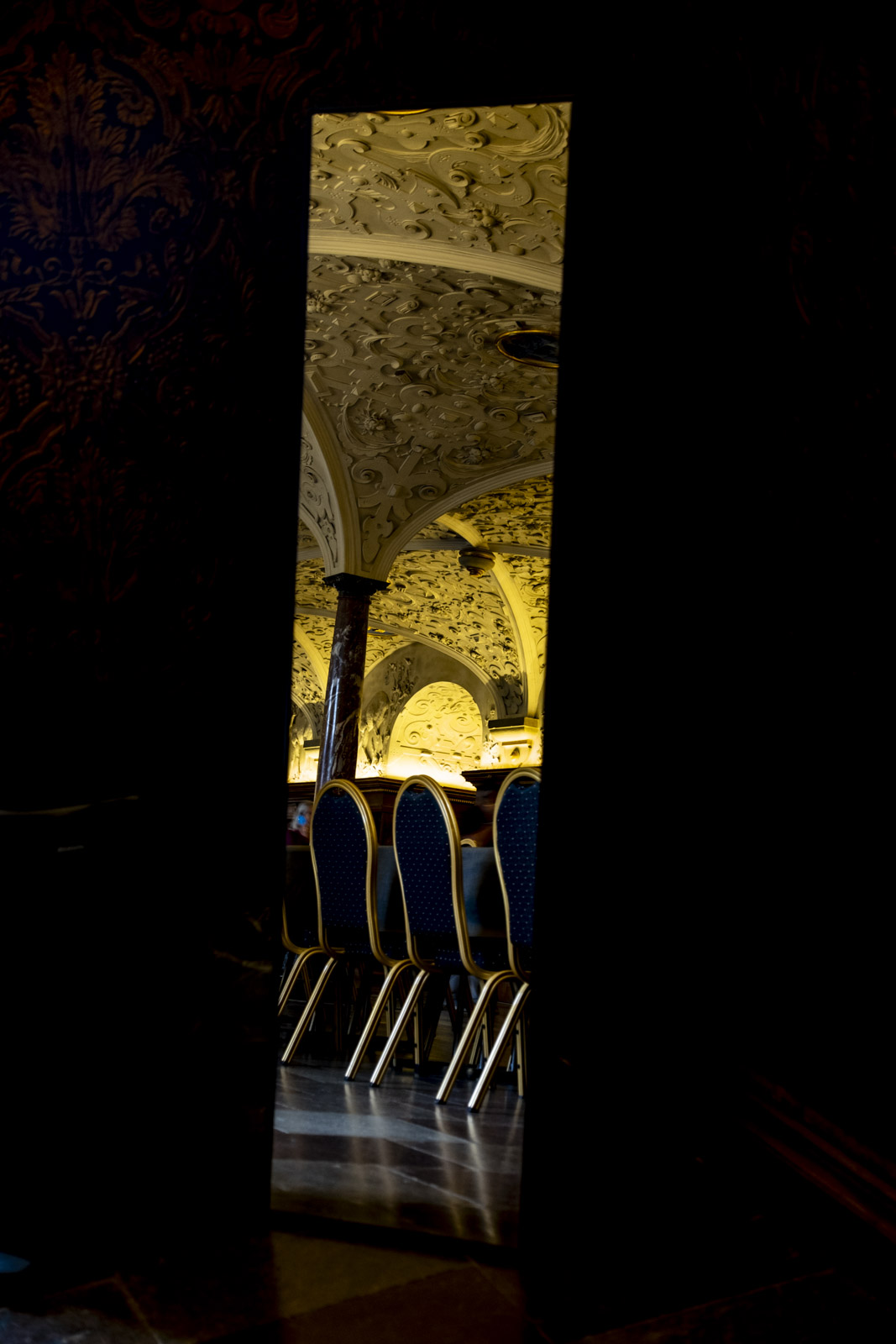
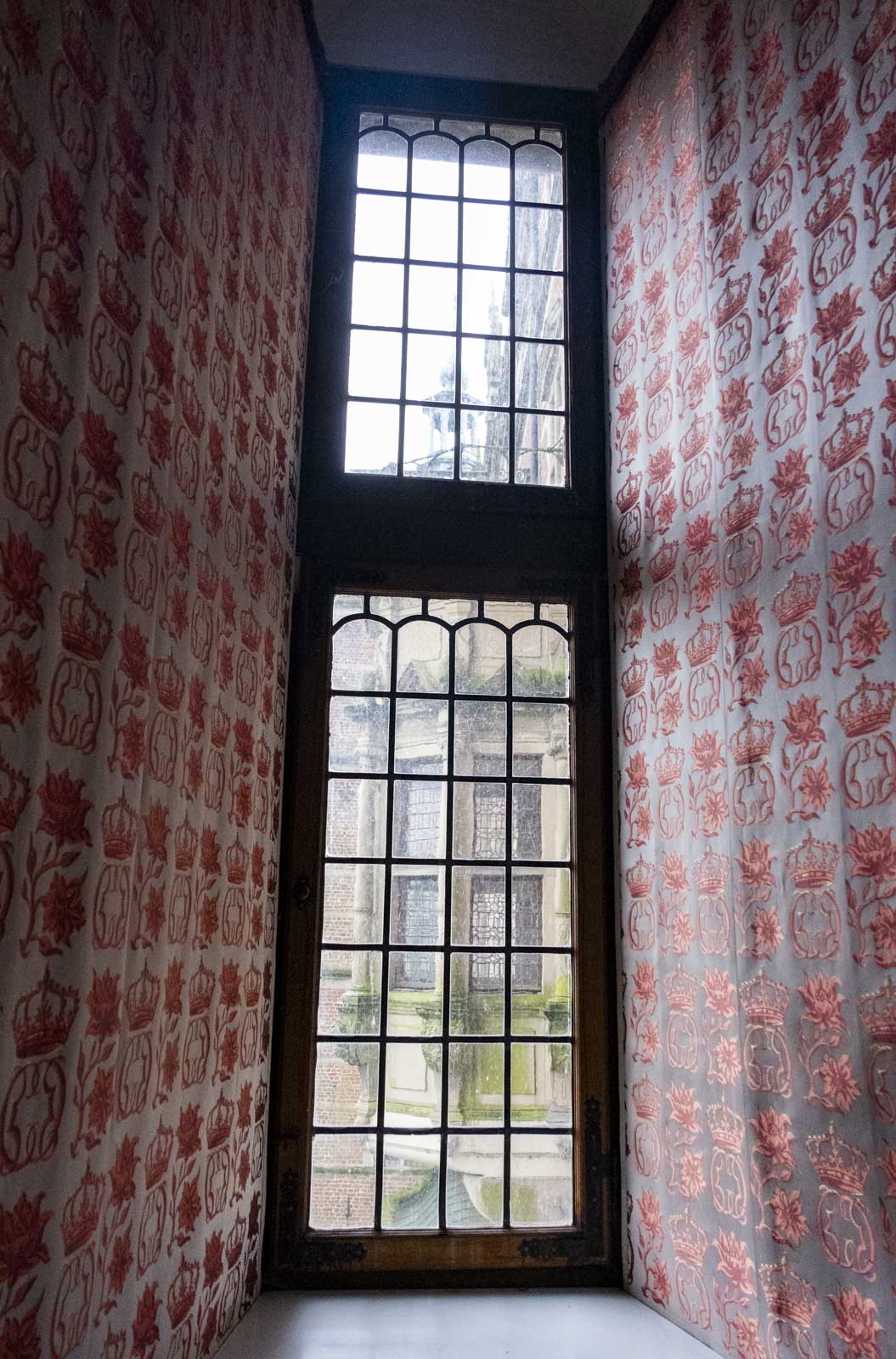
These three images are from Fredriksborg Castle in Denmark. The left one is a mirror in a dark room, in the middle is the fantastic Chapel and the last one is a narrow alcove in the same castle.
These two reflections stand out to me.
The garden is Ashikaga Wisteria Garden. We went in the evening to see it lit up.
Some favourites from that night in the wisteria garden.
So, we would love to see your photos with two rectangles. Let your creativity flow. And please remember that pingbacks do not work on Egidio’s site. You need to put your link in the comments. The “lens-artists” hashtag makes it easier for others to find your post too.
Last week, Ritva focused on backgrounds and how they affect our composition. What beautiful images you shared! Excellent and creative. Next week, Tina will share another fascinating challenge on Saturday, 12 noon (EDT in the USA). Stay tuned. Please see this page to learn more about the Lens-Artists Challenge and its history.
As those who follow her know, Lens-Artists team member Donna of Wind Kisses is taking a break from blogging for personal reasons. She will be very much missed but, hopefully be with us again before too long. We wish Donna and her family only the best, as our thoughts are with all of them.
Ritva is giving us a real treat this week – showing how to use the background to enhance our compositions. What makes your subject shine? A good background is essential to any picture.
Please visit Ritva’s beautiful site for more inspiration and examples!
I will choose some of my favourite techniques for the background to enhance the subject. Backlit late evening poppies create a positive, soft blur around the flowers. This is clearly one of my favourites as I often photograph insects and flowers.
Using negative space is efficient to highlight your subject against a minimal background. How lucky was I to see a woman in RED walking down the stairs when I had my camera ready?
We can harmonize or contrast colours for visual impact. Here I wanted to enhance the filmish feeling by using B&W.
Colour harmony again –
– to the left a totally green picture with an interesting, overgrown branch, and to the right the old red train running in the contrasting green surroundings.
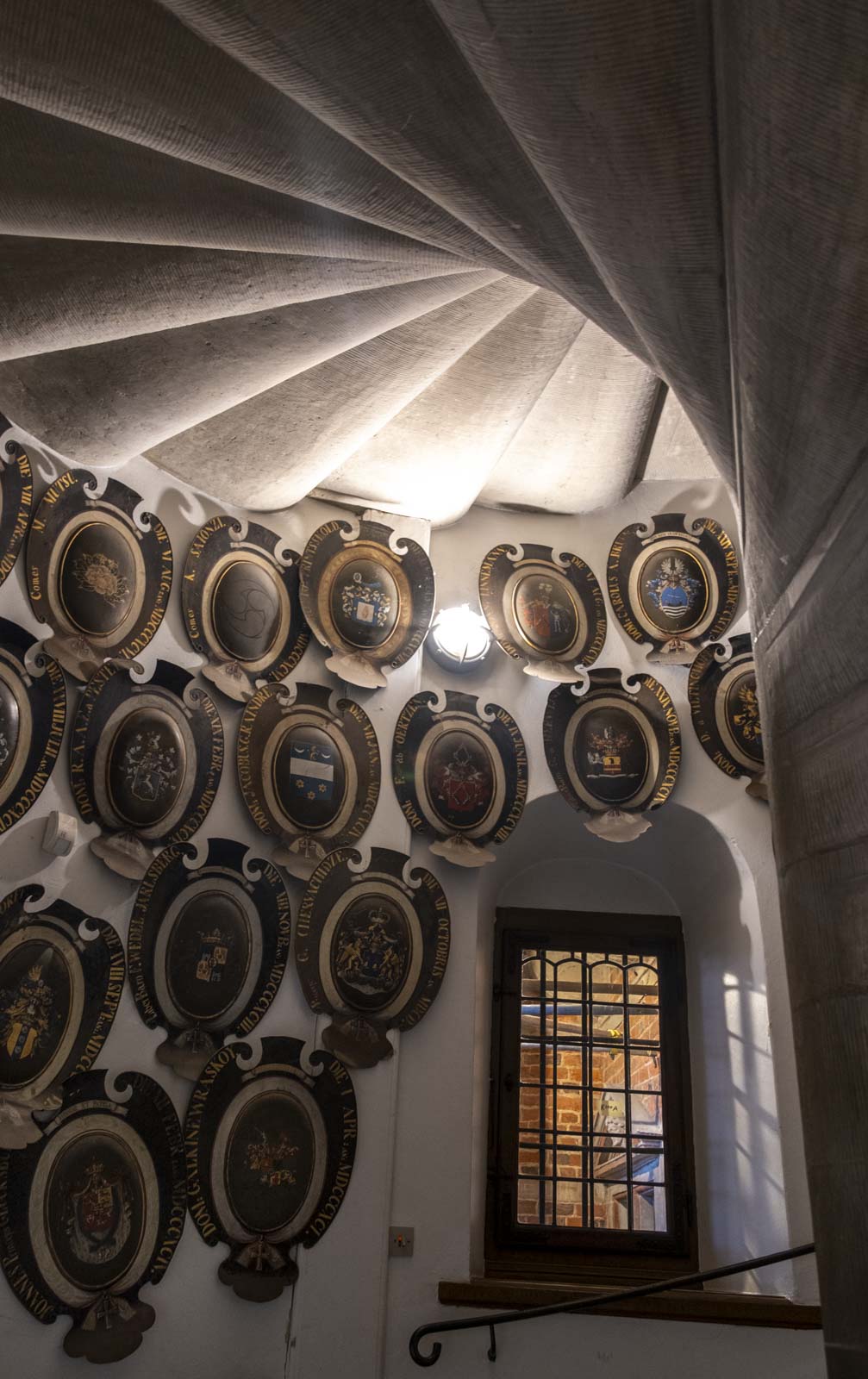
A picture within a picture is something I really like. There are two from Japan, the first one in the header and on the left side here another one. We see a gardener talking to a young woman about ”his” garden while admiring it from the terrace. The picture filled staircase was photographed in a Danish castle, where you also can see another room through the window. There is much going on in this scene, but I decided to use it all in my image.
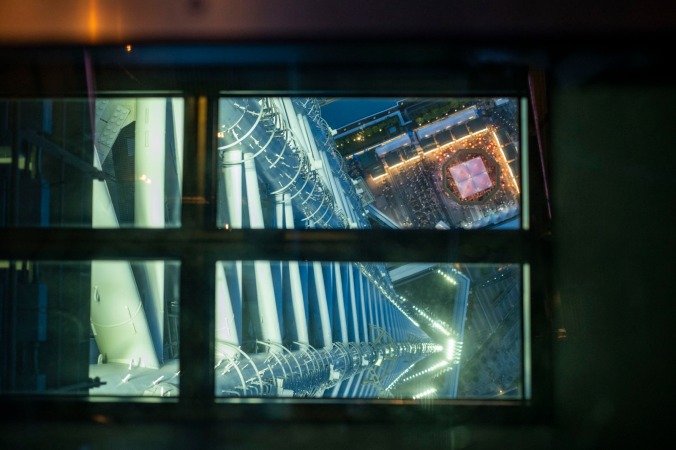
Lastly, two pictures from Tokyo Sky Tree, the first one taken through the framed glass floor and the second one where the city is set between window frames. In both cases, the subject is shining because of its dark surroundings. This applies to the header image too.
As I started with poppies, I will leave you with a poppy too – an enchanting flower. For this one, I was down on the ground and getting close. Deapth of field and back light make it stand out.
Last week we dwelled in the world of connections with Donna as our guide. We got lovely interpretations of connection, and many of them I had never even thought about!
A big thank you to Ritva for an innovative and excellent challenge, and be sure to link to her original post and use our tag. I am already looking forward to next week’s challenge with Egídio. Join him Saturday 12:00 EST to enjoy his beautiful photography, through Brazilian eyes.
Donna asks us: Have you ever thought about how photography connects the world? Nobody sees the world exactly the same way as you do. And, how you interpret this week’s challenge is up to you, you will find the interpretations are limitless.
For this post, I let my thoughts wander – and wonder. Humans are meant to be connected… but are we? In new ways, yes, but in the traditional ways? Today, connections are faster than ever, quicker than ever…but for some people, more difficult than ever. We read about young people who cannot, dare not contact another human being. Be it on the phone or face to face. Some can only write in anonymity in special forums. Or never. In Japan this problem is widely recognized and has been much discussed in media. They even have courses in how to meet someone in person, especially to find a partner.
In my opener is a night view from Tokyo Sky Tree. All those lights…do you feel curious about the souls behind them? Or, maybe you even feel alienated? Personally, I have a mix of those feelings.
On my trip to Japan, I traveled a lot by train, and Shinkansen is a superb way to connect over long distances. They are super fast and always on time – which we cannot say the Swedish trains are… The first ten times I checked my watch – and the trains arrived on the exact second and left on another exact second. Fascinating. Disciplined and clever people.
Connections, yes, that gives you many opportunities and broad possibilities for interpretation. It could be steps and stairs, tunnels, bridges, roads…but also a room where you are forced to meet people, like in trains, planes and buses.
When it comes to people, in my country we sit alone in the bus or train, not talking to each other…everyone reading or playing on the phone. In some countries, it is still easy to make contact with the person sitting next to you, but I am afraid those opportunities are dwindling. Sad but typical of our times. Let’s just put down our phones for a while – there is so much to gain from that. Real connections.
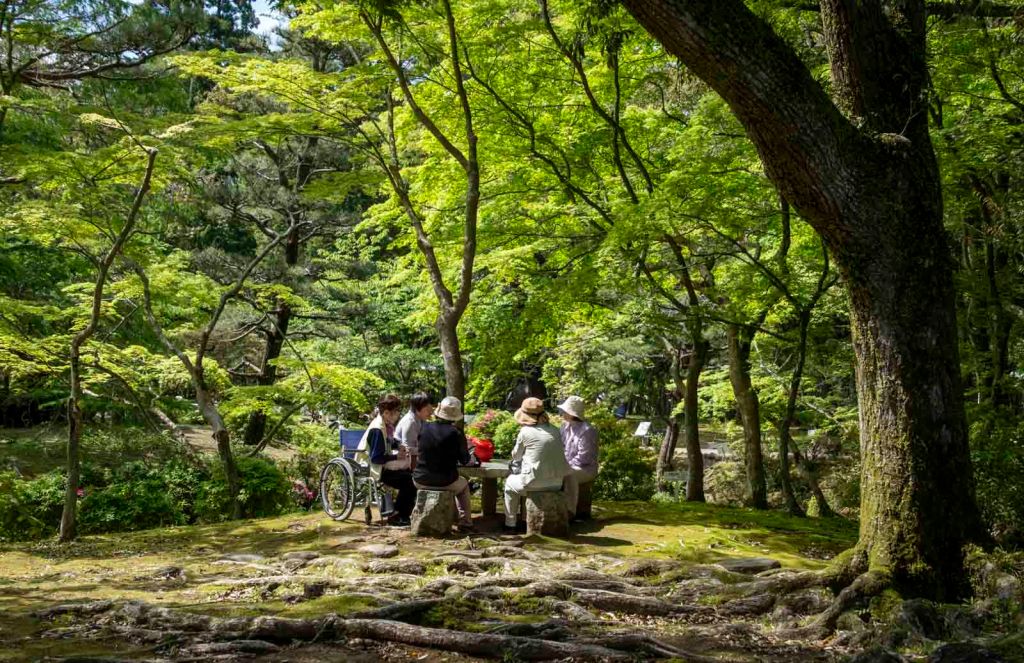
What is a selfie? Is it trying to find a connection to – yourself? Narcissism? I don’t know. In a beautiful park I found these ladies sitting at a table eating and talking…maybe about the loveliness of Spring? Connections like these might be the beginning of something pleasant and enriching…like friendship.
Talking about friendship – animals and pets remain close to our hearts – with unconditional love. It is easy to love when you know you will get the same back again… No disappointments. These two men were carrying their pets all day long. More than gladly they let me photograph them – but only them.
The connection to religion is mostly something happening inside me. In Fukuoka, we happened upon a 41 meter long bronze Buddha reclining in a forest. You could even walk into it. In many religions, a figure of the ”God” is the connection between people/deity/heaven.
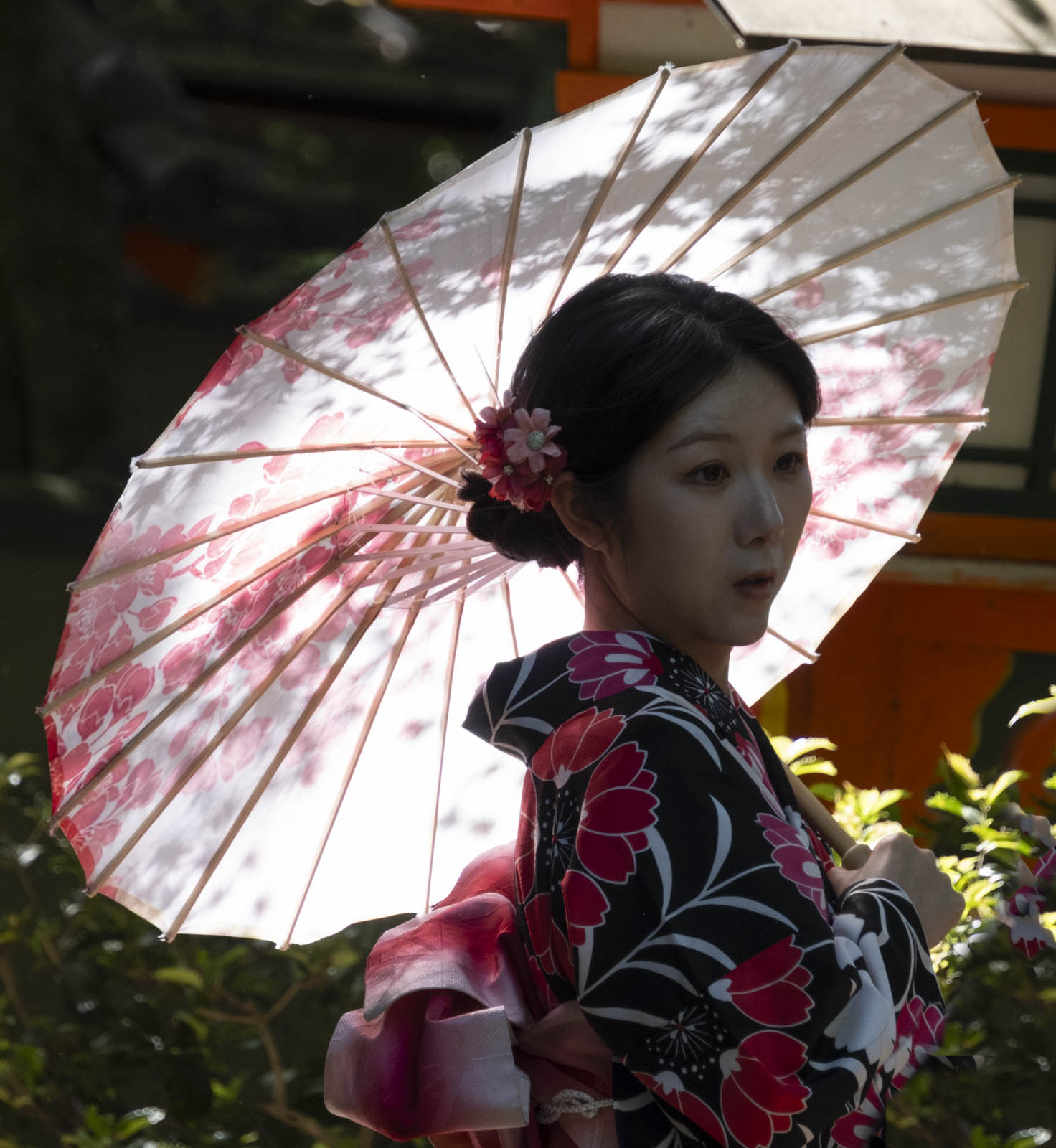
As we arrived during the Golden Week, we saw many people hiring kimonos and other traditional clothes for the festivities. Manifesting the connection between old and new, and also traditions from different countries and cultures.
This was an American couple, where the lady was fully dressed and made up as a Geisha. We saw several couples doing this, sometimes the man too had hired a traditional costume.
Connections – can of course be completely literally meant – tangible, like these wires. Somehow I like that. It is a blur of course, but with meaning. And it’s old time…
Now we are looking forward to connecting with you throughout the week! Remember to use the Lens-Artists tag and/or link to Donna’s post.
Last week we left our comfort zone with John’s challenge, AI. But, it was an interesting conversation and the AI art was extraordinary well done. Whatever you think of AI – it is always good to learn something new!
Next week, Ritva will be our host – go see her fantastic site for more inspiration! Until then, sleep well and eat well – and stay in harmony with yourself so you can feel comfortable in your connections.
The question for today is to what extent AI makes the work something other than photography and at what point should it be identified as such.John is our eminent host. I encourage you to take a look at his site and give the question of AI some thought. He takes a thorough look at it. We are there, and if we listen to the experts – we cannot go back from it. We don’t have to use it though… but do you think it is ”photography”?
Personally I edit my pictures with a light touch – when I edit. I have changed skies, but that is when I work with scanned pictures I cannot make better. And, I write it when I have. Before this post, I had never written a prompt for a totally new picture – To me, this is a different kind of art, fun to try, but I don’t think I will ever do anything but playing with it. So, here we go! I will try the WP AI, as I was so inspired by Donna, and because with WP, we can all try it, even if PS or Lightroom is not an option on our computer. Use the right bar!
My first try was, like Donna’s, to use my blogname. I wrote ”A Lagotto Romagnolo and Cattleyas”. I was not at all happy with that one, and changed it to ” A brown lagotto running in a field of cattleya orchids” That picture is in the opener. The orchids are not cattleyas, but AI could produce a reasonable picture of a Lagotto Romagnolo. Milo is nodding too.
For the second picture I wrote ”A Geisha in a Japanese temple”. For both pictures I tried 7-8 different suggestions.
For the third one, I wrote ”Tokyo Sky Tree”. This option I liked the best, but none of them met my expectations. It was an interesting lesson though.
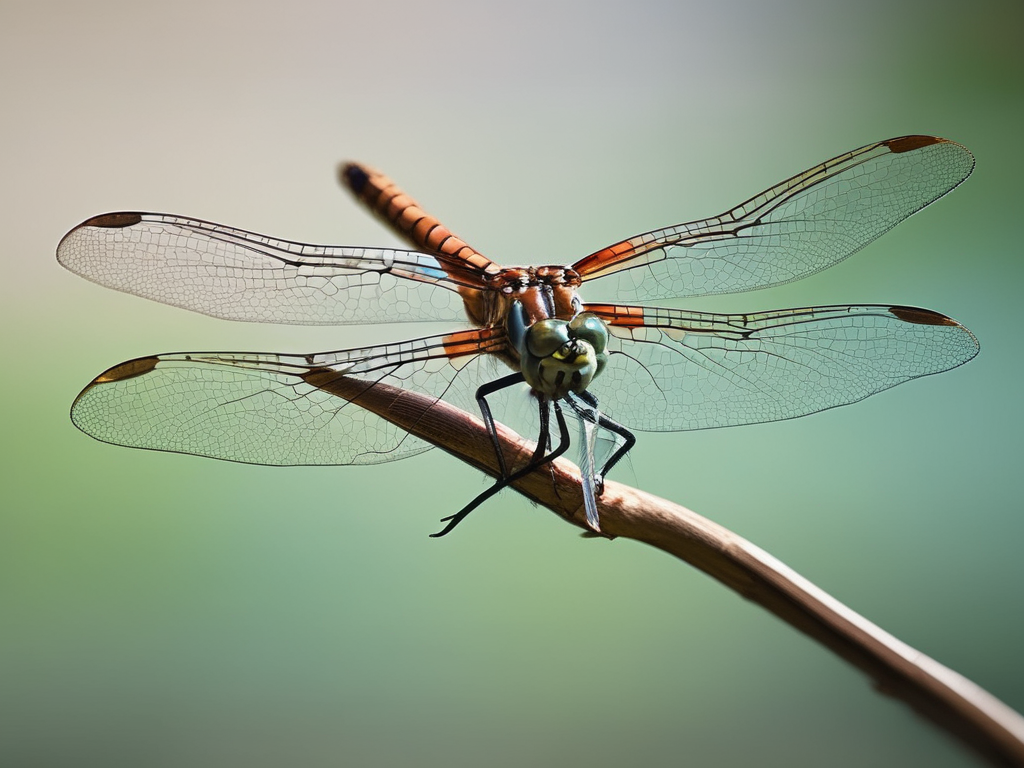
My last try was a macro, and I found this one acceptable. WP’s AI is not good at making the picture feel real, but I saw Sofia’s Firefly play – and they were really really good! My biggest fear is not being able to tell what is real or AI. In fact, today I am more careful with pressing ”like” or adding a heart on instagram – there are too many AI generated pictures. In that perspective, WP is better – those are undoubtably AI… I strongly believe that if the major part of the picture is changed with AI, the photographer should say that in the text, and if the whole picture is AI generated, it is a must. Then it is no longer a photo.
For John’s question about the peninsula picture – the second one shows very strange waves, so, that might be the AI?
Thank you, Sofia, for last weeks floral enchantments, and the chance for me to feature the Japanese Wisteria garden!
Donna will host the challenge next week, go to her inspitational site and see what she is up to! If you’d like to participate in the challenge responses each week but aren’t sure how to get started, check here.
Sofia leads a challenge this week, that is right up my alley – Floral. Again it is Japan that inspires me – and I urge you to visit Sofia’s beautiful site for more inspiration. Let’s have a celebration of flowers! Different angles, close-ups or from further away.
My visit to the Wisteria gardens in Japan is, without exaggerating, the most magical experience I have ever had. I cannot choose what to show from them, so the pictures are many. My words will be few instead – to make up for this multitude… I hope you will forgive me.
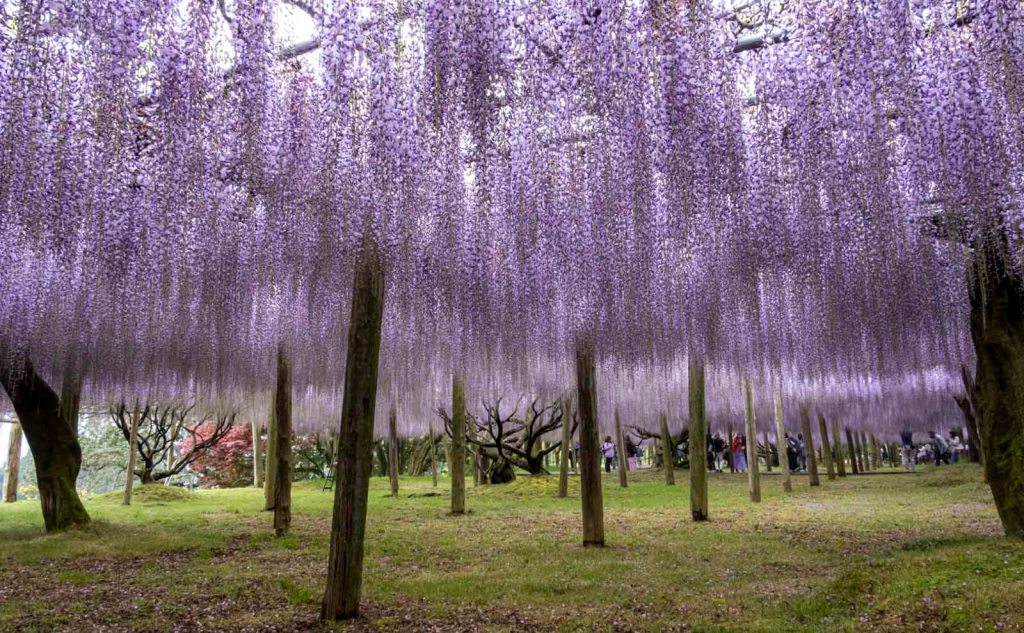
The Kawachi Fujien Wisteria Garden in Kitakyushu is unforgettable.
The garden is situated up in the mountains, and is difficult to reach – there are no trains or buses, you have to take a taxi.
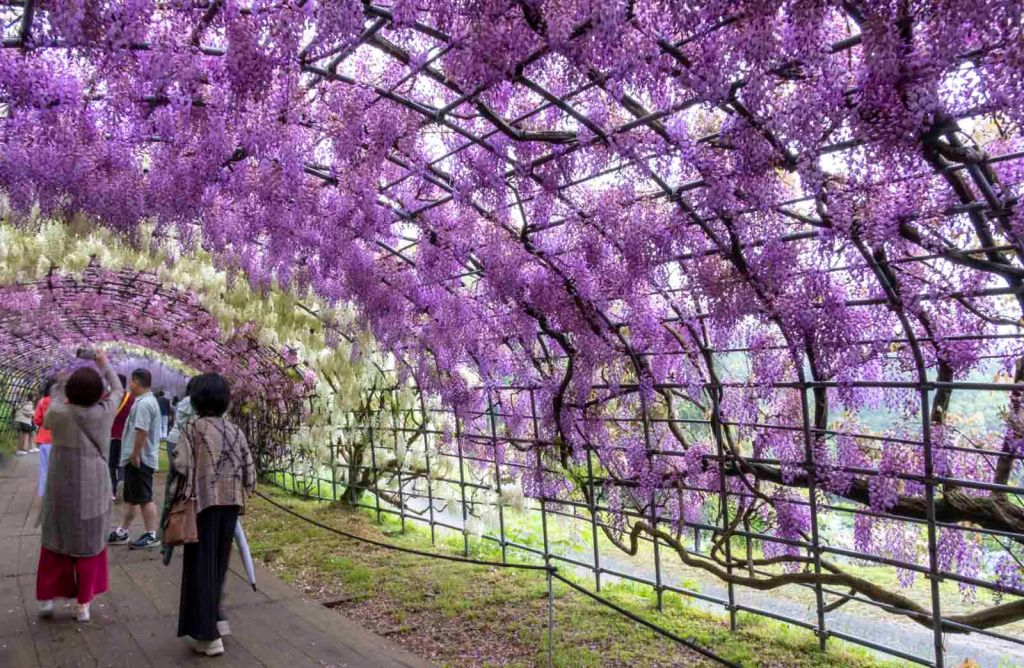
I came for the Wisteria Tunnels. They have one 80 meter tunnel and one 100 meter tunnel, both with multicoloured effects.
The Golden Week with many vacation days make the Japanese esthetics go watching the flowers glow. And they were many, both men and women. And flowers. We did not see any other tourists there, except Japanese people. And us two from Sweden.
I was not disappointed – we had calculated the time rather well, and was lucky too – some of the flowers were over and some had just started.
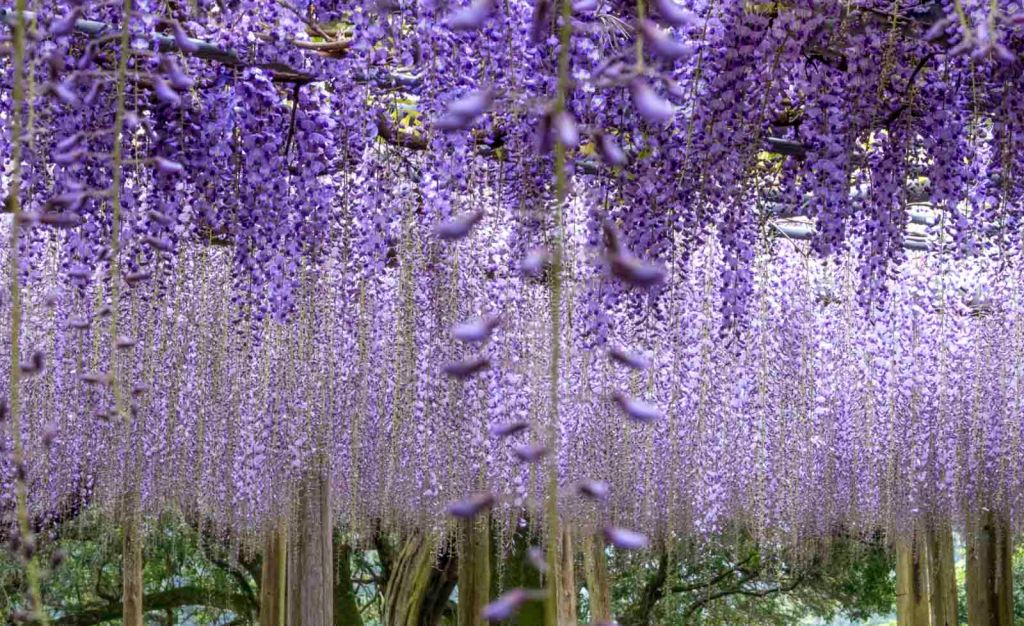
From the outside the tunnels looked compact, and less ”alive”. ”It is the inside that counts”… as with us humans.
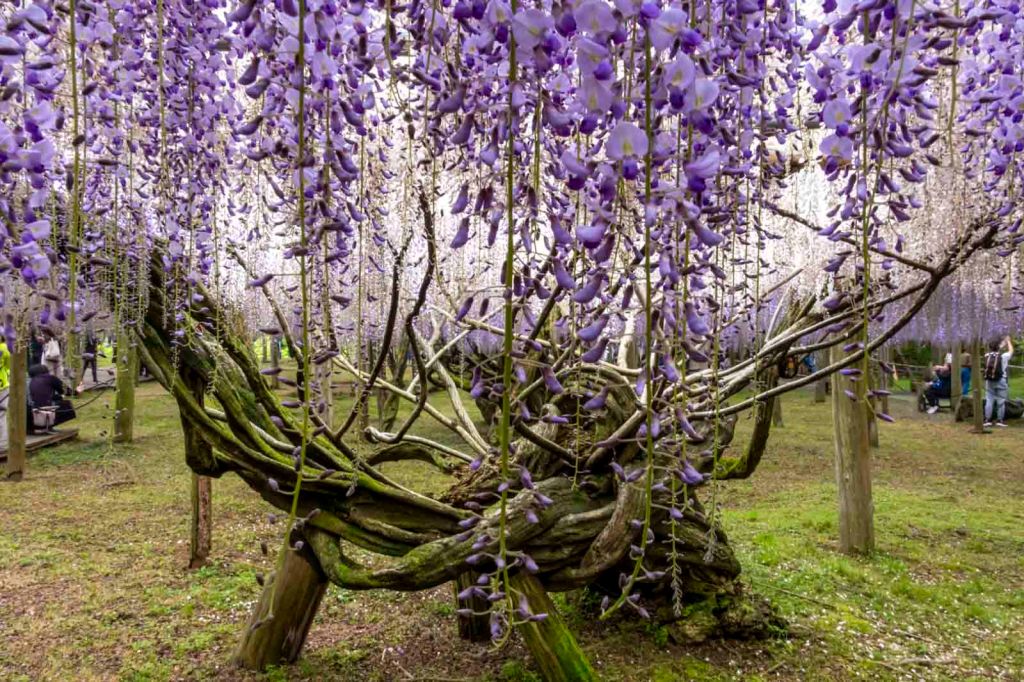
A little ICM and the tree is still alive and visible from the inside.
Some species were big and heavy, hanging in long threads of almost a meter’s length,
while others were shorter, or long and delicate ones.
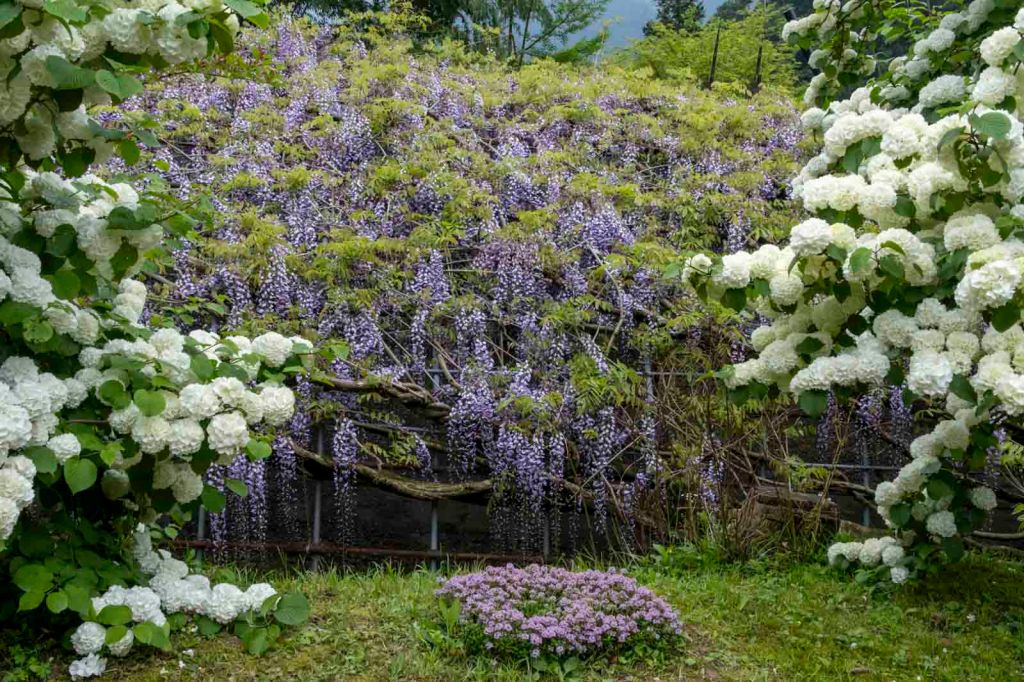
In one of the tunnels there were double flowers – I didn’t know they existed until now.
With this B&W, I wanted to show you the feeling I had while walking up on the mountain to the flat area on top. It felt like snow at home, a calm winter’s day, with softly falling snowflakes in my face. You will see what I mean…
Time did not exist – walking, standing, sitting, contemplating – trying to take it all in and to keep it forever. Stay in the moment. And what a moment!
The old Wisteria trees were otherworldly, and I am still trying to understand I have really been there. Seen them. I would be happy if you stayed with me throughout, but I won’t blame you if you think this is just too much.
A Wisteria tree can grow very old – 150 years for the oldest ones here. If you look at their trunks, you will not doubt it.
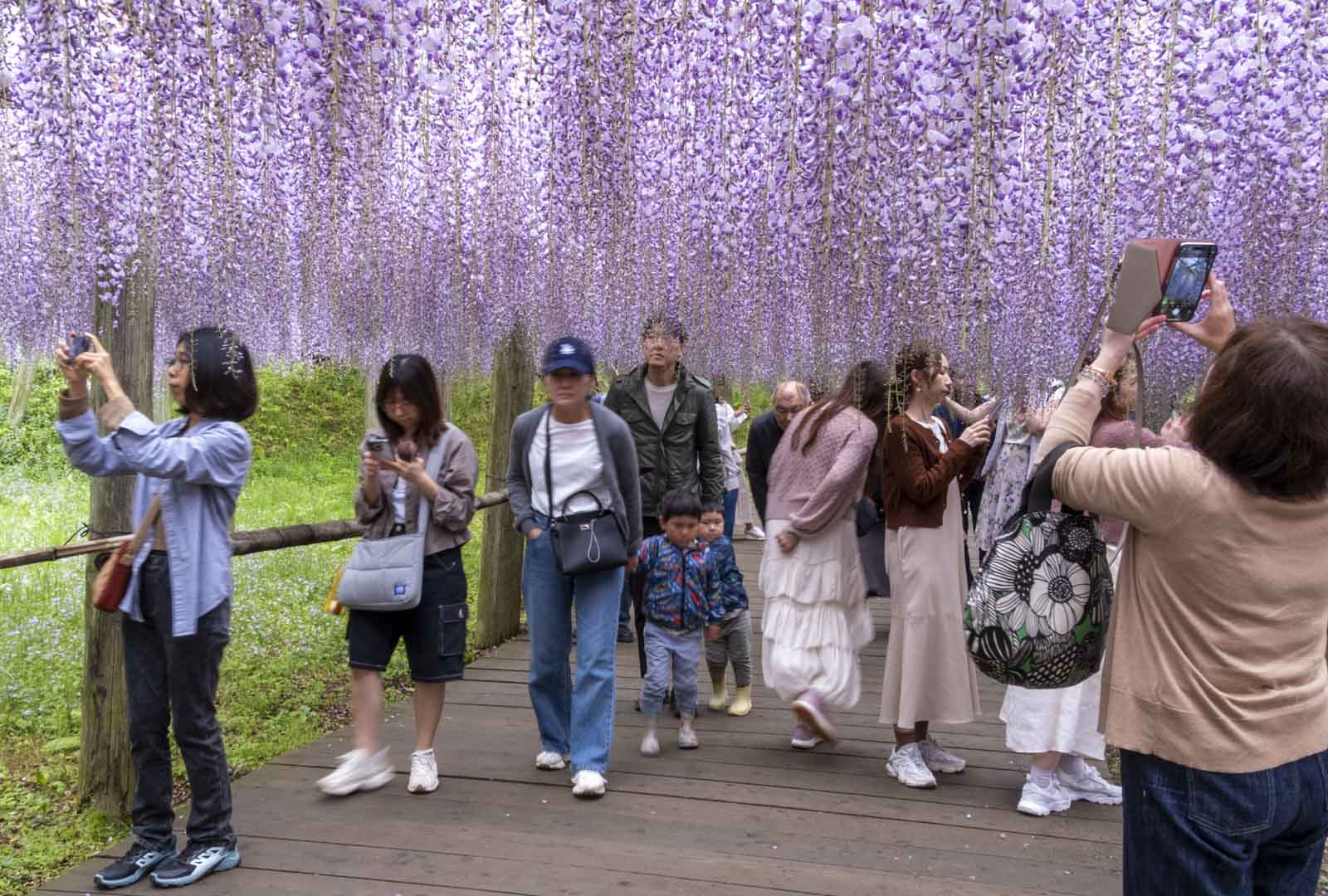
People were oblivious of where or how they walked. Some visitors were very old, and some came in wheelchairs. We heard about people who came every year, even if it was so difficult a place to reach.
Beautiful people, beautiful minds – esthetics.
Snow or purple rain? Otherworldly.
Pink Wisteria was not that common in the park, but this giant was mindblowing.
Thank you so much if you have followed this far. These are but a few of all my photos from Kawachi. I will spare you the rest, but hope you have been inspired to some day visit Japan.
Thank you for last week’s many delicate answers to my challenge – I really enjoyed the variety and how useful this word it is! Next week it’s John’s turn to lead, so please visit his unique site for more inspiration.
Last week Patti hosted a beautiful challenge – Hopeful. A timely theme, and thank you for so much to contemplate and to learn on the meaning and importance of hope!
Coming back from a beautiful journey – I was so inspired by Japan, that Delicate seemed a natural choice. Most of my examples will be from my art experiences there. And, now we want to know: What is delicate to you? Feel free to use it in any meaning: exquisite, fragile, subtle, elegant…etc. We are looking forward to seeing your posts!
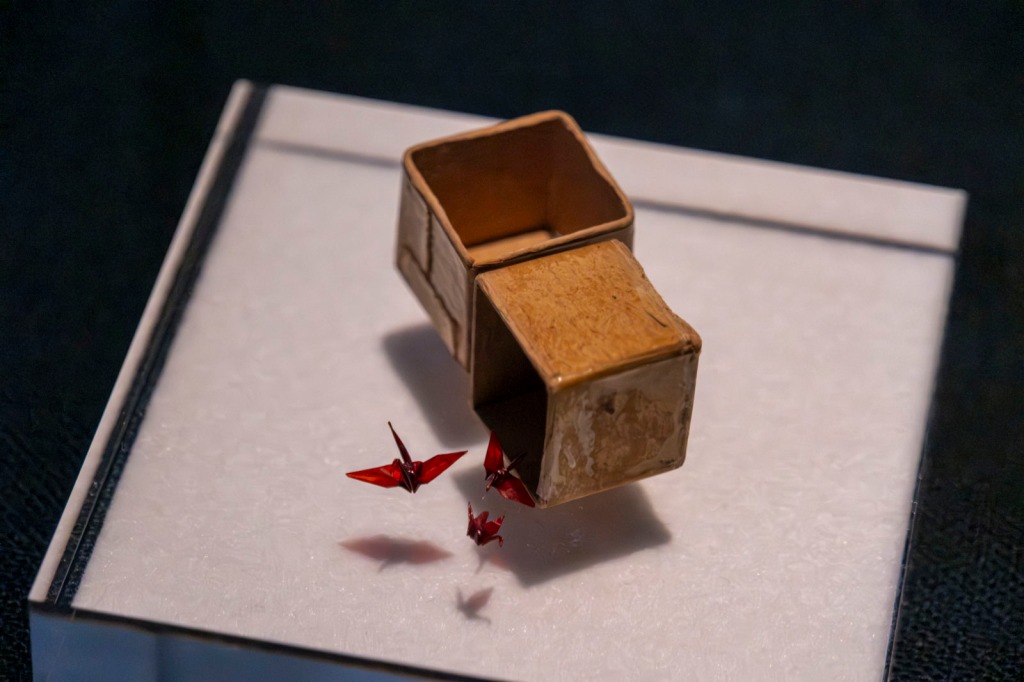
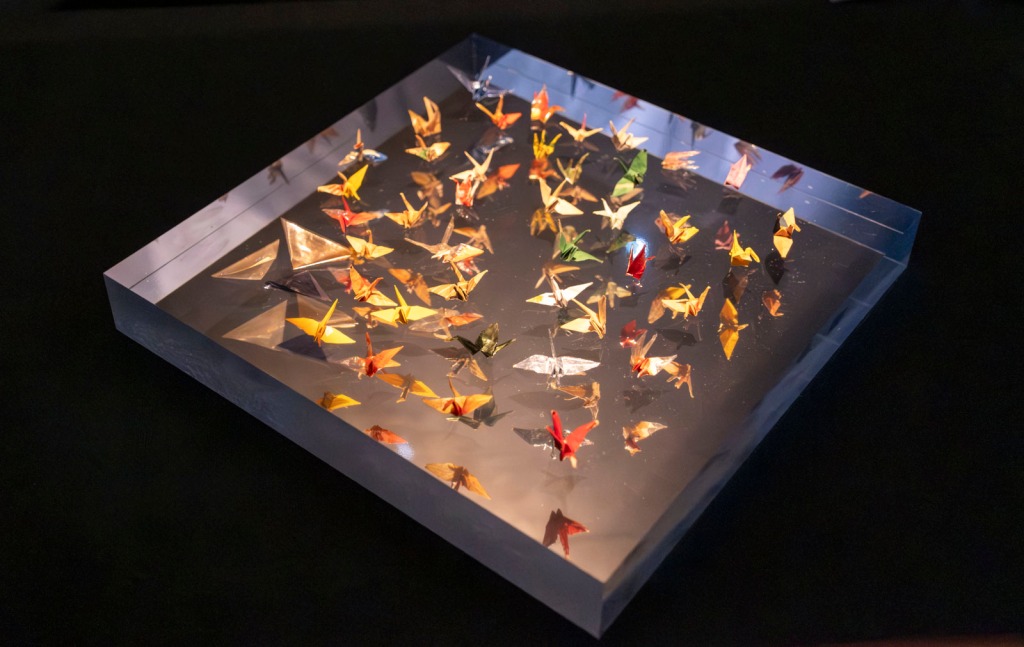
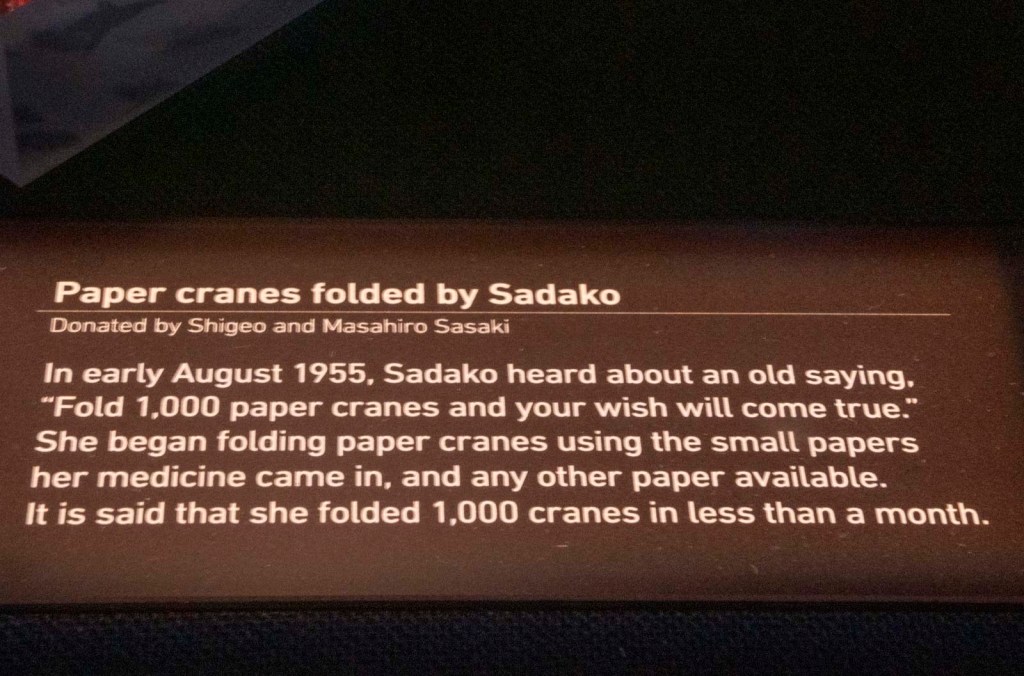
Let’s start with man made art! These are some of Sadako’s delicate cranes made with needles. Sadako was a Japanese girl who died from being exposed to radiation from the A-bomb. She believed she would get well and live if she managed to fold 1000 cranes.
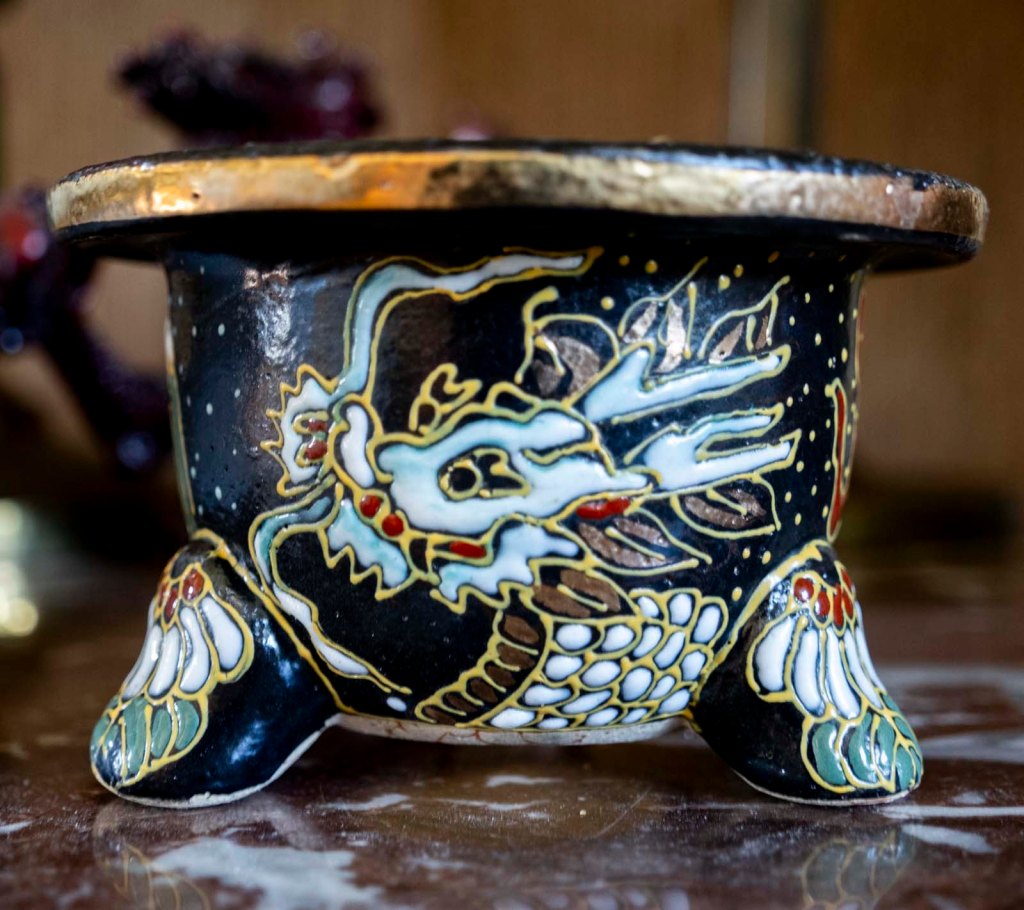
This is a Japanese pot (raku) for growing Fuukiran orchids. I found the pot (diameter about 9cm) in the botanical garden in Nara, and I do plan to try growing a Fuukiran myself.
At one of the many temples I stumbled upon a gorgeously delicate waterpipe decoration – one cannot but admire Japanese art, delicate into the finest detail!
Natural art is important in Japan, but the Japanese tweak it according to tradition and their personal preference. Especially trees.
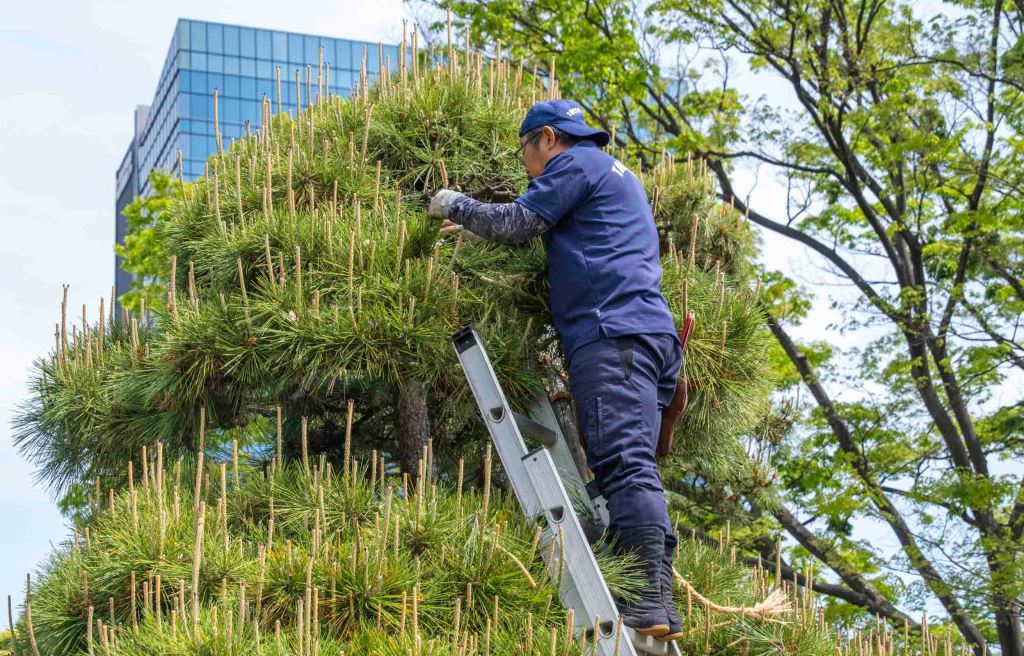
So, pruning gardens is a truly delicate work. Gardeners work meticulously to keep their trees perfect. The goal is a simple, minimalist natural setting design to inspire reflection and meditation. And this garden, in the middle of Tokyo, was no exception. In all the gardens we visited, people were quietly walking the paths. The only sounds were natural ones, wind and bird song, streaming waterfalls.
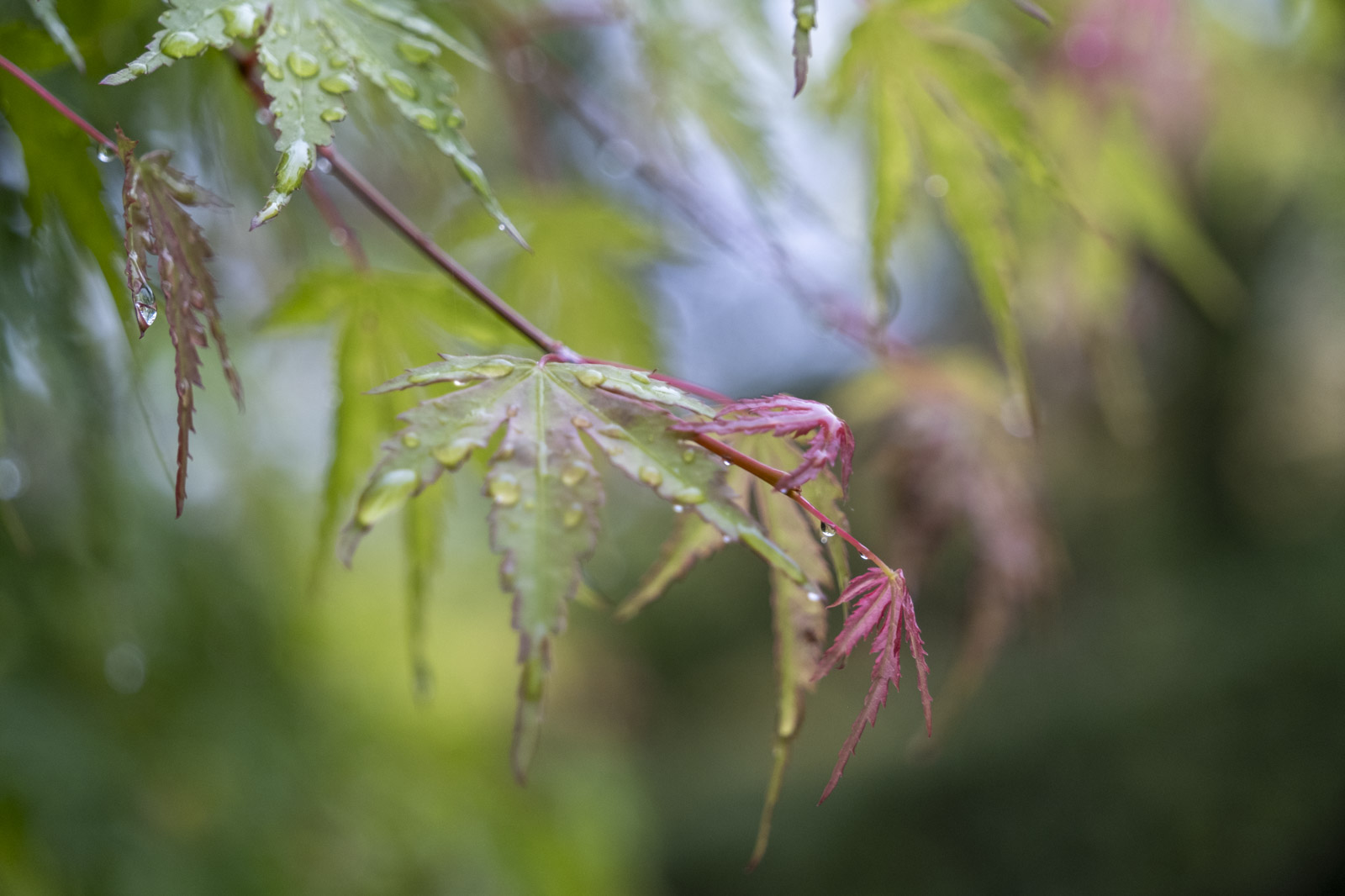
A Japanese maple in one of the many beautiful temple gardens we visited. The trees themselves are works of art and they are highly treasured for their delicate and colourful leaves.
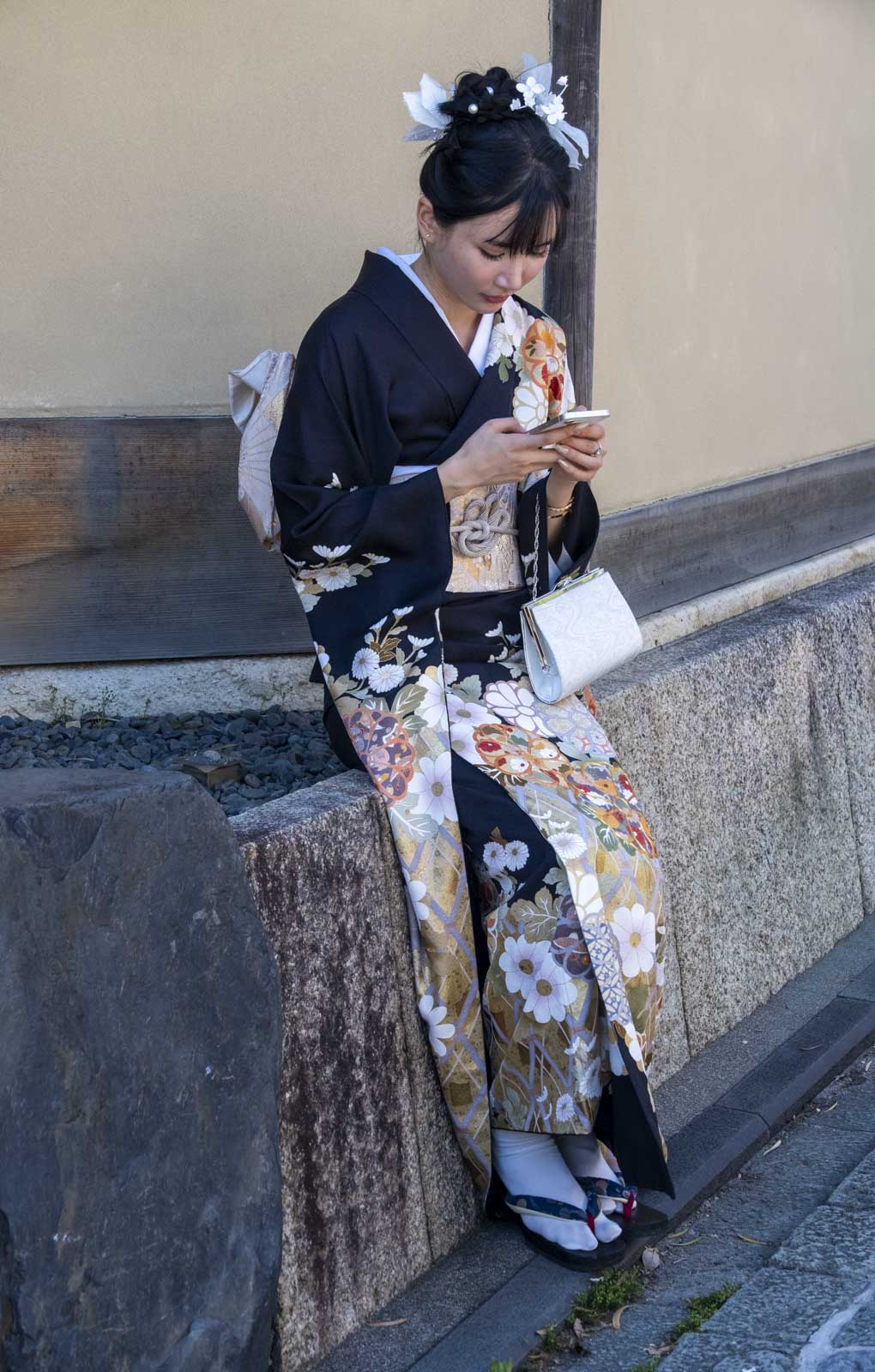
Ordinary People, and Geishas too, sometimes need a break… As we went to Japan during the Golden Week, the long holiday and flowering time in Japan, we saw many Geishas – or at least people dressed up for the festivities. Especially in Kyoto. And I was happy to see it was not only elderly people! The most common thing among youngsters was to dress up (there were endless offers of kimonos for hire) and take selfies at famous temples and gardens. Notice their hairdos and the delicate handbags – and shoes. Phones are there too, of course…
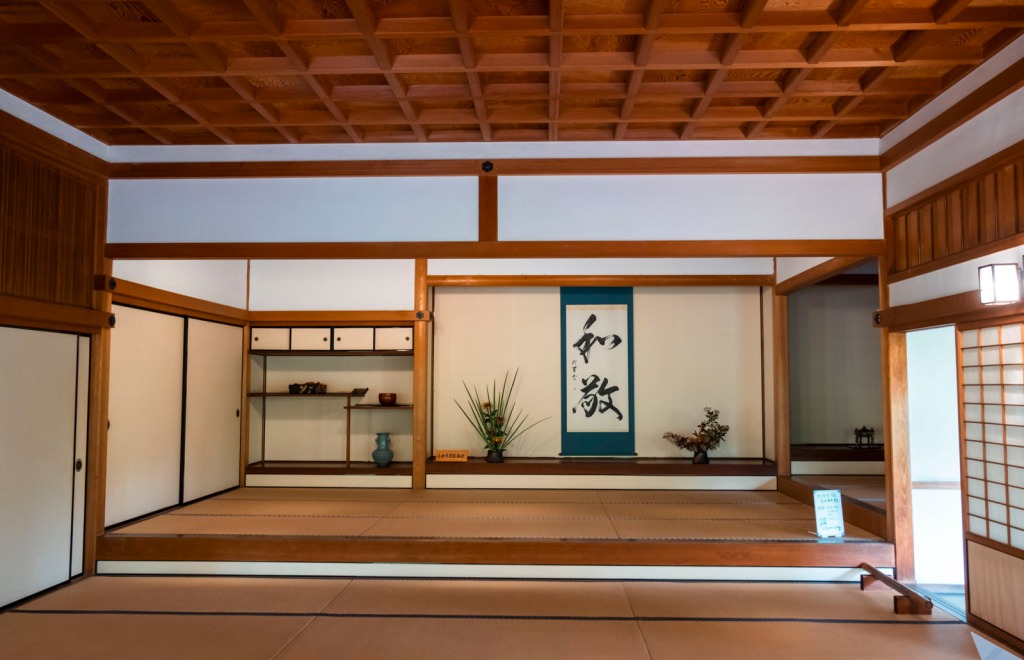
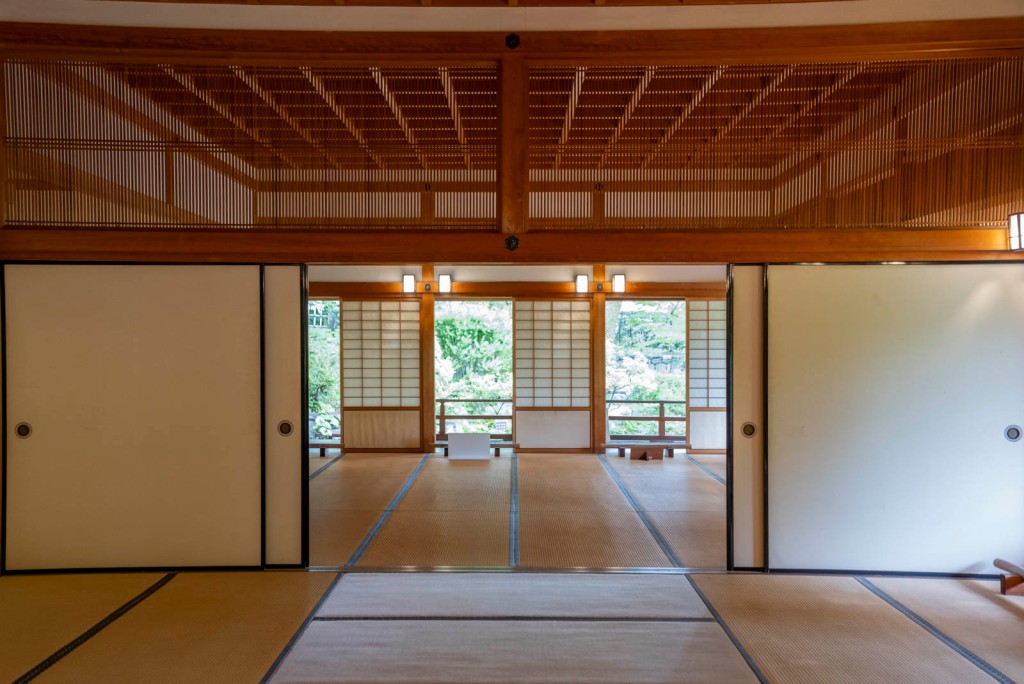
And finally, a Samuraj house in Kokura. Clean lines and rice paper windows. Minimalist.
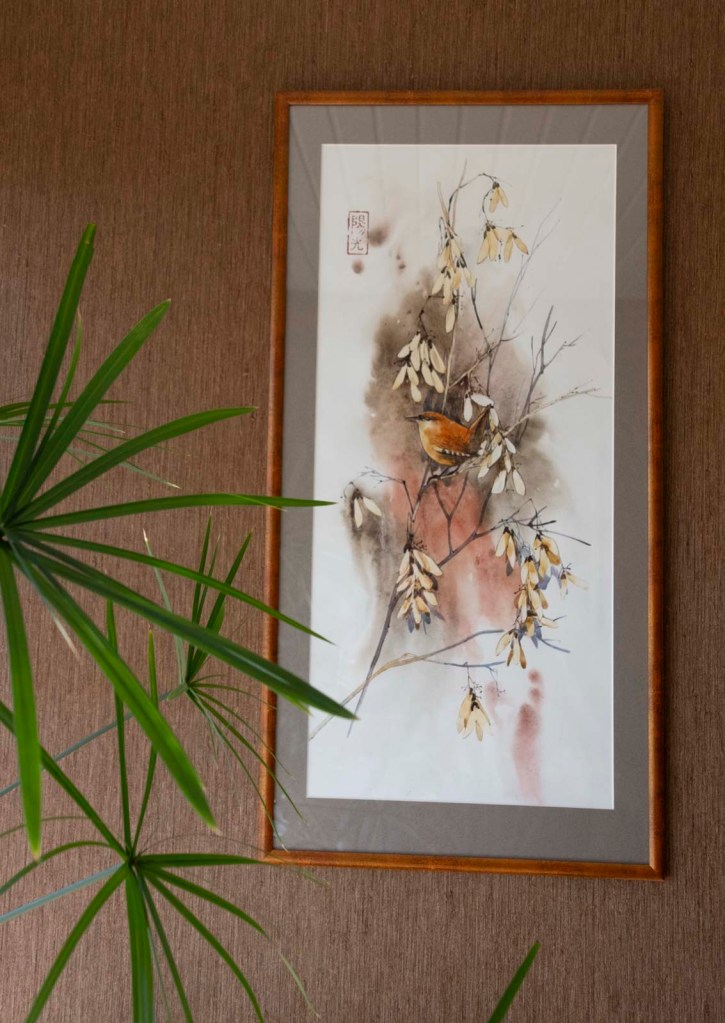
I also want to include a Ukrainian wren, a watercolour by my friend, zen artist Tanya Samsonova. Many artists are inspired by the delicate Japanese style, and surely this painting would fit in any Japanese home.
Starting with the little things and moving up to a whole house – delicate is a useful word. I guess you noticed I haven’t used any flowers for this challenge? If you participate for this challenge (I hope you will!), you might be careful of using them too… because I know that next week Sofia will go Floral. Please visit her beautiful site for more inspiration. Warm hugs and thank you, Sofia, for inspiring me to finally visit Japan – it was just as amazing as you said it would be! (And I am not yet fully recovered from that long flight…)
Well, reading through my post, I just realised that this week is a bit of a milestone – post number 300 since LACP started! That is more than we could have hoped for. Thank you everyone for staying with us!
Lastly, please remember to use the Lens-Artist tag if you are participating, and to link to my original post. Until next time, stay well and enjoy every day!
To live without Hope is to Cease to live. – Fyodor Dostoevsky
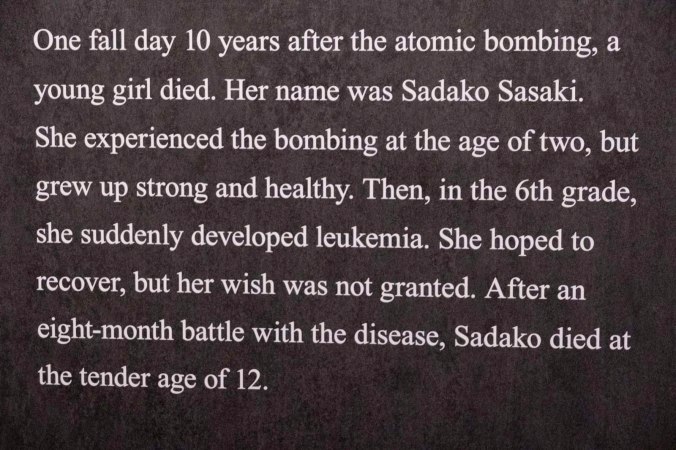
Patti, coming back from Japan, this theme could not have come at a better time for me. Because, when I was 7 years old, I read a book titled: Sadako vill leva. The great impression has lasted throughout the years, and coming to Hiroshima to see her, her family and the story unfold in real photographs was overwhelming. Strong feelings and many tears.
Seeing her own folded cranes set my tears run free…so much hope and effort put into each and every one of those beautiful cranes.
In the Peace Park, Sadako meets us with thousands and thousands of cranes, folded by children from all over the world. In Sweden we still send cranes from school children when they have read her story. They all want to help her reach her goal – and LIVE.
They say Sadako was hopeful every day and believed she would complete her 1000 cranes – and Live. When her strength was weakened, she folded the cranes with needles instead of her hands, and they were so tiny that you could barely hold them.
Here she is, standing on the monument, holding up a crane to touch the sky. And there is a bell inside the monument that every child wants to let chime.
Her story is only one of tens of thousands from that day, but it tells us something about being hopeful and never giving up – having something to work for and to focus on, and something to believe in too. They say hope is the last thing that leaves you…
I will finish with the Phoenix Trees that stood in the courtyard of the Hiroshima Post and Telecommunications Bureau. The courtyard was about 1.3 kilometers from the hypocenter. Because no intervening object stood in the direction of the hypocenter, they took the full force of the heat ray and blast, losing all of their branches and leaves. The sides of the trunks toward the hypocenter was burned and hollowed out.
Although the trees appeared to be dead, their branches put out buds the following spring. Seeing this new life, people took courage and hope. I think we do too.
So now, it’s your turn. What makes you hopeful? Is it a place, a person, or a beautiful creation? Is it art, music, poetry? We’re looking forward to seeing your creative and inspiring posts. Be sure to link to Patti’s post and include the “lens-artists” tag.
Last week Tina’s challenge inspired you to share wonderful posts of children and young animals– even some of your own. A special thanks to Tina! And what’s up for next week? I, Ann-Christine, will lead, so be sure to stop by Leya next Saturday at noon EDT.
Wishing you a week of sunshine, hope, and inspiration.
Looking for more information on joining our challenge? Click here.















































 Leya
Leya 
Du måste vara inloggad för att kunna skicka en kommentar.